MCQGeeks
CBSE
JEE
NTSE
NEET
English
UK Quiz
Quiz
Driving Test
Practice
Games
Driving Test
Mississippi
Mississippi Motorcycle Driving Permit Test-16
Answers
Q.1.
When braking, you should:
First apply the front brake, then the rear.
First apply the rear brake, then the front.
Use both brakes at the same time.
Use brakes in any order.
Q.2.
Which of the following will protect your eyes from the wind?
Goggles
Windshield
Sunglasses
Eyeglasses
Q.3.
If you must brake and swerve to avoid a hazard, you should:
Either brake then swerve or swerve then brake.
Brake and swerve at the same time.
Choose to either brake or swerve.
Not swerve and only use the front brake to stop.
Q.4.
Moving into another lane while taking a curve is often the result of:
Taking the turn too fast.
Lanes that are too narrow.
Not knowing how to steer.
Lanes that are too wide.
Q.5.
To lessen your chances of an accident, you should:
Only ride in the afternoon.
Follow the vehicle in front of you as closely as possible.
Not look ahead and focus only on your controls.
Communicate your intentions to other drivers.
Q.6.
When it is obvious that you are going to turn, you:
Do not need to use a turn signal.
Should still use a turn signal.
Only need to use a turn signal if there are nearby pedestrians.
Only need to use a turn signal if you are at a stop light.
Q.7.
Which of the following is not important when looking for a motorcycle helmet?
The helmet meets U.S. Department of Transportation standards.
The helmet fits snugly all the way around your head.
The helmet has no obvious defects, such as cracks or loose padding.
The helmet looks cool.
Q.8.
The proper clothing for riding a motorcycle should:
Cover your arms and legs completely.
Cover your arms completely, but leave your legs exposed.
Cover your legs completely, but leave your arms exposed.
Be whatever makes you most comfortable, regardless of safety.
Q.9.
Most crashes happen:
On short trips.
At speeds greater than 55 mph.
After several hours of riding.
On long trips.
Q.10.
A three-wheeled motorcycle:
Handles curves about the same as a two-wheeled motorcycle.
Handles curves differently than a two-wheeled motorcycle.
Should not be operated in curves.
Should use the shoulder when taking a curve.
Q.11.
Who should set the pace in a group of riders?
The leader
The riders just behind the leader
The rider in back
The oldest rider
Q.12.
When riding at night you should:
Increase your speed.
Decrease your following distance.
Use the vehicle in front of you to help see.
Wear tinted glasses.
Q.13.
When riding in a group, the best way to keep ranks close while maintaining an adequate safety cushion is to ride:
In pairs.
In a staggered formation.
In a single-file line.
In a passing formation.
Q.14.
Making eye contact with other drivers:
Means that they see you.
Guarantees that they will yield to you.
Doesn’t mean that they see you.
Is not worth the effort it takes.
Q.15.
Riding directly alongside another vehicle is discouraged because:
You may have a difficult time getting to a highway exit.
You may be in the other vehicle’s blind spot.
You may block the driver's view.
It prevents other drivers from passing both of you.
Q.16.
How can a motorcycle operator discourage lane sharing by other drivers?
By giving dirty looks to other drivers
By riding in the center portion of the lane
By riding in the left portion of the lane
By riding in a zigzag pattern
Q.17.
When an operator's left arm is extended straight out to the left, it means the operator:
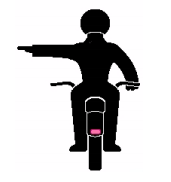
Plans to turn left.
Is about to stop.
Plans to turn right.
Is about to slow down.
Q.18.
Generally, the body eliminates how many alcoholic drinks per hour?
One
Two
Three
Four
Q.19.
Helmeted riders are ________ more likely to survive than those not wearing helmets at the time of a crash.
Two times
Three times
Eight times
Ten times
Q.20.
When you are being passed, you should:
Ride in the center portion of the lane.
Ride in the left portion of the lane.
Ride in the right portion of the lane.
Weave among the three portions of the lane as the vehicle passes.
Q.21.
If you are riding in traffic when a small animal enters your lane, you should:
Do whatever you can, including swerving into other lanes, to avoid hitting the animal.
Switch lanes as quickly as possible.
Stay in your lane.
Flash your lights to try to scare the animal.
Q.22.
A motorcycle operator can improve their visibility by:
Wearing darkly-colored clothing.
Turning off their headlight.
Following another vehicle very closely.
Wearing brightly-colored clothing.
Q.23.
When riding a motorcycle:
It is a good idea to drag your feet.
Your toes should be pointed downward.
You should keep your feet firmly on the footrests.
You should try to keep your feet away from the controls.
Q.24.
A face shield:
Provides protection for the eyes and face.
Is not recommended.
Is required.
Does not protect the face as well as goggles.
Q.25.
When applying the front brake, you should:
Apply the lever by squeezing firmly and progressively.
Grab at the brake with only two fingers.
Press down on the brake lever with your foot.
Stomp on the brake lever.
Support mcqgeeks.com by disabling your adblocker.
×
Please disable the adBlock and continue.
Thank you.
Reload page