MCQGeeks
CBSE
JEE
NTSE
NEET
English
UK Quiz
Quiz
Driving Test
Practice
Games
Driving Test
Mississippi
Mississippi Motorcycle Driving Permit Test-3
Answers
Q.1.
When riding on a slippery surface, you should:
Increase your speed.
Use only the front brake.
Avoid making sudden moves.
Travel on the shoulder so you are not next to other traffic.
Q.2.
Because of their small size, motorcycles seem to be:
Traveling faster than they actually are.
Traveling more slowly than they actually are.
Not moving when they actually are.
Closer than they actually are.
Q.3.
When riding with a passenger, the operator should:
Maintain a longer following distance.
Increase their speed.
Deflate the tires to accommodate the extra weight.
Not warn passengers of impending hazards.
Q.4.
Usually, a good way to handle tailgaters is to:
Change lanes and let them pass.
Come to a complete stop.
Speed up to put distance between you and the tailgater.
Ignore them.
Q.5.
A turn signal should be used any time you plan to:
Change lanes.
Direct another driver’s attention away from your vehicle.
Show other drivers that an exit is approaching.
Invite other drivers into your lane.
Q.6.
Most crashes happen:
Far from home.
On short trips.
On long rides.
Several hours into the ride.
Q.7.
When riding in a group, inexperienced riders should be placed:
In the front of the group.
Just behind the lead rider.
At the back of the group.
Anywhere within the group.
Q.8.
The front brake supplies how much of a motorcycle's stopping power?
About one-quarter
About one-half
About three-quarters
All the stopping power
Q.9.
If your friend has been drinking alcohol, it is a good idea to do any of the following, except:
Arrange for a safe ride home for your friend.
Occupy your friend with activities to distract them from drinking.
Keep your friend from leaving until they are sober.
Allow your friend to ride their motorcycle.
Q.10.
When riding in a group, what does it mean when the lead rider raises their left arm and extends their index finger, as shown in the image?
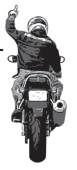
Speed up.
Slow down.
Ride in a single-file formation.
The group will pull off at the next exit.
Q.11.
Studies show that nearly ______ of riders killed in motorcycle crashes had been drinking.
20 percent
40 percent
60 percent
80 percent
Q.12.
A plastic, shatter-resistant face shield:
Is not necessary if you have a windshield.
Only protects your eyes.
Helps protect your whole face.
Does not protect your face as well as goggles.
Q.13.
When adjusting your rearview mirror, be sure you can:
See the lane behind you and the lane next to you.
See only the lane behind you.
See only the lane next to you.
See most of your helmet.
Q.14.
What does this hand signal mean?
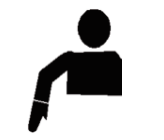
Slow or stop
Left turn
Right turn
Backing up
Q.15.
If in a no passing zone:
A motorcycle may still pass another vehicle.
A motorcycle is not allowed to pass another vehicle.
A motorcycle may pass another vehicle if the pass can be completed before another vehicle approaches.
A motorcycle may pass on the shoulder.
Q.16.
After drinking, what lessens the effects of alcohol?
Exercise
Coffee
Time
Food
Q.17.
You have been drinking alcohol. If you wait an hour for each drink before riding your motorcycle:
You cannot be arrested for drinking and riding.
Your riding skills will not be affected.
Side effects from the drinking may still remain.
You will be okay as long as you ride slowly.
Q.18.
A DOT-approved helmet:
Restricts the wearer's vision to the sides.
Can greatly reduce the severity of a head injury.
Is usually uncomfortable.
Makes it more difficult for the wearer to control their motorcycle.
Q.19.
To lessen your chances of an accident, you should:
Only ride in the afternoon.
Follow the vehicle in front of you as closely as possible.
Not look ahead and focus only on your controls.
Communicate your intentions to other drivers.
Q.20.
How does the stopping distance for motorcycles compare to the stopping distance for cars?
Cars need much longer to stop.
Cars need a little longer to stop.
Motorcycles need longer to stop.
Both motorcycles and cars take about the same amount of time to stop.
Q.21.
Maintain an adequate following distance behind other vehicles:
To allow you time and space to identify and react to hazards.
So you can tailgate.
To allow for traffic counters to accurately count you as a vehicle.
To encourage other drivers to cut you off.
Q.22.
Compared to riding during the day, a motorcycle operator who is riding at night should do all of the following, except:
Ride more slowly.
Allow more space between their motorcycle and other vehicles.
Use their high beam whenever possible.
Tailgate other vehicles.
Q.23.
Where is the rear brake pedal usually located?
On the left handgrip
On the right handgrip
Near the left footrest
Near the right footrest
Q.24.
When riding downhill on a motorcycle with a sidecar:
Stopping will be easier than when riding without a sidecar.
Stopping will take longer than when riding without a sidecar.
You cannot stop.
Stopping is about as easy as it is when riding without the sidecar.
Q.25.
The best lane position:
Is always the right portion of the lane.
Is always the center portion of the lane.
Is always the left portion of the lane.
Varies based on road, weather, and traffic conditions.
Support mcqgeeks.com by disabling your adblocker.
×
Please disable the adBlock and continue.
Thank you.
Reload page