Q.1.
When going through a curve, you should:
Q.2.
Of the crashes involving both a motorcycle and a car, how many are caused by the driver failing to properly yield the right-of-way to the rider?
Q.3.
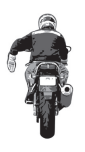
In the context of group riding, what does the hand signal pictured mean?
Q.4.
When being passed, do not move into the portion of the lane farthest from the passing vehicle because:
Q.5.
If you must swerve, you should:
Q.6.
On a slippery surface, you should not:
Q.7.
If in a no passing zone:
Q.8.
Which of the following will best protect your eyes from wind?
Q.9.
Braking in a turn is:
Q.10.
When preparing to pass a vehicle on the left, it is important to ride on the left side of your lane because:
Q.11.
Several factors influence blood alcohol concentration (BAC). Which of the following does not play a role?
Q.12.
Which of the following is not a piece of protective clothing for a motorcycle rider?
Q.13.
Which of the following surfaces provides the best traction for a motorcycle?
Q.14.
A helmet can provide the best protection if:
Q.15.
Reflective material on your helmet:
Q.16.
____ can remove alcohol and its effects from your body.
Q.17.
When both braking and swerving must be done to avoid an unexpected hazard, a rider should:
Q.18.
When deciding on a lane position, you should:
Q.19.
Keep an expanded cushion of space between your motorcycle and the vehicle in front of you:
Q.20.
Your lane position should help you:
Q.21.
When riding a motorcycle and trying to turn, you should:
Q.22.
Where is the front brake lever usually located?
Q.23.
Where is the clutch lever usually located?
Q.24.
The center portion of a lane usually contains an oily strip. This part of the lane is:
Q.25.
When braking: