MCQGeeks
CBSE
JEE
NTSE
NEET
English
UK Quiz
Quiz
Driving Test
Practice
Games
Driving Test
Missouri
Missouri Car Driving Permit Test-19
Answers
Q.1.
If your turn signals fail, you should use ____ to indicate that you are turning.
Your horn
Your headlights
Hand signals
Your emergency flashers
Q.2.
If you are convicted of Driving While Intoxicated (DWI) for the first time, you will:
Lose your license for 90 days.
Be fined $50.
Be required to install an Ignition Interlock Device (IID).
Get off with a warning.
Q.3.
Drivers who have consumed alcohol before getting behind the wheel:
Are always aware of the risks they are taking.
Do not have sufficient control over their bodies and minds or the vehicles being driven.
Are better drivers because they are more careful than sober drivers.
Have quicker reaction times.
Q.4.
What happens if you drink alcohol while taking prescription or over-the-counter medicine?
The medicine reduces the effect of the alcohol.
The alcohol will help the medicine cure a cold.
The combination could multiply the effects of the alcohol or medicine.
There is no effect because they are different substances.
Q.5.
When driving under icy or snowy conditions, which driving technique will help drivers avoid crashes?
Add extra weight to their vehicles to improve traction.
Get off the highways as quickly as possible.
Engage the four-wheel drive on their vehicles.
Reduce their speed and increase their following distance.
Q.6.
For a driver with an intermediate license, driving restrictions include:
That a seat belt must be worn by the driver.
That seat belts must be worn by all passengers.
A curfew between 1:00 a.m and 5:00 a.m.
All of the above.
Q.7.
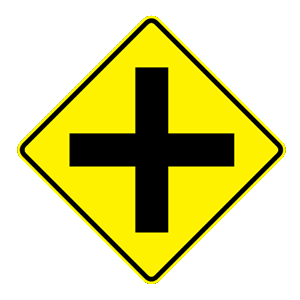
This road sign means:
A steep grade is ahead.
You must turn left ahead.
Do not enter.
A four-way intersection is ahead.
Q.8.
Which of the following statements is true?
A sudden change in weather calls for a change in driving.
You should slow down when driving in rain and fog.
Be particularly aware of vehicles coming up behind you in inclement weather.
All of the above.
Q.9.
When two vehicles enter an intersection from different highways at the same time, which vehicle must yield the right-of-way?
Either one
The vehicle on the left
The vehicle on the right
Neither
Q.10.
You are involved in an accident. You should:
Stop immediately.
Help the injured.
Call the police.
All of the above.
Q.11.
A bicyclist who doesn’t obey traffic laws:
Is in the right because bicyclists don’t have to obey traffic laws.
Can be ticketed.
Will always receive a warning from law enforcement.
Will have their bicycle impounded.
Q.12.
Passing is prohibited:
On hills and curves.
At intersections.
At railroad crossings.
All of the above.
Q.13.
As you near an intersection, the traffic light changes from green to yellow. Your best action is to:
Speed up to beat the red light.
Apply the brakes sharply to stop.
Be prepared to stop in the center of the intersection.
Be prepared to stop before the intersection.
Q.14.
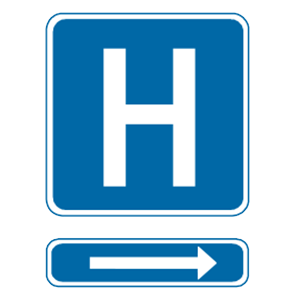
This sign means:
Highway changes ahead and to the right.
Hiking trails ahead and to the right.
Hotel ahead and to the right.
Hospital ahead and to the right.
Q.15.
A good rule to remember for passing is:
Pass on the right whenever possible.
Drive with the flow of traffic and pass only as needed.
Try to get to the front of any slow-moving traffic so that you can see better.
Always flash your lights and sound your horn to alert other drivers to your intentions.
Q.16.
A “No right on red” sign means:
Even if the traffic signal is red, you may turn right.
If the traffic signal is red, you cannot turn right.
The intersection has a high number of traffic crashes.
Even if the traffic signal is red, you do not have to come to a stop.
Q.17.
Guide signs are ____ signs that provide directional and mileage information to drivers.
Yellow
Red
Green
White
Q.18.
While driving, your wheels slip off the edge of the road. You should:
Jerk the steering wheel to force the vehicle back onto the pavement.
Speed up and steer back onto the pavement gradually.
Slam on your brakes and stop.
Slow down by gently using the brakes. Turn the steering wheel to return to the pavement at a safe speed.
Q.19.
When exiting a highway, you should slow down:
On the main road, just before the exit lane.
Once you see a toll booth.
Once you have moved into the exit lane.
When you first see the exit sign.
Q.20.
From top to bottom, the following is the proper order for traffic lights:
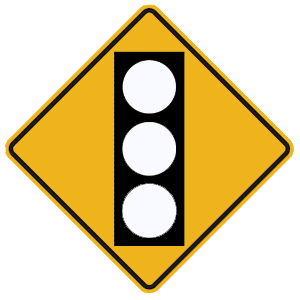
Red, yellow, green.
Red, green, yellow.
Green, red, yellow.
Green, yellow, red.
Q.21.
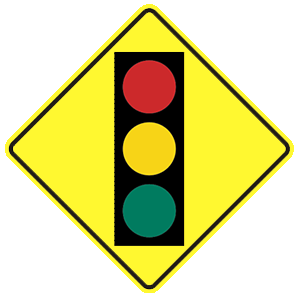
This sign means:
Emergency vehicles ahead.
Uncontrolled intersection ahead.
Four-way stop ahead.
Traffic signal ahead.
Q.22.
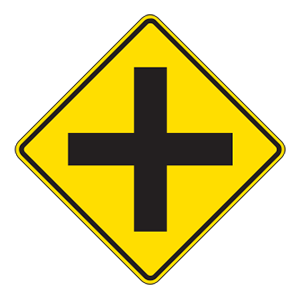
This sign means:
Crossroad ahead.
Flagger ahead.
Lane ends.
Turn right or go straight.
Q.23.
A driver should be extra alert to motorcyclists, bicyclists, and pedestrians because:
They’re difficult to see in traffic.
They obey different traffic laws than larger motor vehicles.
They always have the right-of-way.
They don’t have rearview mirrors.
Q.24.
While backing, you should:
Rely only on your mirrors.
Flash your lights.
Open your door to see if it is safe to proceed.
Turn your head and look through the rear window.
Q.25.
When you see an emergency vehicle with flashing lights, you must:
Slow down and keep moving in your lane.
Keep driving in your lane.
Pull to the right curb and stop.
Stop exactly where you are.
Support mcqgeeks.com by disabling your adblocker.
×
Please disable the adBlock and continue.
Thank you.
Reload page