MCQGeeks
CBSE
JEE
NTSE
NEET
English
UK Quiz
Quiz
Driving Test
Practice
Games
Driving Test
Missouri
Missouri Car Driving Permit Test-22
Answers
Q.1.
You may cross solid yellow lines:
To pass traffic moving in the same direction.
During daylight hours only.
At any time.
When making turns.
Q.2.
When you hear a fire engine siren behind you, you must:
Slow down until it passes you.
Drive with your flashers on.
Pull over to the side of the road and stop.
Speed up and take the nearest exit.
Q.3.
You are approaching an intersection when the traffic light changes from green to solid yellow. You should:
Consider it the same as a caution sign and continue through the intersection.
Stop immediately.
Stop before entering the intersection, unless you are too close to stop safely.
Speed up to get through the intersection before the red light appears.
Q.4.
Which of the following does not happen after drinking?
Your reflexes and reaction time slow down.
Your judgement of speed and distance is distorted.
You are less alert.
You calm down and can concentrate better.
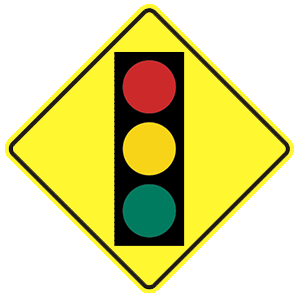
Q.5.
This road sign means:
Roundabout ahead.
No passing zone.
Left turn yield on green.
Traffic signal ahead.
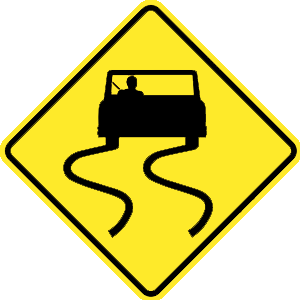
Q.6.
This road sign means:
When pavement is wet, reduce your speed.
The road ahead winds a series of turns or curves.
Traffic increases ahead.
Steep grade ahead.
Q.7.
The amount of space you need to cross traffic depends on the:
Road conditions, weather conditions, and oncoming traffic.
Presence of a stop sign.
Use of your turn signals.
Cars behind you.
Q.8.
Driving while being distracted by any activity:
Is never dangerous.
Usually causes the driver to react more slowly to hazards.
Usually causes the driver to drive faster.
Is only dangerous for young drivers.
Q.9.
If you miss your exit on an interstate expressway:
Stop and make a U-turn.
Get off at the next exit and come back to the exit you missed.
Roll down your window and ask the driver next to you for help.
Back up on the highway.
Q.10.
A red arrow displayed on a traffic light means that:
A driver must proceed slowly through the intersection.
A driver must stop and then proceed when the way is clear.
A driver must stop and then proceed when the signal changes to a green light or green arrow.
A driver may turn in the direction that the red arrow is pointing.
Q.11.
When you need to change lanes, it is important to:
Signal your intentions ahead of the lane change.
Check your blind spot.
Make sure the lane is clear before entering.
All of the above.
Q.12.
What is the first thing you should adjust, if needed, when you get into a car to drive?
Your seat belt
The steering wheel
Your rearview mirror
Your seat
Q.13.
You must stop at a railroad crossing when:
Directed to do so by a flagger.
It is controlled by a stop sign.
Flashing red signals and gates are present and operating.
All of the above.
Q.14.
A pedestrian starts to cross in front of your vehicle. You should:
Flash your lights.
Slow down.
Speed up and pass in front of the pedestrian.
Stop and let the pedestrian cross.
Q.15.
Which of the following is true about driving on a wet roadway?
As you drive faster, your tires become less effective.
Water does not affect cars with good tires.
Deep water is less dangerous than shallow water.
As you decrease your speed, the roadway becomes more slippery.
Q.16.
To safely pass a bicycle, you should:
Honk at the bicyclist to let them know you're trying to pass.
Drive in the bicycle lane until you get a chance to pass.
Slow down and give them as much space as possible.
Rush ahead to pull in front of the bicyclist.
Q.17.
To help relieve fatigue on a long trip, it is a good idea to:
Stop and rest every two hours.
Do arm exercises every hour.
Drive with one eye open at a time.
Change feet on the gas pedal.
Q.18.
Car drivers should know that large trucks:
Have large blind spots.
Can stop more quickly than passenger vehicles.
Do not need more room to maneuver than passenger vehicles.
All of the above.
Q.19.
If your car breaks down on a highway, you should:
Sit in your car and wait for help.
Use your four-way flashers to warn other drivers.
Sound your horn at passing motorists.
Flash your headlights at oncoming traffic.
Q.20.
Look over your shoulder to check your blind spot when:
Pulling toward or away from a curb.
Turning left or right.
Changing lanes.
All of the above.
Q.21.
You come to an intersection displaying a flashing red light. You should:
Come to a full stop and go when it is safe to do so.
Stop only if other cars are also approaching the intersection.
Stop only if other cars are already within the intersection.
Slow down and be prepared to stop, if necessary.
Q.22.
If there are two railroad tracks next to each other:
It is always safe to proceed after one train passes.
You must always stop before crossing the tracks.
When one train passes, look for another train on the other track before proceeding.
Honk your horn as you cross the tracks.
Q.23.
If worried, nervous, angry, or crying, a driver:
Will drive no differently than they would if they were thinking more clearly.
Can drive faster because they are more in touch with their senses.
Should take the time to focus on driving before starting the engine.
Should call a friend to vent while driving.
Q.24.
A speed restriction sign:
May be ignored in rainy, snowy, or icy conditions.
Has a triangular shape.
Is blue with black lettering.
Shows a recommended speed for a curve or turn.
Q.25.
What does an orange-colored sign indicate?
The start of a no passing zone.
A railroad crossing is ahead.
A school zone is ahead.
The presence of construction work.
Support mcqgeeks.com by disabling your adblocker.
×
Please disable the adBlock and continue.
Thank you.
Reload page