MCQGeeks
CBSE
JEE
NTSE
NEET
English
UK Quiz
Quiz
Driving Test
Practice
Games
Driving Test
Missouri
Missouri Car Driving Permit Test-8
Answers
Q.1.
It is important to be alert to motorcycles because:
They are more difficult to see than cars.
They rarely use their headlights.
Motorcyclists are less skilled drivers than other motorists.
All of the above.
Q.2.
You may pass another vehicle if the line dividing your lane from the lane you wish to enter is a ____ line.
Broken white
Double solid yellow
Solid yellow
Solid white
Q.3.
When you see other drivers around you acting or reacting in anger:
Don’t make eye contact.
Don't react with hand gestures.
Distance yourself from the situation.
All of these.
Q.4.
To avoid collisions with vehicles in your blind spots, you should:
Quickly turn your head to see if your blind spot is clear before changing lanes.
Adjust your rearview mirrors every few minutes.
Honk your horn right before turning or changing lanes.
None of the above.
Q.5.
To reduce the effects of headlight glare at night, you should look:
Straight ahead.
Over your shoulder.
At the center of the road
To the right edge of the road.
Q.6.
You are making a left turn from a two-way street onto a one-way street. When you have completed the turn, your car should be:
In the right lane of the street.
In the center of the street.
In the left lane of the street.
In the lane with the least traffic.
Q.7.
Which of the following is true regarding seat belts and child restraints in vehicles?
You should never place an infant or small child in the front seat of a vehicle with airbags.
An airbag can be dangerous to an infant or small child, even in a low-speed collision.
You should always make sure all your passengers are using a seat belt or child restraint.
All of the above.
Q.8.
When turning or changing lanes, you must:
Always signal your intentions, even when no visible traffic is present.
Signal only if there is visible traffic.
Signal only when driving at night.
Signal only when driving in heavy traffic at night.
Q.9.
If you need to drive in foggy weather:
Turn on your low beam headlights.
Turn on your hazard lights.
It is okay to drive at the maximum speed limit.
Do not drive at a speed above 10 miles per hour.
Q.10.
When a traffic signal light turns green, you should:
Yield the right-of-way to pedestrians.
Accelerate as quickly as possible.
Back up slowly.
Not move until another driver waves you on.
Q.11.
You may park or stop along the shoulder of the freeway:
As long as you turn on your four-way (emergency) flashers.
If no part of your vehicle is on the road.
If you need to look at a map for directions.
Only if you have an emergency.
Q.12.
Always signal when:
Changing lanes.
Pulling into or out of a parking space.
Pulling into traffic from a parking area or alley.
All of the above.
Q.13.
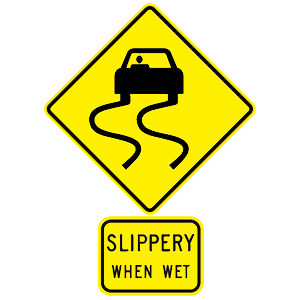
This sign means:
Slippery when wet.
Watch for drunk drivers.
Dangerous curve ahead.
Bump in the road ahead.
Q.14.
Always signal when:
Changing lanes.
Pulling into or out of a parking space.
Pulling into traffic from an alley or parking area.
All of the above.
Q.15.
When getting ready to change lanes, you should:
Check your side view mirror.
Check your rearview mirror.
Quickly turn your head to check for other vehicles.
All of the above.
Q.16.
A red and white triangular sign at an intersection means:
Slow down if an emergency vehicle is approaching.
Look both ways as you cross the intersection.
Always come to a full stop at the intersection.
Slow down and be prepared to stop if necessary.
Q.17.
To be safe when crossing a railroad, you should:
Look both ways, but only when the red light is flashing.
Listen, look both ways, and then proceed if it is safe to do so.
Cross especially quickly when a train is approaching.
Quickly pass under any lowering gates.
Q.18.
Regulatory signs:
Are placed in every location where there is a present danger.
Indicate what a driver must or must not do.
Are diamond-shaped and yellow or green.
May warn drivers that they are approaching a school zone.
Q.19.
Front door windows on a vehicle may be tinted to no more than:
100 percent light blockage.
Whatever looks good.
65 percent light blockage.
50 percent light blockage.
Q.20.
If you are convicted of Driving While Intoxicated (DWI) for the second time in a five-year period, you will:
Lose your license for only 90 days.
Be restricted to drivng on residential roadways.
Be required to install an Ignition Interlock Device (IID).
Be required to drive 10 mph under the speed limit at all times.
Q.21.
If you experience a tire blowout:
Take your foot of the gas.
Do not immediately use your brakes.
Gradually slow down and pull off the side of the road.
All of the above.
Q.22.
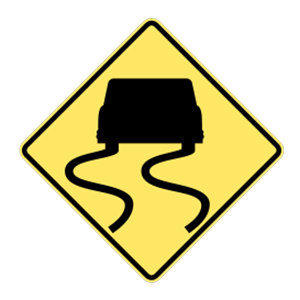
This sign means:
Watch for drunk drivers.
Curves ahead.
Slippery when wet.
Apply your brakes quickly.
Q.23.
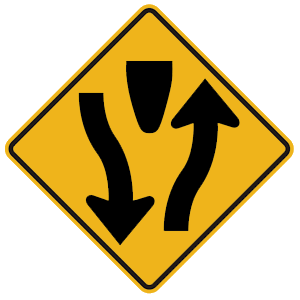
This sign means:
A divided highway ends.
A one-way street begins.
A one-way street ends.
A divided highway begins.
Q.24.
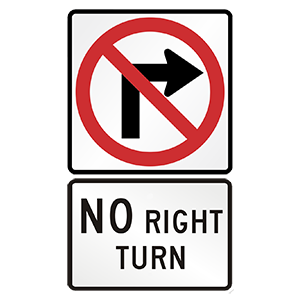
This sign means:
No right turns.
Right turns are permitted.
Stop before turning right.
Sharp curve ahead.
Q.25.
A point accumulation advisory letter will be sent to you if you:
Have too many points taken off of your driving record.
Accumulate a total of four points in 12 months.
Do not score enough points on your driving test.
Fail the written test.
Support mcqgeeks.com by disabling your adblocker.
×
Please disable the adBlock and continue.
Thank you.
Reload page