Q.1.
When riding over rough surfaces, you should:
Q.2.
A thorough check of your motorcycle:
Q.3.
A skidding rear tire:
Q.4.
Which of the following is not a piece of protective clothing for a motorcycle rider?
Q.5.
To reduce your reaction time, you should:
Q.6.
Which of the following is a good color to wear to be seen?
Q.7.
When it is obvious that you are going to turn, you:
Q.8.
When operating a motorcycle on a slippery surface, you should:
Q.9.
Of the crashes involving both a motorcycle and a car, how many are caused by the driver failing to properly yield the right-of-way to the rider?
Q.10.
Of the following, which should you not do to improve your safety when riding at night?
Q.11.
The center portion of a lane usually contains an oily strip. This part of the lane is:
Q.12.
Riding alongside a car:
Q.13.
An advantage to keeping a cushion of space between your motorcycle and other vehicles is that:
Q.14.
As an operator, you should prepare a passenger to ride by instructing them to do each of the following, except:
Q.15.
If operating a three-wheeled motorcycle or riding with a sidecar, do not ride too far to the right of your lane because:
Q.16.
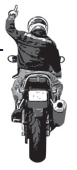
When riding in a group, what does it mean when the lead rider raises their left arm and extends their index finger, as shown in the image?
Q.17.
Riding at night:
Q.18.
You will ______ hear a tire going flat.
Q.19.
When traveling in a group, riders should:
Q.20.
When selecting a helmet, make sure it is all of the following, except:
Q.21.
Each traffic lane gives the motorcyclist how many paths of travel?
Q.22.
As the motorcycle’s weight moves forward while braking, you:
Q.23.
A plastic, shatter-resistant face shield:
Q.24.
It is best to not ride directly alongside another vehicle because:
Q.25.
The gear shift lever is located: