MCQGeeks
CBSE
JEE
NTSE
NEET
English
UK Quiz
Quiz
Driving Test
Practice
Games
Driving Test
Montana
Montana Car Driving Permit Test-8
Answers
Q.1.
On long trips, you can prevent drowsiness by:
Turning on your car radio.
Slowing down.
Stopping at regular intervals for a rest.
Moving your eyes from side to side as you drive.
Q.2.
The most effective thing you can do to reduce your risk of being injured or killed in a traffic crash is to:
Wear your seat belt.
Limit your driving to weekdays.
Stay in the right lane on multilane highways.
Limit your driving to hours between 3:00 p.m. and 6:00 p.m.
Q.3.
Two solid yellow lines on the pavement mean:
Passing is allowed for drivers from both directions.
Passing is not allowed.
Passing is allowed if you are at the top a hill.
Passing is allowed during daylight only.
Q.4.
You may drive across a dashed white line:
At any time.
Only during daylight hours.
When it is safe to change lanes.
Only when passing a motorcycle.
Q.5.
It is important to be alert to motorcycles because:
They are more difficult to see than cars.
They rarely use their headlights.
Motorcyclists are less skilled drivers than other motorists.
All of the above.
Q.6.
Pennant-shaped signs indicate:
School zones.
No passing zones.
Speed limits.
Railroad crossings.
Q.7.
Look over your shoulder to check your blind spot when:
Pulling toward or away from a curb.
Turning left or right.
Changing lanes.
All of the above.
Q.8.
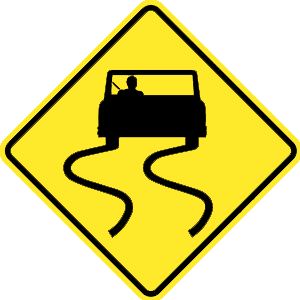
This road sign means:
When pavement is wet, reduce your speed.
The road ahead winds a series of turns or curves.
Traffic increases ahead.
Steep grade ahead.
Q.9.
You must not drive your vehicle at a speed greater than:
The maximum speed limit.
A speed that is faster than is reasonable and prudent.
A speed that is safe for existing conditions.
All of the above.
Q.10.
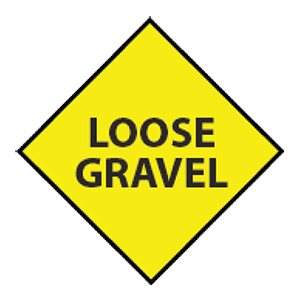
This sign means:
There are trucks hauling gravel ahead.
The highway ahead is under construction.
The highway ahead is covered with loose gravel.
The highway ahead has been sanded for icy conditions.
Q.11.
Emergency vehicles:
Have the right-of-way when using sirens, horns, and/or flashing lights.
May use a loudspeaker to give instructions.
May follow each other.
All of the above.
Q.12.
A work zone:
May be moving or stationary.
Is marked with black and white signs.
Does not require a driver to slow down and pay extra attention.
All of the above.
Q.13.
What does a flashing yellow traffic light mean?
Merging traffic
Proceed with caution.
Pedestrian crossing
Come to a full stop.
Q.14.
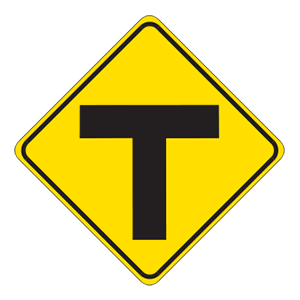
This sign means:
T intersection.
Lane shifting.
Side road.
Do not block intersection.
Q.15.
From the center lane, which maneuver(s) can you perform?
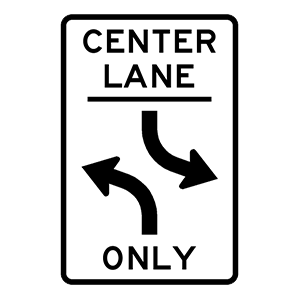
You may make left turns.
You may make U-turns.
You may pass slow-moving traffic.
All of the above.
Q.16.
You must yield for emergency vehicles:
Under no circumstances.
When you see a flashing red or blue light or hear a siren.
Only when other vehicles yield.
None of the above.
Q.17.
Stress can affect your driving by:
Lowing your ability to focus on driving.
Decreasing your chances of an accident.
Causing you to fall asleep at the wheel.
Making you more aware of others around you.
Q.18.
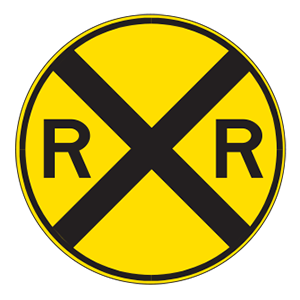
This sign means:
Railroad crossing.
One-way traffic.
Limited parking.
Playground ahead.
Q.19.
When encountering a funeral procession, a driver:
May not drive between the vehicles forming the procession unless authorized to do so by a police officer.
May not enter an intersection and cross the path of a funeral procession as it is proceeding through a solid red traffic light.
Must yield the right-of-way to any motor vehicle that is part of the funeral procession.
All of the above.
Q.20.
Turn signals must be visible:
For 500 feet.
For 250 feet.
For 300 feet.
Only at night.
Q.21.
Drive below the posted speed limit when:
Anything makes conditions less than perfect.
You see a police car.
Entering a highway where there are other cars.
You are on a four-lane road.
Q.22.
The amount of space you need to cross traffic depends on the:
Road conditions, weather conditions, and oncoming traffic.
Presence of a stop sign.
Use of your turn signals.
Cars behind you.
Q.23.
A diamond-shaped sign is a:
Road hazard sign.
Interstate route sign.
School crossing sign.
Speed limit sign.
Q.24.
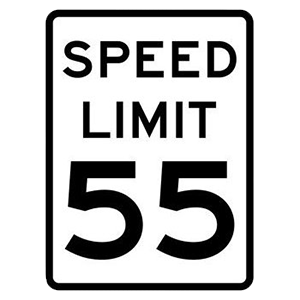
This road sign means:
You must travel at the speed indicated.
The maximum legal speed on the roadway is 55 mph.
You must travel through the intersection at the posted speed.
None of the above.
Q.25.
Compared to driving during the day, driving at night is:
Less dangerous.
No more or less dangerous.
More dangerous.
Easier on your eyes.
Q.26.
The driver's left arm and hand are extended downward. This hand signal means that the driver plans to:
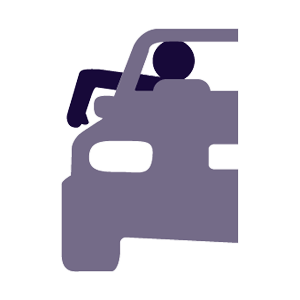
Turn left.
Turn right.
Stop.
Start up.
Q.27.
Alcohol causes:
Loss of concentration.
Poor coordination.
Slower judgment.
All of the above.
Q.28.
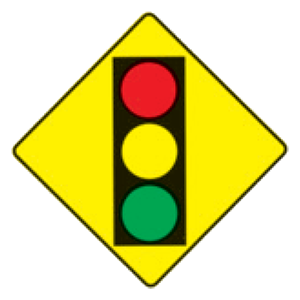
This sign means:
Stop sign ahead.
Lane closed ahead.
Railroad crossing ahead.
Traffic signal ahead.
Q.29.
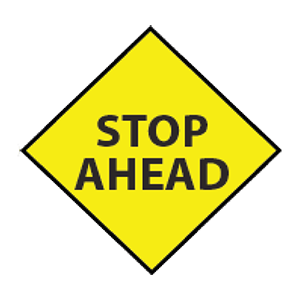
This sign means:
There is a bus stop ahead.
There is a stop sign ahead.
There is a caution sign ahead.
You must stop if other cars stop.
Q.30.
Traffic signs and pavement markings:
Must always be obeyed.
Are merely suggestions.
Must be followed only when there is other traffic.
Must be followed only when a police officer is present.
Q.31.
When getting ready to change lanes, you should:
Check your side view mirror.
Check your rearview mirror.
Quickly turn your head to check for other vehicles.
All of the above.
Q.32.
Which of the following statements about railroad crossings is true?
It is against the law to go around lowered gates at a crossing.
You must stop at a railroad crossing when directed to do so by a flagger.
Not all railroad crossings are equipped with flashing red signals and gates.
All of the above.
Q.33.
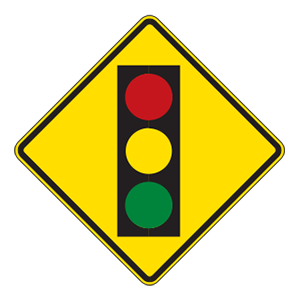
This sign means:
Traffic signal.
Fire station.
T intersection.
Left turn signal.
Support mcqgeeks.com by disabling your adblocker.
×
Please disable the adBlock and continue.
Thank you.
Reload page