MCQGeeks
CBSE
JEE
NTSE
NEET
English
UK Quiz
Quiz
Driving Test
Practice
Games
Driving Test
Nebraska
Nebraska Car Driving Permit Test-14
Answers
Q.1.
Drivers may park in the handicap parking access aisles located directly beside handicap parking stalls.
True
False
Q.2.
When driving in a work zone, you should:
Activate your four-way flashers.
Stay alert, obey all posted signs, maintain a safe speed, and be prepared to stop.
Increase your speed so as not to impede traffic.
Q.3.
At dawn or dusk and in rain or snow, it can be hard to see and be seen. A good way to let other drivers know you are there is to turn:
Up the instrumental panel lights.
On your parking lights.
On your headlights.
Q.4.
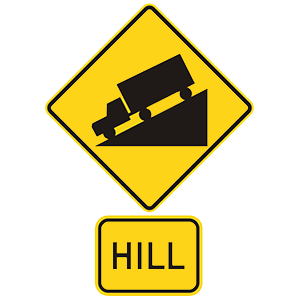
What does this road sign mean?
Falling rocks
Trucks use second gear
Steep hill
Q.5.
If an emergency or road assistance vehicle is stopped on the side of the road while using its flashing lights, an approaching driver must:
Stop.
Move into a lane at least one travel lane away from the stopped vehicle, if possible.
Speed up to pass the stopped vehicle.
Pull onto the left shoulder and stop.
Q.6.
The amount of alcohol in the blood is referred to as:
Implied consent (IC).
Blood alcohol concentration (BAC).
Rate of alcohol consumption (RAC).
Q.7.
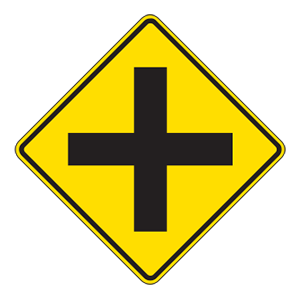
This sign means:
Crossroad ahead.
Flagger ahead.
Lane ends.
Turn right or go straight.
Q.8.
When encountering an aggressive driver, you should:
Avoid eye contact, slow down, and let them pass.
Cut them off to slow them down.
Retaliate by tailgating them.
Make sure they know you disapprove of their behavior.
Q.9.
Collisions are more likely to happen when:
All vehicles are traveling at about the same speed.
One lane of traffic is traveling faster than the other lanes.
One vehicle is traveling faster or slower than the flow of traffic.
Q.10.
Except when passing, maintain a following distance of at least ____ when driving behind working snow removal vehicles.
100 feet
200 feet
500 feet
1,000 feet
Q.11.
Having a driver license is a:
Requirement.
Privilege.
Right.
Q.12.
At intersections with a "Yield" sign, you must:
Yield the right-of-way to cross traffic that is near enough to cause conflict.
Yield the right-of-way only to vehicles on your right.
Always slow down and proceed without stopping.
Q.13.
Children up to ageare prohibited from riding in cargo areas.
True
False
Q.14.
Rumble strips are present to:
Warn drowsy or inattentive drivers that they are leaving the road.
Indicate that a stop is ahead.
Help slow a vehicle that is experiencing brake failure.
Q.15.
This sign indicates that the road ahead:
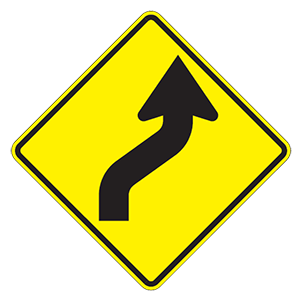
Turns sharply right, then left.
Curves right, then left.
Curves right.
Q.16.
Which of the following are used on some highways to direct drivers into the proper lanes for turning?
Flashing red lights
Flashing yellow lights
White lines on the side of the road
White arrows in the middle of the lanes
Q.17.
When parking your vehicle on any hill:
One of your rear wheels should touch the curb.
Use your parking brake and leave the vehicle in "park."
Your front wheels should be parallel to the road, if there is no curb.
Q.18.
Distracted driving may be caused by:
Eating, drinking, or smoking.
Talking or texting on a cellular phone.
Changing a radio station or CD.
All of the above.
Q.19.
Certain highway signs require drivers to obey an indicated instruction. Such signs are known as:
Regulatory signs.
Warning signs.
Information signs.
Guide signs.
Q.20.
"No zones" are areas around trucks where cars:
Disappear into blind spots or are so close that they restrict the truck driver's ability to stop and maneuver safely.
Have sufficient space to travel behind the truck.
Have several car lengths between their vehicle and the truck.
Q.21.
At a four-way stop:
Drivers may insist on the right-of-way, even at the risk of an accident.
The driver who arrives first to the intersection should proceed first.
Drivers may slow down and proceed, if the road is clear.
Q.22.
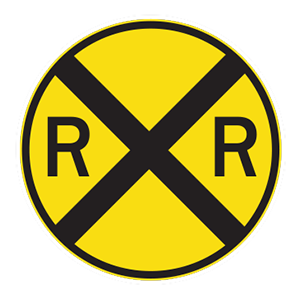
This sign means:
Stop sign ahead.
Railroad crossing ahead.
Construction ahead.
Q.23.
Your vehicle's stopping distance increases when stopping:
On a wet or icy road.
On paved highways.
When driving at night.
All of the above.
Q.24.
The Child Passenger Restraint Law requires that all children up to age ____ ride properly secured in a federally-approved child safety seat.
Four
Six
Eight
Q.25.
When making an emergency roadside stop, you should:
Flash your headlights to warn other drivers.
Shift your transmission to the parking gear and set the parking brake.
Leave your vehicle running and exit the vehicle.
Support mcqgeeks.com by disabling your adblocker.
×
Please disable the adBlock and continue.
Thank you.
Reload page