MCQGeeks
CBSE
JEE
NTSE
NEET
English
UK Quiz
Quiz
Driving Test
Practice
Games
Driving Test
Nebraska
Nebraska Motorcycle Driving Permit Test-16
Answers
Q.1.
Blind spots on motorcycles:
Are nothing to worry about.
Should be consistently checked by riders.
Don't exist if the motorcycle has a rearview mirror.
Q.2.
The center portion of the lane:
Should be always avoided.
Has an accumulation of oil and grease but usually provides enough traction for safe riding.
Does not allow other motorists to see you in most instances.
Q.3.
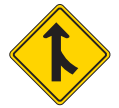
What does this sign mean?
Two-way traffic
Right lane ends
Merge
Q.4.
When traveling at night, it is:
Easier to judge distances than it is during the day.
About as easy to judge distances as it is during the day.
More difficult to judge distances than it is during the day.
Q.5.
A passenger on a motorcycle should:
Put their feet on the ground when the motorcycle is stopped.
Not ride without a back rest.
Sit as far forward as possible without crowding the operator.
Q.6.
You approach an emergency vehicle that is stopped on the side of the road while using its flashing lights. You should:
Stop on the roadway behind the emergency vehicle.
Stop and wait until the emergency vehicle begins moving again.
Merge into a lane away from the emergency vehicle.
Q.7.
The front brake:
Should only be used in an emergency.
Should be used with the rear brake.
Is unsafe to use.
Q.8.
When sitting on a motorcycle, you should:
Use your arms to hold up your body.
Sit at an angle so your arms can support your weight.
Sit so you can use your arms to control the motorcycle.
Q.9.
Riding on ______ may provide poor traction.
Pavement markings
Dry pavement
The roadway under a bridge
Q.10.
If you are riding behind another vehicle at night, you can determine if there are bumps on the road ahead by:
Listening for the other vehicle scraping against the pavement.
Noticing the other vehicle’s taillights bouncing up and down.
Looking at the rear bumper of the vehicle ahead and trying to determine if it is bouncing.
Q.11.
Under normal riding conditions, one of the best ways to help others see your motorcycle is:
To flash your lights.
To keep your high beam headlight turned on.
To ensure that your motorcycle is painted a dark color.
Q.12.
To make it easier to be seen by other motorists, you should:
Wear brightly-colored clothing while riding.
Wear darkly-colored clothing while riding.
Wave your arms while riding.
Q.13.
Where is the greatest potential for conflict between you and other vehicles?
At intersections
On the highway
On any road
Q.14.
A proper lane position should do all of the following, except:
Increase your ability to see.
Help you avoid surface hazards.
Encourage other drivers to share your lane.
Q.15.
The Motorcycle Safety Foundation recommends a SEE strategy to make safe judgments while riding. What does "SEE" stand for?
Search, Evaluate, and Execute.
Slow, Experienced, and Error-free.
Safe, Experienced, and Evasive.
Q.16.
Of the following, it is most important to flash your brake light when:
Someone is following you too closely.
You will be slowing suddenly.
There is a stop sign ahead.
Q.17.
If your motorcycle begins to weave while you are riding over rain grooves or bridge gratings, you should:
Speed up to get over the surface faster.
Exaggerate the zigzag motion to get the attention of other drivers.
Maintain a steady speed and ride straight across the grooves or gratings.
Q.18.
Wearing which of the following colors will make you less visible to other motorists?
Orange
Yellow
Brown
Q.19.
What does a flashing red traffic light mean?
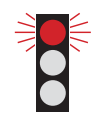
Come to a complete stop and proceed when it is safe to do so.
Only stop to yield to other traffic.
Vehicles will be entering the roadway.
Q.20.
The front brake supplies about how much of a motorcycle's potential stopping power?
About one-quarter
About one-half
About three-quarters
Q.21.
When selecting a jacket that will be used as protective apparel, a motorcycle rider should look for a jacket that is:
Black, or another dark color.
Warm.
Made of leather or synthetic materials.
Q.22.
What should be your first consideration when buying a motorcycle helmet?
Appearance
Protection
Price
Q.23.
You should maintain an increased following distance:
If the pavement is slippery.
If traffic is light.
If you can see through the vehicles in front of you to determine traffic conditions.
Q.24.
Where should you position your motorcycle when entering a curve?
The outside of the curve
The inside of the curve
Wherever traffic and road conditions require
Q.25.
To minimize the potential for fatigue, you should:
Turn on the radio.
Take frequent rest breaks.
Drink caffeine.
Support mcqgeeks.com by disabling your adblocker.
×
Please disable the adBlock and continue.
Thank you.
Reload page