MCQGeeks
CBSE
JEE
NTSE
NEET
English
UK Quiz
Quiz
Driving Test
Practice
Games
Driving Test
Nevada
Nevada Car Driving Permit Test-20
Answers
Q.1.
Smoking and preparing to smoke while driving:
Do not affect driving abilities.
Help maintain driver alertness.
Are distracting activities.
Are not distracting activities.
Q.2.
When passing a row of parked vehicles, you should:
Be prepared for a person or vehicle to unexpectedly enter your lane.
Expect all other drivers and pedestrians to respect your right-of-way.
Honk to alert drivers and pedestrians to your presence.
Increase your speed to avoid any pedestrians.
Q.3.
Defensive driving is:
Driving aggressively.
Using safe driving strategies to prevent crashes.
More dangerous than not driving defensively.
A bad idea.
Q.4.
If you see this sign above your lane, you:
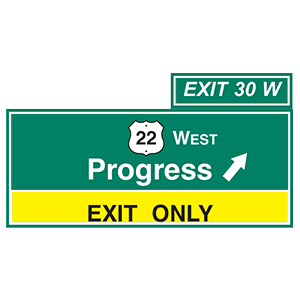
May not exit the freeway.
May either continue through the interchange or exit the freeway from your current lane.
May stay in your lane and continue through the interchange.
Must exit the freeway, if you stay in your current lane.
Q.5.
To drive safely at night, you should:
Increase your following distance.
Not drive if you are tired.
Make sure your headlights are working properly.
All of the above.
Q.6.
You may not park within ____ of a crosswalk.
50 feet
40 feet
30 feet
20 feet
Q.7.
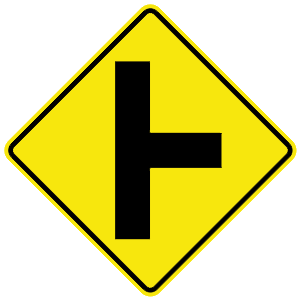
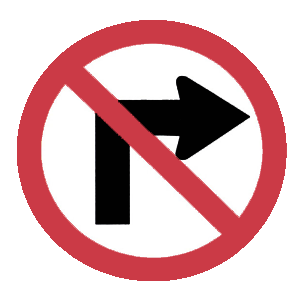
This road sign means:
All traffic must turn right.
No right turn.
All traffic must go straight ahead.
A road joins from the right.
Q.8.
You may drive across a dashed white line:
At any time.
Only during daylight hours.
When it is safe to change lanes.
Only when passing a motorcycle.
Q.9.
When driving on a road that is not a freeway, drivers should look down the road at least ____ ahead of their vehicle.
12 seconds
10 seconds
Five seconds
Three seconds
Q.10.
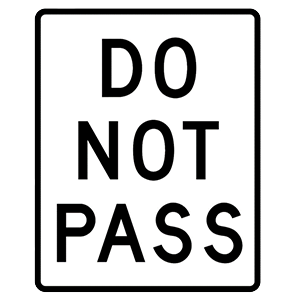
If you see this sign, you:
Must not pass another vehicle.
May pass a slow-moving vehicle if you can do so quickly.
May pass if you know the road ahead.
May pass, but only at night.
Q.11.
It is legal to go faster than the speed limit when passing another vehicle.
True
False
Q.12.
When driving in fog, you should use your high beam headlights.
TRUE
FALSE
Q.13.
You are driving at night and another vehicle is approaching from the opposite direction. Your headlights:
Should be on their high beam setting.
Should be on their low beam setting.
Should be off. Use your parking lights.
May be on either their high or low beam setting.
Q.14.
When you are in a line of traffic that is crossing a railroad track that has no signals or gates:
You have the right-of-way and do not need to check for trains.
You may pass slower drivers while crossing the track.
You need to make sure there is space for your vehicle to get all the way across the tracks without stopping.
All of the above
Q.15.
You are driving on the roadway and hear a siren behind you. You should:
Stop where you are.
Pull over to the right and stop.
Speed up to get out of the way.
Slow down.
Q.16.
What does a single dashed yellow line separating traffic mean?
Drivers may pass if it is safe to do so.
Both lanes travel in the same direction.
Drivers may not pass.
Drivers may pass, even if it could be dangerous.
Q.17.
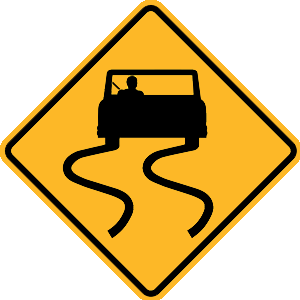
This sign means:
Don't drink if you are going to drive.
Slippery when wet.
Road curves ahead.
You are approaching a hill.
Q.18.
Alcohol is the single greatest common factor in fatal motor vehicle crashes.
True
False
Q.19.
If two drivers arrive at the same time to a four-way intersection controlled by stop signs:
The driver on the right has the right-of-way.
The driver on the left has the right-of-way.
One driver may continue driving without stopping.
One driver should honk to indicate that they are giving up the right-of-way.
Q.20.
When driving in fog, you should use your:
Low beam headlights.
High beam headlights.
Parking lights.
Hazard flashers.
Q.21.
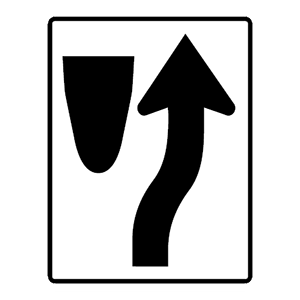
This road sign means:
Side road.
Keep to the side indicated by the arrow.
You may drive in the left lane.
You have the right-of-way.
Q.22.
When you need to change lanes, it is important to:
Signal your intentions ahead of the lane change.
Check your blind spot.
Make sure the lane is clear before entering.
All of the above.
Q.23.
This road sign means:
No left turn.
No U-turns.
No exit.
No right turn.
Q.24.
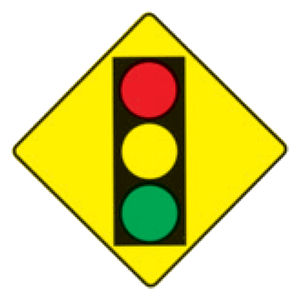
This sign means:
Stop sign ahead.
Lane closed ahead.
Railroad crossing ahead.
Traffic signal ahead.
Q.25.
Railroad crossings should always be considered:
Safe to cross, as it is unlikely that a train will be coming.
Dangerous.
Safe locations to park a car.
A place where it is required to stop
Q.26.
You want to back out of your driveway. You see children playing nearby. Before you start to move your car, you should:
Rev your engine to warn the children that you are moving.
Sound your horn so the children will hear you.
Walk to the back of the car to be sure the way is clear.
Tell the children to stay away from the driveway.
Q.27.
You may cross solid yellow lines:
To pass traffic moving in the same direction.
During daylight hours only.
At any time.
When making turns.
Q.28.
A solid white line down the center of a two-lane road indicates:
Lanes are moving in opposite directions and drivers are not permitted to pass.
Lanes are moving in opposite directions and drivers are permitted to pass when it is safe to do so.
Lanes are moving in the same direction and drivers are not permitted to pass.
Lanes are moving in the same direction and drivers are permitted to pass when it is safe to do so.
Q.29.
When a curb is painted ____, it indicates a reserved handicap parking area.
Yellow
Blue
White
Green
Q.30.
Drinking alcohol and driving is:
A minor traffic safety problem.
A serious traffic safety problem.
Safe if you have only had a few drinks.
Only dangerous to the driver who drinks.
Q.31.
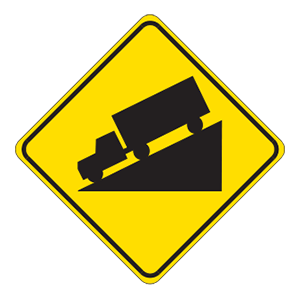
This sign means:
Steep downgrade.
Crossroad ahead.
No right turn.
Narrow bridge.
Q.32.
You experience an incident at work that has left you feeling angry. When you get to your car, you should:
Play the radio loudly so you won’t think about it.
Drive fast on the interstate to let off steam.
Take a few minutes to cool off before you begin your drive home.
Stop at your favorite bar and have a few drinks before driving home.
Q.33.
When entering a street from a driveway, you:
Must drive slowly to allow approaching vehicles and pedestrians time to get out of your way.
Must honk your horn so approaching vehicles and pedestrians know to give you room.
Must stop and proceed only when there are no pedestrians or vehicles approaching.
Can disregard any pedestrians if there is no sidewalk.
Q.34.
When should drivers use their parking brake?
Every time they park
Only when parking on an incline
Only when parked in a driveway
Never
Q.35.
What are the colors of warning signs indicating upcoming hazards?
Black letters or symbols on a white background
Black letters or symbols on a yellow background
White letters or symbols on a blue background
White letters or symbols on a green background
Q.36.
A single broken white line down the center of a two-lane road indicates:
Lanes are moving in opposite directions and drivers are not permitted to pass.
Lanes are moving in opposite directions and drivers are permitted to pass when it is safe to do so.
Lanes are moving in the same direction and drivers are not permitted to pass.
Lanes are moving in the same direction and drivers are permitted to pass when it is safe to do so.
Q.37.
If your turn signals fail, you should use ____ to indicate that you are turning.
Your horn
Your headlights
Hand signals
Your emergency flashers
Q.38.
Defensive driving is:
Identifying dangerous driving situations and taking action to avoid accidents.
Defending yourself against poor drivers by getting ahead of them in traffic.
Following the vehicle ahead of you at a close distance.
Quickly changing lanes and shifting in and out of traffic congestion.
Q.39.
A seat belt should be adjusted so that it:
Is loose.
Is buckled snugly across your hip bones and lower abdomen.
Is hidden beneath the seat.
Keeps the seat belt buzzer or light from operating.
Q.40.
When driving to an unfamiliar area, you:
Should depend on road signs to find your way.
Should plan your trip in advance.
Only have to know generally where your destination is.
Should always choose the most direct route.
Q.41.
When using a roundabout, drivers should:
Yield to traffic already in the roundabout.
Yield to entering traffic.
Drive in a clockwise direction.
Stop in the middle of the roundabout.
Q.42.
The most effective thing you can do to reduce your risk of being injured or killed in a traffic crash is to:
Wear your seat belt.
Limit your driving to weekdays.
Stay in the right lane on multilane highways.
Limit your driving to hours between 3:00 p.m. and 6:00 p.m.
Q.43.
When driving near heavy trucks, other drivers and highway users must make allowances for:
The increased stopping distance required by large vehicles.
The decreased stopping distance required by large vehicles.
The decreased noise of larger vehicles.
The increased speed of larger vehicles.
Q.44.
Before changing lanes on a multilane highway, you should:
Sound your horn.
Turn on your headlights.
Reduce your speed.
Check your mirrors and blind spots.
Q.45.
If you are stopped by a police officer, you should:
Unbuckle your seat belt and lower your window.
Get your paperwork ready before the officer reaches your car.
Stay in your vehicle with your hands on the steering wheel and wait for the officer to approach you.
Get out of your car and walk toward the patrol car.
Q.46.
You should be cautious when passing a bicycle because:
You are moving faster than the bicycle.
The bicycle always has the right-of-way.
Oncoming traffic may not see you pull out to pass the bicycle.
The cyclist may have to swerve into traffic to avoid an object on the road.
Q.47.
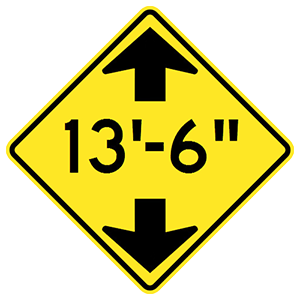
This road sign means:
Divided highway begins.
A steep grade is ahead.
The overpass ahead has a low clearance.
Two lanes of traffic moving in opposite directions are about to merge.
Q.48.
Downward-facing triangular signs:
Indicate school zones.
Tell drivers to yield.
Indicate construction zones.
Indicate railroad crossings.
Q.49.
If you need to drive in foggy weather:
Turn on your low beam headlights.
Turn on your hazard lights.
It is okay to drive at the maximum speed limit.
Do not drive at a speed above 10 miles per hour.
Q.50.
When driving on slick roads, you should:
Take turns more slowly than usual.
Change lanes quickly.
Accelerate quickly.
Brake hard.
Support mcqgeeks.com by disabling your adblocker.
×
Please disable the adBlock and continue.
Thank you.
Reload page