MCQGeeks
CBSE
JEE
NTSE
NEET
English
UK Quiz
Quiz
Driving Test
Practice
Games
Driving Test
Nevada
Nevada Car Driving Permit Test-7
Answers
Q.1.
This sign means:
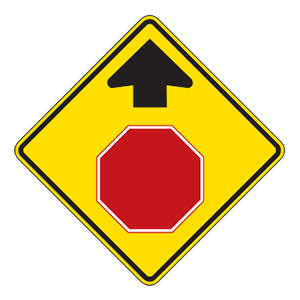
Stop ahead.
Buggy warning.
Limited parking.
Do not block intersection.
Q.2.
Before turning left, it is important to:
Sound your horn.
Yield to oncoming vehicles.
Swing to the right side of your lane.
Wait until oncoming traffic has a red light.
Q.3.
A red flashing traffic light has the same meaning as a:
Solid red light.
Stop sign.
Yield sign.
Caution sign.
Q.4.
Driving at night requires increased caution because:
Traffic moves faster at night.
There is a larger volume of traffic at night.
Drivers cannot see as well at night.
Accidents occur more frequently at night.
Q.5.
If you need to stop quickly and your vehicle is not equipped with an Anti-Lock Braking System (ABS), you should:
Hold down the brake pedal.
Firmly pump your brakes.
Lightly tap the brakes.
Release the brake pedal.
Q.6.
Braking distance is affected by:
The speed your vehicle is traveling.
The condition of your brakes and tires.
The condition of the pavement.
All of the above.
Q.7.
Confirm that your passengers have buckled their seat belts:
Only if it’s raining or snowing.
Before starting the engine.
When a police officer stops you.
Only when you’re beginning a long trip.
Q.8.
You must stop at a railroad crossing when:
Directed to do so by a flagger.
It is controlled by a stop sign.
Flashing red signals and gates are present and operating.
All of the above.
Q.9.
You are involved in an accident and another person is injured. You should:
Moved the injured away from the scene immediately.
Always leave the injured where they are.
Not move the injured unnecessarily. Keep the injured warm and administer first aid.
Stay away from the injured.
Q.10.
What happens if you drink alcohol while taking prescription or over-the-counter medicine?
The medicine reduces the effect of the alcohol.
The alcohol will help the medicine cure a cold.
The combination could multiply the effects of the alcohol or medicine.
There is no effect because they are different substances.
Q.11.
A yellow light that flashes on and off means:
Stop and look for other vehicles, then go if there is no traffic.
Stop and wait for a green light.
Speed up to clear the intersection quickly.
Slow down and proceed with caution.
Q.12.
Defensive driving is:
Driving aggressively.
Using safe driving strategies to prevent crashes.
More dangerous than not driving defensively.
A bad idea.
Q.13.
A driver can legally pass on the right side of another vehicle:
If the vehicle is waiting to turn left and there is an available passing lane.
Even if it means driving off the pavement.
On a narrow bridge.
At any time.
Q.14.
You are waiting to turn left at a multilane intersection and opposing traffic is blocking your view. You should:
Accelerate rapidly when the first lane you need to cross is clear.
Wait until you can see all the lanes you need to cross before going ahead with your turn.
Wait for an oncoming driver to wave you across the intersection.
Edge your car into each lane of opposing traffic as soon as it clears.
Q.15.
Allowing a space cushion between your vehicle and its surroundings is important because it:
Prevents distractions from other vehicles.
Allows you time to react to unexpected situations.
Keeps traffic flowing at a safe pace.
Keeps other drivers alert.
Q.16.
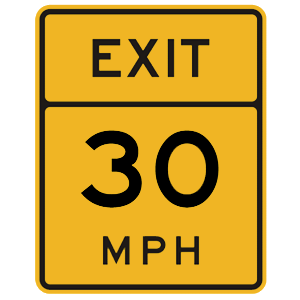
This road sign indicates:
The maximum safe speed for a residential area.
The maximum safe speed for an expressway exit.
The maximum safe speed for an expressway entrance.
The maximum safe speed for a work zone.
Q.17.
What is the only way to reduce your blood alcohol concentration (BAC)?
Drink coffee.
Exercise.
Allow your body time to get rid of the alcohol.
Take a cold shower.
Q.18.
What does a single dashed white line separating traffic mean?
Drivers may pass, even if it could be dangerous.
Lanes move in opposite directions.
Drivers may not pass.
Drivers may pass if it is safe to do so.
Q.19.
Downward-facing triangular signs:
Indicate school zones.
Tell drivers to yield.
Indicate construction zones.
Indicate railroad crossings.
Q.20.
You are driving on the roadway and hear a siren behind you. You should:
Stop where you are.
Pull over to the right and stop.
Speed up to get out of the way.
Slow down.
Q.21.
When parking your vehicle downhill on a two-way street:
Turn your wheels to the right.
Turn your wheels to the left.
Keep your wheels pointed straight ahead.
Leave your transmission in neutral.
Q.22.
Signaling your intentions before turning, changing lanes, or driving away from a curb:
Is necessary only if other traffic is present.
Is a good driving habit and is required by law.
Is necessary only during the maneuver, not before.
Is not necessary if the maneuver is done slowly.
Q.23.
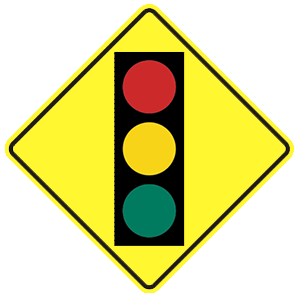
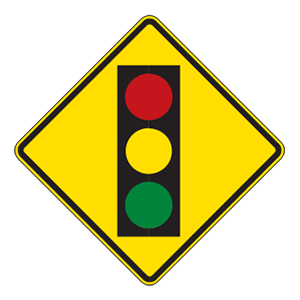
This sign means:
Emergency vehicles ahead.
Uncontrolled intersection ahead.
Four-way stop ahead.
Traffic signal ahead.
Q.24.
When driving on slick roads, you should:
Take turns more slowly than usual.
Change lanes quickly.
Accelerate quickly.
Brake hard.
Q.25.
Which of the following influence(s) the effects of alcohol?
The amount of food in the stomach
The body weight of an individual
How much time passes between drinks
All three choices
Q.26.
The consumption of alcohol while taking drugs can:
Decrease the effects of the drugs and alcohol.
Increase the effects of both the drugs and alcohol.
Help cure your illness.
Improve your driving ability.
Q.27.
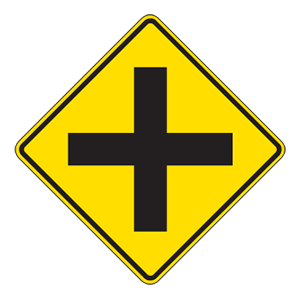
This sign means:
Crossroad ahead.
Flagger ahead.
Lane ends.
Turn right or go straight.
Q.28.
Which of the following is true about driving on a wet roadway?
As you drive faster, your tires become less effective.
Water does not affect cars with good tires.
Deep water is less dangerous than shallow water.
As you decrease your speed, the roadway becomes more slippery.
Q.29.
A good rule to remember for passing is:
Pass on the right whenever possible.
Drive with the flow of traffic and pass only as needed.
Try to get to the front of any slow-moving traffic so that you can see better.
Always flash your lights and sound your horn to alert other drivers to your intentions.
Q.30.
Your body gets rid of approximately:
Three alcoholic drinks an hour.
One alcoholic drink an hour.
Two alcoholic drinks an hour.
None of the above.
Q.31.
Who is required to wear a seat belt in a moving vehicle?
The driver
Child passengers
Adult passengers
All of the above
Q.32.
If conditions are unsafe, you may not leave a child under the age of eight in a vehicle unattended.
True
False
Q.33.
Traffic signals sometimes display arrows to control turns from specific lanes. A solid yellow arrow:
Is never used as a traffic signal.
Has the same meaning as a circular yellow traffic light.
Means that drivers may turn in the direction indicated by the arrow.
Tells drivers that a green arrow is about to be shown.
Q.34.
Headlights are legally required to be in use when people or vehicles cannot be clearly seen at a distance of 1,feet.
True
False
Q.35.
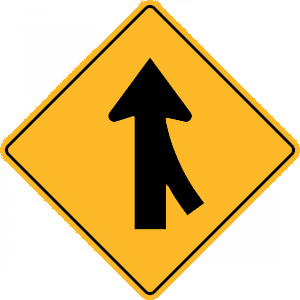
This sign means:
One-way traffic.
Intersection ahead.
Merging traffic from the right.
Highway curves ahead.
Q.36.
This sign means:
Traffic signal.
Fire station.
T intersection.
Left turn signal.
Q.37.
If someone is driving aggressively behind you, you should:
Try to get out of the aggressive driver’s way.
Stare at the driver as he or she is passing you.
Speed up as he or she is passing you.
Block the passing lane.
Q.38.
To help prevent crashes, you should:
Communicate with other road users.
Ignore other drivers on the road.
Drive only on side streets and back roads.
Avoid driving during rush hour.
Q.39.
When sharing the road with a truck, it is important to remember that trucks generally:
Require longer distances to stop than smaller vehicles do.
Require less time to pass on a downgrade than smaller vehicles do.
Require a smaller turning radius than smaller vehicles do.
Require less time to pass on an incline than smaller vehicles do.
Q.40.
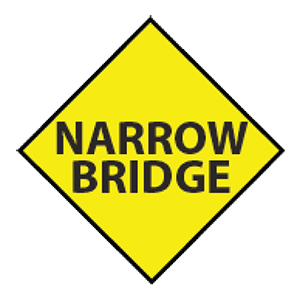
This sign means:
Trucks are permitted on an upcoming narrow bridge.
The bridge ahead is open to one-way traffic only.
The bridge ahead is wide enough for only one car at a time.
The bridge ahead may be too narrow to meet or pass a truck.
Q.41.
What should you do when an emergency vehicle is approaching while displaying flashing red or blue lights?
See if you can reach your destination before the emergency vehicle catches up to you.
Continue driving but try to stay out of its way.
Pull over to the side of the road and come to a complete stop.
Stop in the middle of an intersection.
Q.42.
When sharing the road with large commercial vehicles, you should:
Expect the large vehicles to require extra time and space to slow down and stop.
Remember that commercial vehicles have substantial blind spots.
Properly signal your turns and lane changes well in advance.
All of the above.
Q.43.
Driving while being distracted by any activity:
Is never dangerous.
Usually causes the driver to react more slowly to hazards.
Usually causes the driver to drive faster.
Is only dangerous for young drivers.
Q.44.
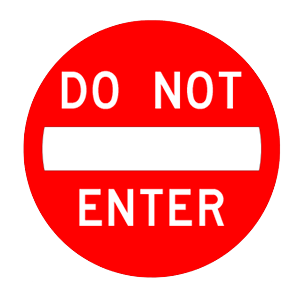
This sign means:
Heavy traffic ahead.
Do not enter.
Railroad crossing.
Yield.
Q.45.
You may use a shared center turn lane:
As a travel lane to pass other vehicles.
To make a left turn onto another street, road, or driveway.
To make a right turn onto another street, road, or highway.
All of the above.
Q.46.
When a curb is painted ____, it means no stopping, standing, or parking is permitted at any time.
Yellow
Blue
Green
Red
Q.47.
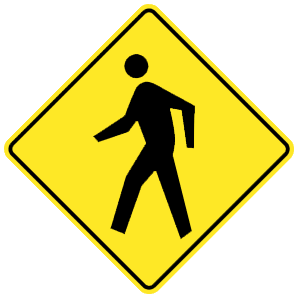
This road sign means:
School crossing.
Pedestrian crossing.
Jogging trail.
Busy sidewalk.
Q.48.
You are driving at night and another vehicle is approaching from the opposite direction. Your headlights:
Should be on their high beam setting.
Should be on their low beam setting.
Should be off. Use your parking lights.
May be on either their high or low beam setting.
Q.49.
You are driving up a hill and are approaching a heavy truck from the rear. You should know that:
The truck may be traveling at a speed slower than the posted speed limit.
You may not be able to safely pass the truck.
You may not be able to legally pass the truck.
All of the above.
Q.50.
Large vehicles have blind spots that can extend up tofeet directly behind the vehicle.
TRUE
FALSE
Support mcqgeeks.com by disabling your adblocker.
×
Please disable the adBlock and continue.
Thank you.
Reload page