MCQGeeks
CBSE
JEE
NTSE
NEET
English
UK Quiz
Quiz
Driving Test
Practice
Games
Driving Test
Nevada
Nevada Car Driving Permit Test-8
Answers
Q.1.
At night, it is hardest to see:
Road signs.
Pedestrians.
Other motorists.
Street lights.
Q.2.
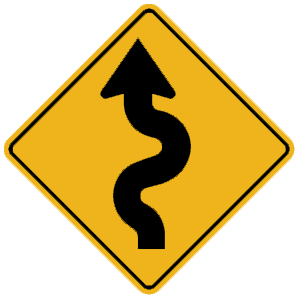
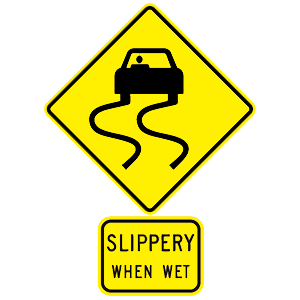
This sign tells you that:
No turns are allowed on this road.
The road narrows ahead.
There are a series of curves ahead.
The road may be slippery when wet.
Q.3.
To be safe when crossing a railroad, you should:
Look both ways, but only when the red light is flashing.
Listen, look both ways, and then proceed if it is safe to do so.
Cross especially quickly when a train is approaching.
Quickly pass under any lowering gates.
Q.4.
If you’re going to turn left onto a one-way street, you should complete the turn into:
The right lane.
The lane closest to your previous lane.
Either lane.
Neither lane.
Q.5.
When driving on an open highway, you should signal to turn ____ before beginning a turn.
20 feet
50 feet
100 feet
300 feet
Q.6.
The presence of double solid yellow lines means you may pass another vehicle from either direction.
TRUE
FALSE
Q.7.
You notice that the driver in the vehicle ahead of you is driving with one hand and talking to a passenger. You should:
Give the vehicle extra space.
Know that the driver in the vehicle ahead is reducing their safety margin by being an inattentive driver.
Avoid following the driver's example.
All of the above.
Q.8.
A bicyclist who doesn’t obey traffic laws:
Is in the right because bicyclists don’t have to obey traffic laws.
Can be ticketed.
Will always receive a warning from law enforcement.
Will have their bicycle impounded.
Q.9.
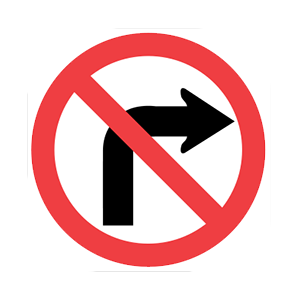
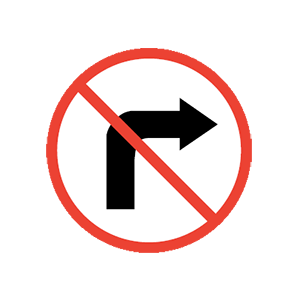
This sign means:
No right turn.
You must turn right.
Watch for traffic on your right.
Don’t park on the right side of the street.
Q.10.
Your ability to stop is affected by:
Signal lights.
Other cars on the road.
The time of day.
The condition of the road.
Q.11.
When you hear a fire engine siren behind you, you must:
Slow down until it passes you.
Drive with your flashers on.
Pull over to the side of the road and stop.
Speed up and take the nearest exit.
Q.12.
This sign is used to warn drivers:
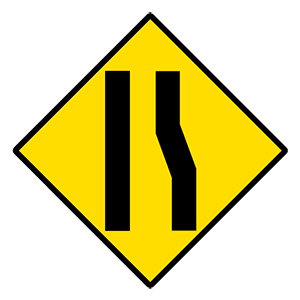
That the right lane ends and traffic should merge left.
That the road curves ahead.
About upcoming intersections.
About road construction.
Q.13.
When in a travel lane on the roadway:
You may stop to drop off passengers.
You may stop to look up an address.
You may make a U-turn or back up if you get on the wrong entrance ramp of the freeway.
Don’t stop for any reason. Keep moving until you can safely pull off the road.
Q.14.
The faster the speed of your vehicle, the longer it takes to stop when you must react to other drivers' unexpected movements.
TRUE
FALSE
Q.15.
Drive below the posted speed limit when:
Anything makes conditions less than perfect.
You see a police car.
Entering a highway where there are other cars.
You are on a four-lane road.
Q.16.
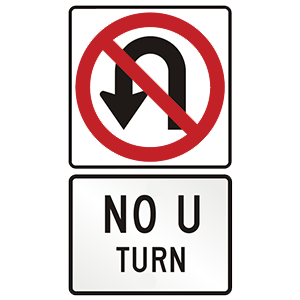
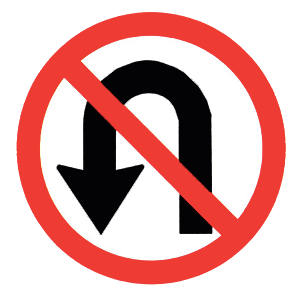
This sign means:
No right turn.
Keep right.
No U-turn.
Left lane must turn left.
Q.17.
If involved in an accident, a driver should:
Stop their vehicle at or near the scene.
Not stand or walk in traffic lanes.
Turn off the ignitions of wrecked vehicles.
All of the above.
Q.18.
It is important to slow down:
On narrow or winding roads.
At intersections or railroad crossings.
When the road is wet or slippery.
All of the above.
Q.19.
You are driving when it begins to rain. You should:
Drive faster than surrounding traffic.
Drive at the maximum posted speed limit.
Slow down.
Drive closely behind the vehicle in front of you.
Q.20.
If someone has consumed alcoholic drinks, what will help the person overcome the influence of those drinks?
Tomato juice and lime
Hot coffee
Fresh air
Only time
Q.21.
What do speed limit signs indicate?
Potential driving speeds for the area
The maximum or minimum speed that is legally allowed to be driven
The speed drivers should drive in heavy traffic
The speed drivers should drive under poor conditions
Q.22.
Passing is prohibited:
On hills and curves.
At intersections.
At railroad crossings.
All of the above.
Q.23.
This sign means:
U-turns are prohibited.
U-turns are permitted.
Winding road ahead.
Sharp left turn ahead.
Q.24.
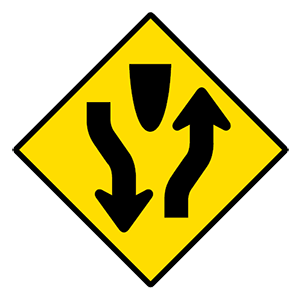
How should drivers use a shared center lane when traveling on a multilane roadway with traffic moving in opposite directions?
To pass other vehicles
To slow down or stop before turning left
As an additional travel lane when traffic is moving slowly
As a parking lane
Q.25.
This sign means:
No left turn.
No stopping.
No U-turn.
Detour ahead.
Q.26.
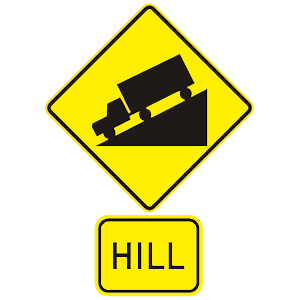
This sign means:
Trucks only.
Trucks are entering the highway.
Upcoming hill.
Trucks have the right-of-way.
Q.27.
A broken yellow line alongside a solid yellow line means:
Passing on the left is permitted from either direction.
Passing is permitted from the lane next to the broken line.
Passing is permitted from the lane next to the solid line.
Passing is not allowed from either direction.
Q.28.
When you approach a railroad crossing without flashing warning signals or crossing gates, you should:
Cross the tracks immediately and as quickly as possible.
Always stop before crossing the tracks.
Prepare to yield to any train at the crossing.
Speed up to beat any oncoming train.
Q.29.
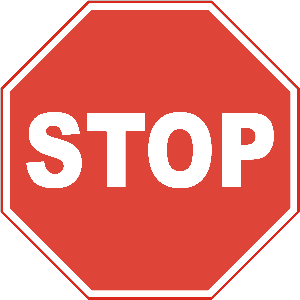
A stop sign is shaped like a(n):
Rectangle.
Square.
Circle.
Octagon.
Q.30.
What does this road sign mean?
Slow down and prepare to stop if cars are approaching you.
Come to a full stop and go when it is safe to do so.
Proceed carefully through the intersection, not always stopping.
Stop only for traffic on an intersecting road.
Q.31.
Drinking coffee after drinking alcohol:
Decreases blood alcohol concentration.
Cancels the effect of the alcohol.
Has no effect on blood alcohol concentration.
Increases blood alcohol concentration.
Q.32.
When parallel parking, you must park within ____ inches of the curb.
10
12
18
24
Q.33.
When meeting a car with blinding headlights, you should:
Use your bright lights until the other vehicle dims theirs.
Flash your lights on and off to warn the other driver.
Dim your lights and then speed up to pass quickly.
Look toward the right side of the road.
Q.34.
Drivers may text while driving:
Under no circumstances.
At any time in any manner.
If they are very skilled drivers.
If their eyes only leave the road for a couple of moments.
Q.35.
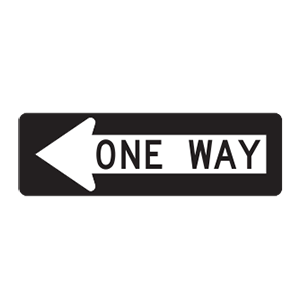
This sign means:
One-way traffic.
Two-way left turn.
Two-way traffic.
Minimum speed limit.
Q.36.
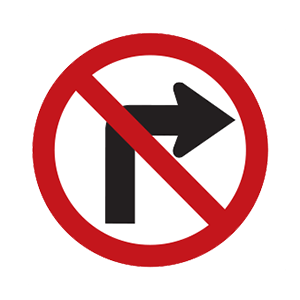
This road sign means:
Turn right after making a complete stop.
Right turns are not permitted.
Left turns are permitted.
None of the above.
Q.37.
Certain highway signs require drivers to obey an indicated instruction. Such signs are known as:
Regulatory signs.
Warning signs.
Information signs.
Guide signs.
Q.38.
This sign means:
Slippery when wet.
Watch for drunk drivers.
Dangerous curve ahead.
Bump in the road ahead.
Q.39.
When passing other vehicles:
Check your mirrors and blind spots.
Honk your horn at least three times.
Re-enter your lane within 10 feet of the passed vehicle.
There is no need to signal.
Q.40.
To check your blind spot when changing lanes to the left, you should glance:
Over your right shoulder.
At your side mirror.
Over your left shoulder.
At your rearview mirror.
Q.41.
When approaching a traffic signal displaying a flashing yellow arrow, drivers:
Should merge into a lane in the direction of the arrow.
Should come to a complete stop.
May turn left after yielding to oncoming traffic and pedestrians.
Have the right-of-way and may expect oncoming traffic to stop for them.
Q.42.
If you see this sign above your lane, you:
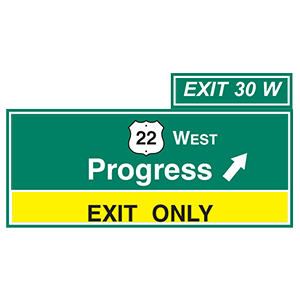
May not exit the freeway.
May either continue through the interchange or exit the freeway from your current lane.
May stay in your lane and continue through the interchange.
Must exit the freeway, if you stay in your current lane.
Q.43.
This road sign means:
Do not pass.
Do not enter.
No turn on red.
Keep right.
Q.44.
While driving, your wheels slip off the edge of the road. You should:
Jerk the steering wheel to force the vehicle back onto the pavement.
Speed up and steer back onto the pavement gradually.
Slam on your brakes and stop.
Slow down by gently using the brakes. Turn the steering wheel to return to the pavement at a safe speed.
Q.45.
You are driving when it starts to sleet or snow. You should:
Keep your windshield and mirrors clear.
Allow additional distance between your vehicle and the vehicles that you are following.
Approach all vehicles with caution.
All of the above.
Q.46.
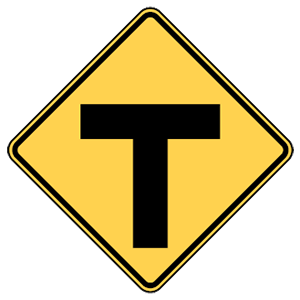
This sign shows one type of:
Right turn.
Intersection.
Lane change.
Road curve.
Q.47.
Hydroplaning is usually caused by:
Excessive stops.
Sudden stops.
Sudden turns.
Excessive speed.
Q.48.
If worried, nervous, angry, or crying, a driver:
Will drive no differently than they would if they were thinking more clearly.
Can drive faster because they are more in touch with their senses.
Should take the time to focus on driving before starting the engine.
Should call a friend to vent while driving.
Q.49.
This sign indicates that:
There is a steep hill ahead.
No trucks are allowed on an upcoming hill.
A logging road is ahead.
There are trucks on an upcoming hill.
Q.50.
Which of the following must you obey over the other three?
A steady red light
A police officer
A stop sign
A flashing red light
Support mcqgeeks.com by disabling your adblocker.
×
Please disable the adBlock and continue.
Thank you.
Reload page