MCQGeeks
CBSE
JEE
NTSE
NEET
English
UK Quiz
Quiz
Driving Test
Practice
Games
Driving Test
Nevada
Nevada Car Driving Permit Test-9
Answers
Q.1.
When riding in a vehicle, small children:
May be safely held by a strong adult.
Will be safe if they are standing on the floor in the back of the vehicle.
Will not be hurt in an accident because they are small.
Must never be allowed to ride while standing in the vehicle.
Q.2.
Which of the following statements is true?
Signal at least 100 feet before changing lanes to pass and ensure there is no oncoming traffic.
Use your mirrors and look over your left shoulder to check your blind spot when passing to the left.
When passing, wait until you can see both headlights of the passed car in your rearview mirror before returning to your original lane.
All of the above.
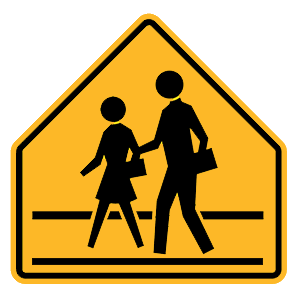
Q.3.
This sign means:
Pedestrians only.
Intersection ahead.
Hiking trails ahead.
School crossing ahead.
Q.4.
When driving in traffic, it is safest to:
Fluctuate your speed to keep alert.
Drive faster than the flow of traffic.
Drive slower than the flow of traffic.
Drive with the flow of traffic.
Q.5.
The most effective safety restraints in a traffic crash are:
Only a lap and shoulder belt.
Only an airbag.
Both a lap/shoulder belt and an airbag.
No safety restraints.
Q.6.
An octagonal sign is always a:
Speed limit sign.
Stop sign.
Hospital sign.
Railroad warning sign.
Q.7.
It is legal to go faster than the speed limit when passing another vehicle.
True
False
Q.8.
This sign is a:
Service sign.
Regulatory sign.
Warning sign.
Stop sign.
Q.9.
When you park uphill on a street with a curb:
Keep the front wheel straight and set the parking brake.
Turn the front wheels away from the curb.
Turn the front wheels toward the curb.
Turn the back wheels into the curb.
Q.10.
A diamond-shaped sign:
Warns of existing or possible hazards.
Alerts drivers to school zones.
Alerts drivers to public recreation areas.
Alerts drivers to upcoming food and gas locations.
Q.11.
A railroad crossbuck sign should be treated the same as a yield sign.
True
False
Q.12.
When driving at night, using only your parking lights is unlawful.
True
False
Q.13.
Lanes of traffic moving in opposite directions are divided by ____ lines.
White
Red
Black
Yellow
Q.14.
This sign is a warning that you are approaching:
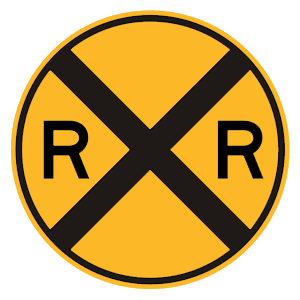
An intersection.
A crosswalk.
A railroad crossing.
A blasting zone.
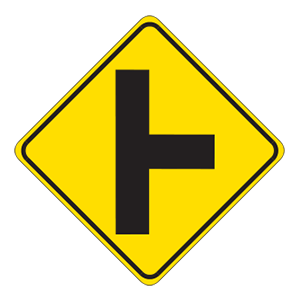
Q.15.
This sign means:
Side road.
Low clearance.
Merging traffic.
Prepare to stop.
Q.16.
Which of the following about winter driving is not true?
Winter is the most difficult driving season.
Checking your vehicle's antifreeze and windshield washer fluid levels is especially important during the winter.
Using cruise control in winter weather is a safe thing to do.
It is best to use snow tires on your vehicle.
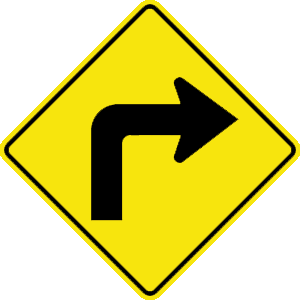
Q.17.
This road sign means:
One-way road.
No right turn.
Exit.
Sharp right turn in the road ahead.
Q.18.
Another driver is trying to pass your car. You should:
Pull off the road.
Signal to the other driver when it is safe for them to pass.
Check for oncoming traffic and adjust your speed to allow safe passing.
Speed up.
Q.19.
What is the first thing you should adjust, if needed, when you get into a car to drive?
Your seat belt
The steering wheel
Your rearview mirror
Your seat
Q.20.
Two solid white lines painted across a traffic lane show the boundaries of a crosswalk. As a driver, you should know that:
Motor vehicles have the right-of-way over pedestrians in crosswalks.
When pedestrians are in crosswalks, they should be given the right-of-way.
No one has the right-of-way in a crosswalk.
Pedestrians are responsible to stay out of the way of all traffic.
Q.21.
You may not park:
On a hill.
In a parking lot.
On a crosswalk or in a marked bicycle lane.
Within 12 inches of the right side of the road.
Q.22.
While backing, you should:
Rely only on your mirrors.
Flash your lights.
Open your door to see if it is safe to proceed.
Turn your head and look through the rear window.
Q.23.
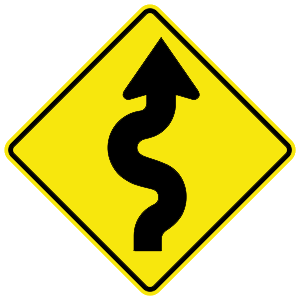
This road sign means:
Sharp turn to the right.
Double curve.
Winding road.
Pavement ends.
Q.24.
At a school crossing sign, you should:
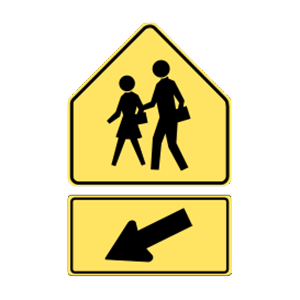
Always stop, whether there’s a stop sign or not.
Watch for children and be ready to stop.
Always sound your horn when you see children.
Be ready to help children crossing the street.
Q.25.
When should drivers use their parking brake?
Every time they park
Only when parking on an incline
Only when parked in a driveway
Never
Q.26.
You are approaching a railroad crossing and you do not see or hear a train. You must stop:
If a stop sign is posted.
If a crossing gate is lowered.
If the crossing lights are flashing.
All of the above.
Q.27.
Your brake lights tell other drivers that you:
Are making a turn.
Have your emergency brake on.
Are changing lanes.
Are slowing down or stopping.
Q.28.
When driving on major highways:
Stay alert.
Keep your eyes moving.
Be ready to react to road hazards.
All of the above.
Q.29.
If you are driving on a one-way street and an emergency vehicle using its flashing lights approaches your vehicle, you must:
Drive with your flashers turned on.
Drive toward the nearest roadside and stop.
Speed up and take the nearest exit.
Slow down until the vehicle passes you.
Q.30.
Which of the following statements is true?
It is okay for drivers of other vehicles to follow motorcycles closely.
A motorcycle with two people on it is more balanced than a motorcycle with just one rider.
The driver of a passenger vehicle must change lanes completely when passing a motorcycle.
Drivers of other vehicles can expect a motorcycle's brake lights to turn on when the motorcyclist slows down.
Q.31.
Alcohol causes:
Loss of concentration.
Poor coordination.
Slower judgment.
All of the above.
Q.32.
Regulatory signs are usually ____ and should always be obeyed.
White
Blue
Green
Orange
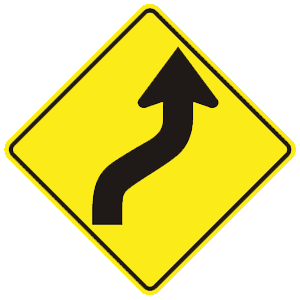
Q.33.
This sign means:
The highway ahead curves only to the right.
The highway ahead turns sharply to the right.
The highway ahead curves to the right and then to the left.
The highway ahead curves to the left and then to the right.
Q.34.
The amount of space you need to cross traffic depends on the:
Road conditions, weather conditions, and oncoming traffic.
Presence of a stop sign.
Use of your turn signals.
Cars behind you.
Q.35.
An inattentive driver is a driver who:
Stares at objects off the roadway or daydreams while driving.
Maintains eye contact during a conversation with a passenger while driving.
Only watches the vehicle ahead of their vehicle.
All of the above.
Q.36.
Before turning, you should:
Use your signal.
Turn the wheel.
Increase your speed.
Change lanes.
Q.37.
When the driver behind you wants to pass, you should:
Speed up.
Go the same speed.
Slow down to allow room in front of your vehicle for the other driver to complete the pass easily.
Change lanes.
Q.38.
A red traffic signal light means that you must:
Stop at the stop line.
Stop before entering any crosswalk.
Stop before entering the intersection.
All of the above.
Q.39.
Vehicle stopping distances never depend on:
Your own reaction time.
The time of day.
The condition of your vehicle's brakes.
The condition and type of your vehicle's tires.
Q.40.
Which of the following statements is true?
A sudden change in weather calls for a change in driving.
You should slow down when driving in rain and fog.
Be particularly aware of vehicles coming up behind you in inclement weather.
All of the above.
Q.41.
You must yield for emergency vehicles:
Under no circumstances.
When you see a flashing red or blue light or hear a siren.
Only when other vehicles yield.
None of the above.
Q.42.
You are driving on a divided multilane highway and see or hear the signal of an approaching emergency vehicle. You should:
Disregard the signal if there are other lanes available for the emergency vehicle.
Stop as quickly as you can.
Slow down, move your vehicle to provide a clear path for the emergency vehicle, and stop.
Increase your speed to get out of the way of the emergency vehicle.
Q.43.
To drive safely at night, you should:
Increase your following distance.
Not drive if you are tired.
Make sure your headlights are working properly.
All of the above.
Q.44.
When approaching a steady green traffic light, drivers should:
Continue driving, unless there are vehicles or pedestrians already in the intersection.
Stop if a police officer is nearby.
Treat the intersection like a four-way stop.
Come to a complete stop before proceeding.
Q.45.
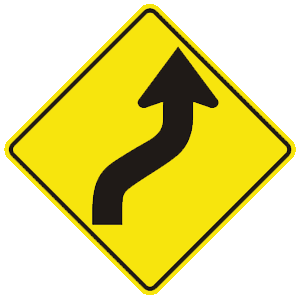
This road sign means:
Road construction ahead.
The road ahead curves left, then right.
The road ahead curves right, then left.
Steep grade ahead.
Q.46.
Traffic signs and pavement markings:
Must always be obeyed.
Are merely suggestions.
Must be followed only when there is other traffic.
Must be followed only when a police officer is present.
Q.47.
When is it illegal to drive below the speed limit?
When driving slowly disrupts the normal flow of traffic
When in heavy traffic in a construction zone
Only when driving in rural areas.
When driving under adverse weather conditions
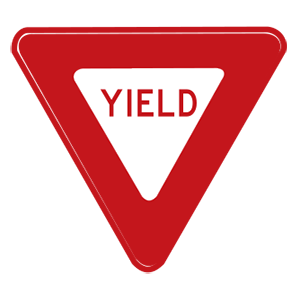
Q.48.
This sign means:
Yield.
Crossroad ahead.
Keep right.
Yield ahead.
Q.49.
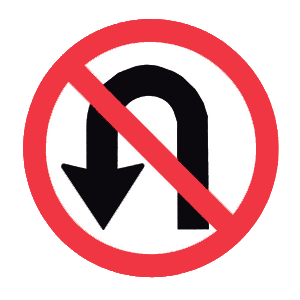
This sign means:
No U-turn.
No turning.
No left turn.
No right turn.
Q.50.
____ greatly increase stopping distances and severity of crashes.
High speeds
Slow speeds
Night drives
Uphill inclines
Support mcqgeeks.com by disabling your adblocker.
×
Please disable the adBlock and continue.
Thank you.
Reload page