MCQGeeks
CBSE
JEE
NTSE
NEET
English
UK Quiz
Quiz
Driving Test
Practice
Games
Driving Test
New Hampshire
New Hampshire Car Driving Permit Test-2
Answers
Q.1.
When approaching a flashing yellow light, drivers should:
Increase their speed.
Come to a complete stop.
Turn on their headlights.
Slow down and proceed with caution.
Q.2.
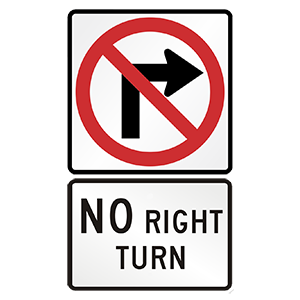
This sign means:
No right turns.
Right turns are permitted.
Stop before turning right.
Sharp curve ahead.
Q.3.
A red flashing traffic light has the same meaning as a:
Solid red light.
Stop sign.
Yield sign.
Caution sign.
Q.4.
A traffic light displaying a green arrow and a red light means that:
You may only drive straight ahead.
You may drive only in the direction of the green arrow.
You must wait for a solid green light to proceed in any direction.
Vehicles moving in any direction must stop.
Q.5.
Which of the following must you obey over the other three?
A steady red light
A police officer
A stop sign
A flashing red light
Q.6.
A diamond-shaped sign is a:
Road hazard sign.
Interstate route sign.
School crossing sign.
Speed limit sign.
Q.7.
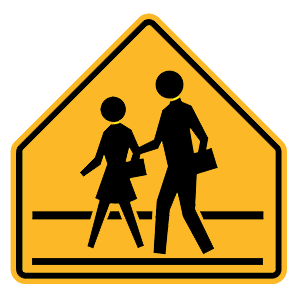
This sign means:
Pedestrians only.
Intersection ahead.
Hiking trails ahead.
School crossing ahead.
Q.8.
The effect that lack of sleep has on your safe driving ability is the same as:
The effect that alcohol has.
The effect that amphetamines have.
The effect that anger has.
The effect that driving with teenagers has.
Q.9.
How can you lower the risk of hydroplaning?
Do not speed when the roads are wet.
Use tires with proper air pressure.
Replace tires with bad tread.
All of the above.
Q.10.
You notice that the driver in the vehicle ahead of you is driving with one hand and talking to a passenger. You should:
Give the vehicle extra space.
Know that the driver in the vehicle ahead is reducing their safety margin by being an inattentive driver.
Avoid following the driver's example.
All of the above.
Q.11.
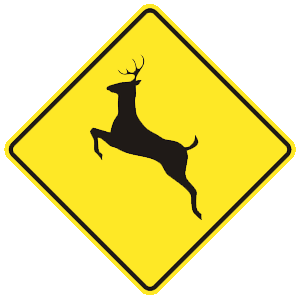
This road sign means:
Hunting area.
State park.
Deer crossing.
Wildlife preserve.
Q.12.
When exiting a highway, you should slow down:
On the main road, just before the exit lane.
Once you see a toll booth.
Once you have moved into the exit lane.
When you first see the exit sign.
Q.13.
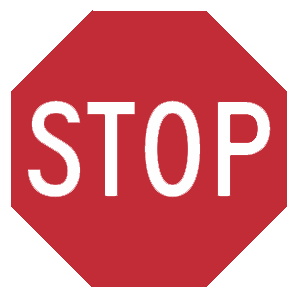
When you see this sign, you must:
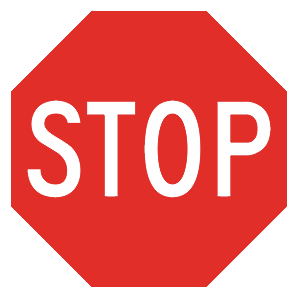
Stop completely and check for pedestrians and cross traffic.
Slow down without coming to a complete stop.
Stop completely and wait for a green light.
Slow down and check for traffic.
Q.14.
A solid yellow line on your side of the centerline means:
Slow down.
Pass with caution.
Do not pass.
Keep right on hills.
Q.15.
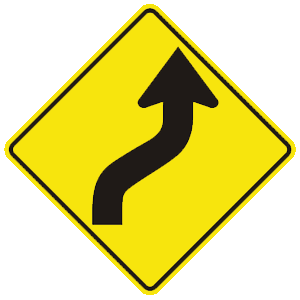
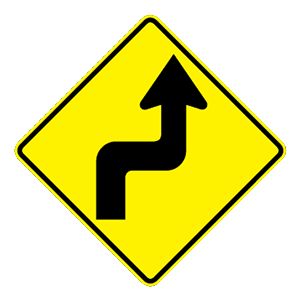
This road sign means:
Road construction ahead.
The road ahead curves left, then right.
The road ahead curves right, then left.
Steep grade ahead.
Q.16.
When approaching a school bus that is stopped on the opposite side of a divided highway, drivers:
May continue driving.
Must stop until the school bus begins moving.
Must stop until the stop arm is lifted.
Must stop and wait for the flashing lights to stop.
Q.17.
Passing is not allowed within ____ of a railroad crossing.
500 feet
100 feet
200 feet
300 feet
Q.18.
You experience an incident at work that has left you feeling angry. When you get to your car, you should:
Play the radio loudly so you won’t think about it.
Drive fast on the interstate to let off steam.
Take a few minutes to cool off before you begin your drive home.
Stop at your favorite bar and have a few drinks before driving home.
Q.19.
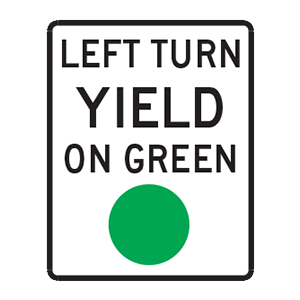
This sign means:
Left turn yield on green.
One-way.
Cattle crossing.
Two-way left turn.
Q.20.
You may cross solid yellow lines:
To pass traffic moving in the same direction.
During daylight hours only.
At any time.
When making turns.
Q.21.
An "End school zone" sign indicates:
That the speed limit is 20 mph.
The beginning of a reduced speed zone.
The increased possibility of encountering pedestrians.
The end of a reduced speed zone.
Q.22.
A steady green light at an intersection means that you:
Must slow down and prepare to stop.
Must stop and check for oncoming traffic before proceeding.
May drive through the intersection if the road is clear.
May not turn right.
Q.23.
At a light rail intersection, always:
Look both ways before crossing tracks.
Pay attention and obey all traffic signals.
Share the road with pedestrians and bicyclists.
All of these.
Q.24.
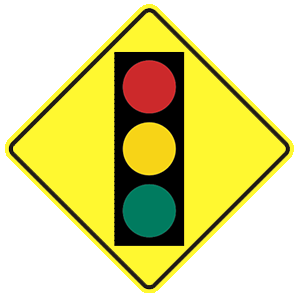
This sign means:
Emergency vehicles ahead.
Uncontrolled intersection ahead.
Four-way stop ahead.
Traffic signal ahead.
Q.25.
What is the first thing you should adjust, if needed, when you get into a car to drive?
Your seat belt
The steering wheel
Your rearview mirror
Your seat
Q.26.
Highway markings:
Are usually not important.
Are only found in construction zones.
Provide information for drivers.
Are usually red and blue in color.
Q.27.
When you see other drivers around you acting or reacting in anger:
Don’t make eye contact.
Don't react with hand gestures.
Distance yourself from the situation.
All of these.
Q.28.
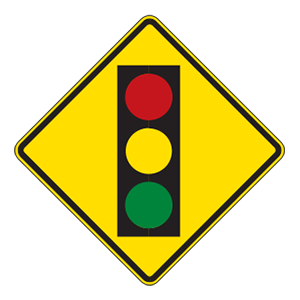
This sign means:
Traffic signal.
Fire station.
T intersection.
Left turn signal.
Q.29.
At night, it is hardest to see:
Road signs.
Pedestrians.
Other motorists.
Street lights.
Q.30.
When parking your vehicle downhill on a two-way street:
Turn your wheels to the right.
Turn your wheels to the left.
Keep your wheels pointed straight ahead.
Leave your transmission in neutral.
Q.31.
The act of turning your head and checking your blind spot before changing lanes, driving away from a curb, or merging your vehicle into traffic is:
A bad driving habit.
A good driving habit.
Unnecessary.
Not necessary if you use the rearview mirror.
Q.32.
Under normal weather and traffic conditions, keep a minimum following distance of:
One second.
Two seconds.
Three seconds.
Four seconds.
Q.33.
This road sign means:
Slow down or stop.
Stop, if necessary.
You must come to a complete stop.
Drive with caution and be ready to stop.
Q.34.
A person's ability to drive can be impaired by:
Alcohol.
Any medication.
A lack of sleep.
All of the above.
Q.35.
This road sign means:
The road ahead turns sharply right, then left.
The road ahead turns sharply left, then right.
The road ahead curves to the left.
Construction ahead.
Q.36.
Many crashes are caused by:
Drivers traveling too fast for conditions.
Drivers consistently checking their mirrors and blind spots.
Drivers yielding the right-of-way.
Drivers maintaining a four-second following distance.
Q.37.
When the driver behind you wants to pass, you should:
Speed up.
Go the same speed.
Slow down to allow room in front of your vehicle for the other driver to complete the pass easily.
Change lanes.
Q.38.
Which is the most common cause of traffic crashes?
New drivers
Human error
Bad weather
Bad roads
Q.39.
What should you do if your vehicle’s right wheels leave the pavement?
Stop quickly.
Immediately pull all the way off of the road and get back on when it is safe.
Accelerate and steer back on the road quickly.
Take your foot off the accelerator, slow down, then ease back onto the road when it is safe to do so.
Q.40.
You are involved in an accident. You should:
Stop immediately.
Help the injured.
Call the police.
All of the above.
Support mcqgeeks.com by disabling your adblocker.
×
Please disable the adBlock and continue.
Thank you.
Reload page