Q.1.
If wearing footwear with laces, the laces:
Q.2.
If a tire goes flat and you must brake, you should:
Q.3.
When carrying a passenger in a sidecar, you should:
Q.4.
To reduce your reaction time, you should:
Q.5.
When preparing to pass a vehicle on the left, it is important to ride on the left side of your lane because:
Q.6.
____ can remove alcohol and its effects from your body.
Q.7.
Which of the following is not considered protective clothing for a motorcyclist?
Q.8.
Before changing lanes, you should:
Q.9.
When riding at night, you should do all of the following, except:
Q.10.
What does this signal mean?
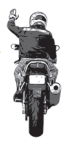
Q.11.
Compared to riding during the day, a motorcycle operator who is riding at night should do all of the following, except:
Q.12.
In New Hampshire, a person who is age 21 or older with a minimum blood alcohol concentration (BAC) of ______ is considered legally intoxicated.
Q.13.
Which of the following is not a benefit of riding in a close group?
Q.14.
A plastic, shatter-resistant face shield:
Q.15.
The best way to stop quickly is to:
Q.16.
The single most effective thing you can do to improve your chances of surviving an accident is:
Q.17.
When approaching railroad tracks that cross your lane at an angle, it is usually:
Q.18.
When riding in a group, the best way to keep ranks close while maintaining an adequate safety cushion is to ride:
Q.19.
If braking in a curve:
Q.20.
When should the front brake be used?
Q.21.
Each traffic lane gives the motorcyclist how many paths of travel?
Q.22.
Which of the following surfaces provides the best traction for a motorcycle?
Q.23.
For the best protection, jackets and pants:
Q.24.
Moving into another lane while taking a curve is often the result of:
Q.25.
More than half of all crashes: