MCQGeeks
CBSE
JEE
NTSE
NEET
English
UK Quiz
Quiz
Driving Test
Practice
Games
Driving Test
New Jersey
New Jersey Car Driving Permit Test-16
Answers
Q.1.
When you see other drivers around you acting or reacting in anger:
Don’t make eye contact.
Don't react with hand gestures.
Distance yourself from the situation.
All of these.
Q.2.
Traffic signals sometimes display arrows to control turns from specific lanes. A green arrow:
Is used only on one-way streets.
Has the same meaning as a circular green traffic light, but traffic must turn in the direction indicated by the arrow.
Means that you may proceed, but only if the green arrow is accompanied by a circular green light.
Points the way to an airport.
Q.3.
When dealing with pedestrians, a driver must:
Make sure the pedestrian is aware of their vehicle.
Always yield the right-of-way, even if the pedestrian is in the wrong.
Yield the right-of-way only when the pedestrian is legally entitled to it.
Slow down and sound their horn near a crosswalk.
Q.4.
Which of the following is true regarding seat belts and child restraints in vehicles?
You should never place an infant or small child in the front seat of a vehicle with airbags.
An airbag can be dangerous to an infant or small child, even in a low-speed collision.
You should always make sure all your passengers are using a seat belt or child restraint.
All of the above.
Q.5.
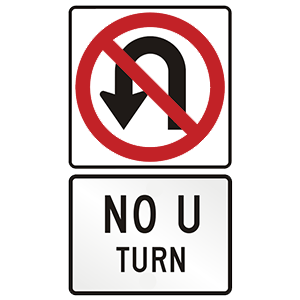
This sign means:
U-turns are prohibited.
U-turns are permitted.
Winding road ahead.
Sharp left turn ahead.
Q.6.
If you are driving behind a school bus and it shows a flashing red light signaling a stop, you must:
Stop at least 25 feet away.
Slow down to 10 mph.
Speed up and pass.
Stop directly behind the bus.
Q.7.
If you need to stop quickly and your vehicle is not equipped with an Anti-Lock Braking System (ABS), you should:
Hold down the brake pedal.
Firmly pump your brakes.
Lightly tap the brakes.
Release the brake pedal.
Q.8.
When you hear a fire engine siren behind you, you must:
Slow down until it passes you.
Drive with your flashers on.
Pull over to the side of the road and stop.
Speed up and take the nearest exit.
Q.9.
You are driving in the left lane and want to move into the right lane. You should:
Check your mirrors, signal, and look over your left shoulder for other vehicles before changing lanes.
Check your mirrors, signal, and look over your right shoulder for other vehicles before changing lanes.
Check your mirrors, signal, and look over both shoulders for other vehicles before changing lanes.
Check your mirrors, signal, and change lanes.
Q.10.
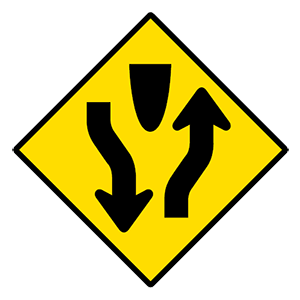
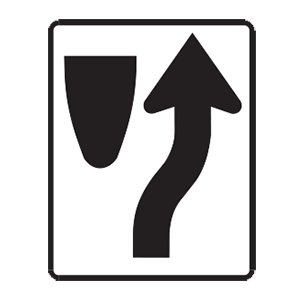
This sign means:
One-way traffic.
Divided highway ahead.
Two-way traffic.
Keep left.
Q.11.
Two solid white lines painted across a traffic lane show the boundaries of a crosswalk. As a driver, you should know that:
Motor vehicles have the right-of-way over pedestrians in crosswalks.
When pedestrians are in crosswalks, they should be given the right-of-way.
No one has the right-of-way in a crosswalk.
Pedestrians are responsible to stay out of the way of all traffic.
Q.12.
Double solid yellow lines painted down the middle of the road mean:
Railroad crossing ahead.
Pedestrian crossing ahead.
Passing is not permitted from either direction.
Passing is permitted from either direction.
Q.13.
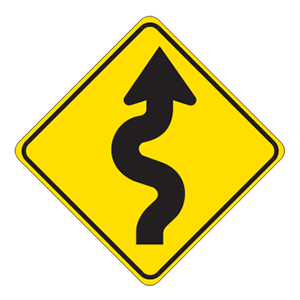
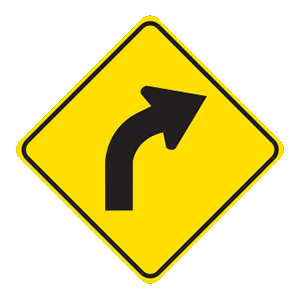
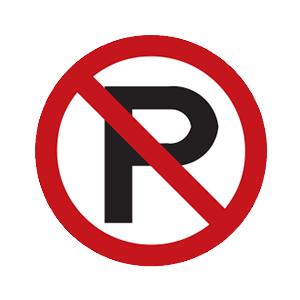
This sign means:
Winding road.
No parking.
Right lane closed.
Multiple turns.
Q.14.
When driving near heavy trucks, other drivers and highway users must make allowances for:
The increased stopping distance required by large vehicles.
The decreased stopping distance required by large vehicles.
The decreased noise of larger vehicles.
The increased speed of larger vehicles.
Q.15.
Regulatory signs are usually ____ and should always be obeyed.
White
Blue
Green
Orange
Q.16.
You are approaching an intersection when the traffic light changes from green to solid yellow. You should:
Consider it the same as a caution sign and continue through the intersection.
Stop immediately.
Stop before entering the intersection, unless you are too close to stop safely.
Speed up to get through the intersection before the red light appears.
Q.17.
You are driving on a busy street and your vehicle’s accelerator sticks open. You should:
Blow your horn.
Slam on your brakes.
Turn on your four-way flashers.
Turn off your ignition, taking care not to engage the steering wheel locking mechanism.
Q.18.
This road sign means:
Keep right.
Keep left.
Pass with caution.
No passing.
Q.19.
When driving in traffic, it is safest to:
Fluctuate your speed to keep alert.
Drive faster than the flow of traffic.
Drive slower than the flow of traffic.
Drive with the flow of traffic.
Q.20.
When stopped for a traffic violation or at an equipment check, the driver must produce:
Proof of insurance.
Their license.
Proof of registration.
All of the above.
Q.21.
The speed limit in school zones is:
25 mph.
35 mph.
45 mph.
50 mph.
Q.22.
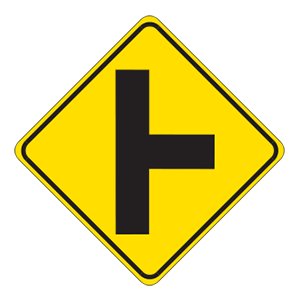
This sign means:
Side road.
Low clearance.
Merging traffic.
Prepare to stop.
Q.23.
This sign is used to warn drivers:
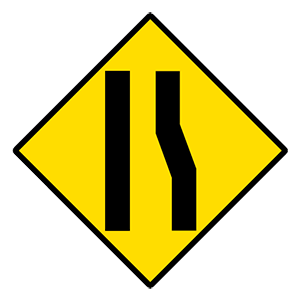
That the right lane ends and traffic should merge left.
That the road curves ahead.
About upcoming intersections.
About road construction.
Q.24.
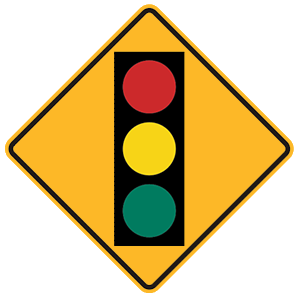
This sign means:
Continue at your current speed.
You must stop ahead.
Speeding is not allowed.
There is a traffic signal ahead.
Q.25.
Where is passing prohibited?
In a tunnel.
On a bridge.
In an underpass.
All of the above.
Q.26.
The best way to deal with tailgaters is to:
Speed up to increase the distance between you and the tailgater.
Slam on your brakes to get the other driver to back off.
Change lanes or gradually slow down to encourage them to pass.
Ignore them.
Q.27.
Which of the following statements about railroad crossings is true?
It is against the law to go around lowered gates at a crossing.
You must stop at a railroad crossing when directed to do so by a flagger.
Not all railroad crossings are equipped with flashing red signals and gates.
All of the above.
Q.28.
Signs that are colored orange are:
Work zone signs.
Regulatory signs.
School zone signs.
Guide signs.
Q.29.
The effect that alcohol has on your reflexes and judgment:
Is less pronounced when consuming beer instead of wine.
Is less pronounced when consuming wine instead of beer.
Is most pronounced when consuming hard ciders and mixed drinks.
Depends on the amount of alcohol in your bloodstream.
Q.30.
When you see this sign, it means:
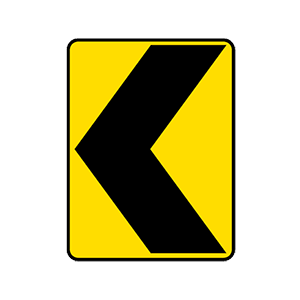
There is an object on the roadway.
Traffic is coming from the right.
The road is curving sharply to the left.
There is a merge point ahead.
Q.31.
A “No standing” sign at a certain location means:
You may never stop your vehicle there.
You may park there if the driver remains in the vehicle.
You may stop temporarily only to pickup or discharge passengers.
You may stop to load or unload merchandise.
Q.32.
You may honk your horn when you:
Have to stop quickly.
Are passing another car.
Have lost control of your car.
Are passing a bicyclist.
Q.33.
You are driving on a highway divided by two solid yellow lines. You may:
Cross these lines only to make a left turn into or from an alley, private road, or driveway.
Cross these lines to pass other vehicles, but only if there is no oncoming traffic.
Cross these lines under no circumstances.
Cross these lines only to make a U-turn.
Q.34.
You are coming to a railroad crossing where the crossing signals are flashing. You should:
Stop and look for a train.
Slow down and look for a train.
Look for a train, then speed up.
Do what the vehicle ahead of you does.
Q.35.
If you’re going to turn left onto a one-way street, you should complete the turn into:
The right lane.
The lane closest to your previous lane.
Either lane.
Neither lane.
Q.36.
This sign means:
Keep right.
Low shoulder.
No parking at any time.
Lane ends.
Q.37.
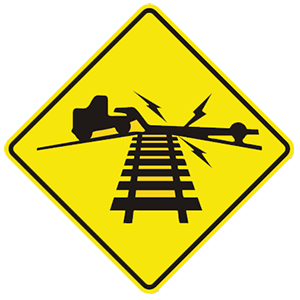
This road sign means:
No passing zone.
Winding road.
Pedestrian crossing.
Low ground railroad crossing.
Q.38.
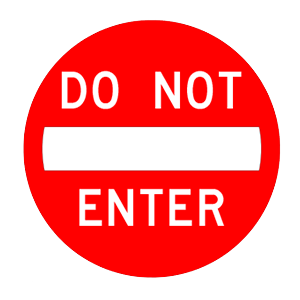
This sign means:
Heavy traffic ahead.
Do not enter.
Railroad crossing.
Yield.
Q.39.
Don’t follow other cars too closely because:
You may not see the road between the cars.
You may not have time to stop if the vehicle in front of you slows or stops suddenly.
You may not see the vehicle's turn signals.
You may not see the other vehicle’s brake lights.
Q.40.
Slower-moving traffic on a multilane highway should:
Drive in any lane.
Drive in the left lane.
Drive in the lane with the least amount of traffic.
Drive in the right lane.
Q.41.
If you are driving in another driver's blind spot, you should:
Move forward or drop back so the other driver can see you.
Keep a steady pace.
Stay in the driver's blind spot.
Honk to let them know you are there.
Q.42.
The best way to avoid hydroplaning is to:
Keep your tires properly maintained.
Slow down when roads are wet or slushy.
Watch out for standing water or puddles.
All of the above.
Q.43.
This sign means:
Curve ahead.
Roadwork ahead.
Merging traffic.
No left turn.
Q.44.
You cannot pass safely on a two-way, two-lane street unless:
You are able to clearly see the road ahead.
You can return to your lane before meeting oncoming traffic.
Your vehicle is capable of the speed necessary to pass.
All of the above.
Q.45.
Who must yield when a driver is turning and a pedestrian is crossing without a traffic light?
Whoever started moving last
The driver
Whoever is slower
The pedestrian
Q.46.
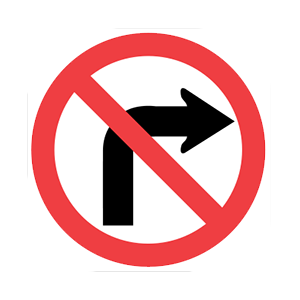
This sign means:
No right turn.
You must turn right.
Watch for traffic on your right.
Don’t park on the right side of the street.
Q.47.
When driving to an unfamiliar area, you:
Should depend on road signs to find your way.
Should plan your trip in advance.
Only have to know generally where your destination is.
Should always choose the most direct route.
Q.48.
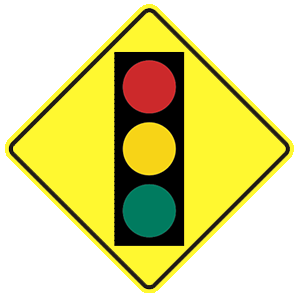
This road sign means:
Roundabout ahead.
No passing zone.
Left turn yield on green.
Traffic signal ahead.
Q.49.
You come to an intersection with a flashing red light. You must:
Slow down and drive carefully through the intersection.
Turn either right or left, since the road is blocked ahead.
Stop at the intersection and wait for a flashing green light.
Stop at the intersection, then proceed as traffic allows.
Q.50.
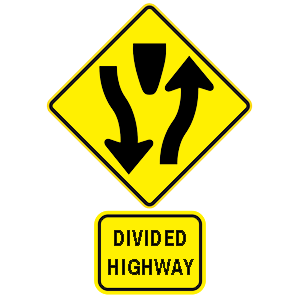
This sign means:
No parking.
Divided highway ahead.
Left turn signal.
Yield.
Support mcqgeeks.com by disabling your adblocker.
×
Please disable the adBlock and continue.
Thank you.
Reload page