MCQGeeks
CBSE
JEE
NTSE
NEET
English
UK Quiz
Quiz
Driving Test
Practice
Games
Driving Test
New Jersey
New Jersey Car Driving Permit Test-5
Answers
Q.1.
Unless otherwise posted, the speed limit in suburban business districts is:
70 mph.
55 mph.
40 mph.
35 mph.
Q.2.
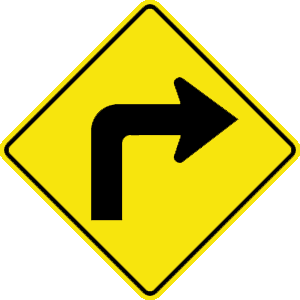
This road sign means:
One-way road.
No right turn.
Exit.
Sharp right turn in the road ahead.
Q.3.
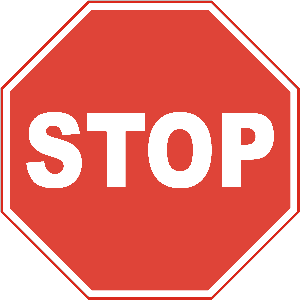
When you see this sign, you must:
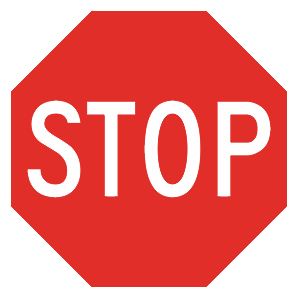
Stop completely and check for pedestrians and cross traffic.
Slow down without coming to a complete stop.
Stop completely and wait for a green light.
Slow down and check for traffic.
Q.4.
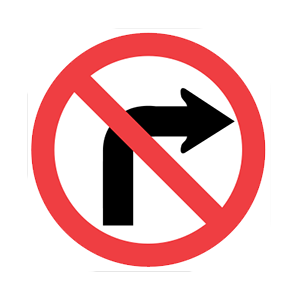
This sign means:
No right turn.
You must turn right.
Watch for traffic on your right.
Don’t park on the right side of the street.
Q.5.
If someone is driving aggressively behind you, you should:
Try to get out of the aggressive driver’s way.
Stare at the driver as he or she is passing you.
Speed up as he or she is passing you.
Block the passing lane.
Q.6.
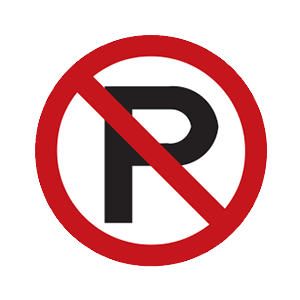
This sign means:
No parking.
Divided highway ahead.
Left turn signal.
Yield.
Q.7.
Lanes of traffic moving in opposite directions are divided by ____ lines.
White
Red
Black
Yellow
Q.8.
If your windshield wipers suddenly fail during rain or snow, you should:
Slow down.
Roll down the driver's side window and put your head out so you can see ahead.
Brake and pull off the road.
All of the above.
Q.9.
What does this road sign mean?
Slow down and prepare to stop if cars are approaching you.
Come to a full stop and go when it is safe to do so.
Proceed carefully through the intersection, not always stopping.
Stop only for traffic on an intersecting road.
Q.10.
On slippery roads, you should:
Slow down.
Drive more quickly.
Drive the speed limit, with caution.
Not drive more quickly than 20 mph.
Q.11.
Which of the following are used on some highways to direct drivers into the proper lanes for turning?
Flashing red lights
Flashing yellow lights
White lines on the side of the road
White arrows in the middle of the lanes
Q.12.
You can practice driving with a valid learner permit:
Between 12:01 a.m. and 5 a.m.
Between 9 a.m. and 9 p.m.
Between 5 a.m. and 11 p.m.
Anytime.
Q.13.
Passing is prohibited:
At intersections.
On hills and curves.
At railroad crossings.
All of the above.
Q.14.
A yellow light that flashes on and off means:
Stop and look for other vehicles, then go if there is no traffic.
Stop and wait for a green light.
Speed up to clear the intersection quickly.
Slow down and proceed with caution.
Q.15.
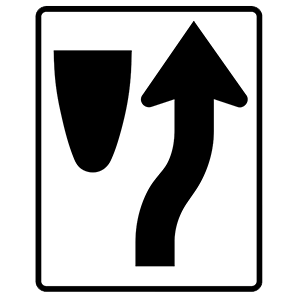
This sign means:
Divided highway ends.
One-way traffic ahead.
Two-way traffic ahead.
Keep to the right.
Q.16.
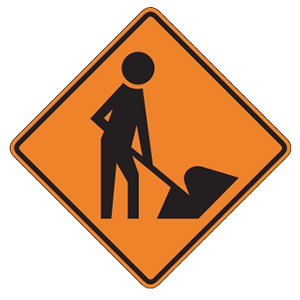
This sign means that:
A community service group is picking up trash along the highway ahead.
Workers are on or very close to the road in the work zone ahead.
Children are at play ahead.
There is a pedestrian crosswalk ahead.
Q.17.
Which of the following commonly causes traffic accidents?
Inattentive driving
Excessive speed under the driving conditions
Following other vehicles too closely
All of the above
Q.18.
You are driving on a busy street and your vehicle’s accelerator sticks open. You should:
Blow your horn.
Slam on your brakes.
Turn on your four-way flashers.
Turn off your ignition, taking care not to engage the steering wheel locking mechanism.
Q.19.
A “No standing” sign at a certain location means:
You may never stop your vehicle there.
You may park there if the driver remains in the vehicle.
You may stop temporarily only to pickup or discharge passengers.
You may stop to load or unload merchandise.
Q.20.
A good defensive driver:
Drives slowly at all times.
Looks out for the actions of other drivers.
Travels at a constant speed.
Only drives in familiar areas.
Q.21.
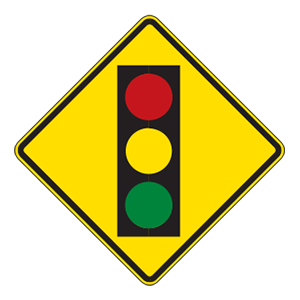
This sign means:
Traffic signal.
Fire station.
T intersection.
Left turn signal.
Q.22.
Drivers who eat and drink while driving:
Make no driving errors.
Have trouble driving slowly.
Are better drivers because they are not hungry.
Have trouble controlling their vehicles.
Q.23.
Highway markings:
Are usually not important.
Are only found in construction zones.
Provide information for drivers.
Are usually red and blue in color.
Q.24.
You may drive around or under a gate that is being lowered or raised at a railroad crossing:
As long as an approaching train is not too close.
If your vehicle can do so without damaging the gate.
If you first look carefully in both directions.
Under no circumstances.
Q.25.
Which of the following must you obey over the other three?
A steady red light
A police officer
A stop sign
A flashing red light
Q.26.
If you experience a tire blowout:
Take your foot of the gas.
Do not immediately use your brakes.
Gradually slow down and pull off the side of the road.
All of the above.
Q.27.
If an oncoming driver is heading toward you in your lane, you should:
Blow your horn, steer right, and accelerate.
Blow your horn, steer left, and brake.
Blow your horn, steer right, and brake.
Stay in the center of your lane, blow your horn, and brake.
Q.28.
Drivers who have consumed alcohol before getting behind the wheel:
Are always aware of the risks they are taking.
Do not have sufficient control over their bodies and minds or the vehicles being driven.
Are better drivers because they are more careful than sober drivers.
Have quicker reaction times.
Q.29.
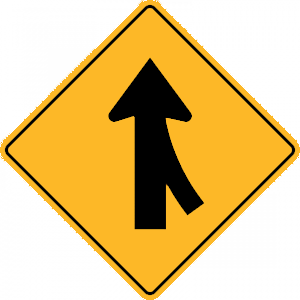
When you see this sign, it means:
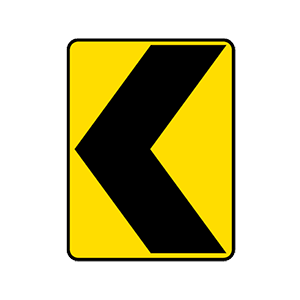
There is an object on the roadway.
Traffic is coming from the right.
The road is curving sharply to the left.
There is a merge point ahead.
Q.30.
Unless otherwise posted, the speed limit on rural roadways is:
25 mph.
35 mph.
50 mph.
65 mph.
Q.31.
Always signal when:
Changing lanes.
Pulling into or out of a parking space.
Pulling into traffic from a parking area or alley.
All of the above.
Q.32.
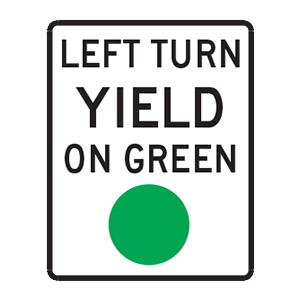
This sign means:
Left turn yield on green.
One-way.
Cattle crossing.
Two-way left turn.
Q.33.
A driver entering interstate traffic from an entrance or acceleration ramp:
Should yield to drivers already on the interstate.
Has the right-of-way.
May force their way into traffic.
Can assume that other drivers will change lanes to make room.
Q.34.
If another driver cuts you off in traffic, you should:
Pull next to the driver and yell at them.
Let it go.
Flash your high beams at the driver.
Get back at the other driver by cutting them off.
Q.35.
A person walking with a white cane or guide dog is likely to be:
A deaf person.
A person involved with a traffic study.
A blind person.
None of the above.
Q.36.
While driving, your wheels slip off the edge of the road. You should:
Jerk the steering wheel to force the vehicle back onto the pavement.
Speed up and steer back onto the pavement gradually.
Slam on your brakes and stop.
Slow down by gently using the brakes. Turn the steering wheel to return to the pavement at a safe speed.
Q.37.
The “No zone” is:
A term used to describe blind spots around a truck or bus.
A special speed zone.
A roadway with restrictions on vehicle stereo volume.
The television show that replaced The Twilight Zone.
Q.38.
When a vehicle with an Anti-Lock Braking System starts to lose traction on a slippery road, drivers should:
Pump the brakes.
Press and hold the brake pedal.
Press and hold the gas pedal.
Lightly tap the brakes.
Q.39.
You are driving on the roadway and hear a siren behind you. You should:
Stop where you are.
Pull over to the right and stop.
Speed up to get out of the way.
Slow down.
Q.40.
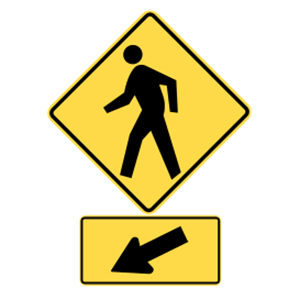
This sign means:
Pedestrians walking along the road ahead.
Pedestrian crossing ahead.
Pedestrians must not cross here.
Be alert for construction workers on the road.
Q.41.
You are driving on a divided multilane highway and see or hear the signal of an approaching emergency vehicle. You should:
Disregard the signal if there are other lanes available for the emergency vehicle.
Stop as quickly as you can.
Slow down, move your vehicle to provide a clear path for the emergency vehicle, and stop.
Increase your speed to get out of the way of the emergency vehicle.
Q.42.
To drive safely at night, you should:
Increase your following distance.
Not drive if you are tired.
Make sure your headlights are working properly.
All of the above.
Q.43.
You are making a left turn from a two-way street onto a one-way street. When you have completed the turn, your car should be:
In the right lane of the street.
In the center of the street.
In the left lane of the street.
In the lane with the least traffic.
Q.44.
This sign means:
One-way traffic.
Intersection ahead.
Merging traffic from the right.
Highway curves ahead.
Q.45.
A slow-moving vehicle emblem is:
A rectangular red sign.
A circular green sign.
A diamond-shaped yellow sign.
A triangular orange sign.
Q.46.
What are the colors of signs that tell you the distance to the next exit on a highway?
Yellow with black letters
Black with white letters
Red with white letters
Green with white letters
Q.47.
What might happen when alcohol is combined with another drug?
The effects of the alcohol and the drug may both be increased.
Nothing will happen.
The effects of the alcohol and the drug may both be reduced.
The effects of only the alcohol may be reduced.
Q.48.
When approaching a traffic signal displaying a steady green arrow, drivers:
Should merge into a lane in the direction of the arrow.
Should slow to a stop, if it is safe to do so.
May turn in the direction of the arrow after yielding to traffic and pedestrians already in the intersection.
May drive straight through the intersection.
Q.49.
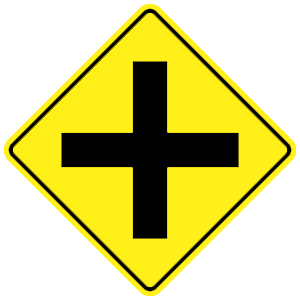
This road sign means:
Increase your speed.
Railroad crossing ahead.
Intersection ahead.
Four-way stop ahead.
Q.50.
Driving while being distracted by any activity:
Is never dangerous.
Usually causes the driver to react more slowly to hazards.
Usually causes the driver to drive faster.
Is only dangerous for young drivers.
Support mcqgeeks.com by disabling your adblocker.
×
Please disable the adBlock and continue.
Thank you.
Reload page