MCQGeeks
CBSE
JEE
NTSE
NEET
English
UK Quiz
Quiz
Driving Test
Practice
Games
Driving Test
New Jersey
New Jersey Motorcycle Driving Permit Test-15
Answers
Q.1.
Where is the rear brake pedal usually located?
On the left handgrip
On the right handgrip
Near the left footrest
Near the right footrest
Q.2.
When looking through a turn, you should:
Turn both your head and your shoulders to get a better look.
Turn just your head, not your shoulders.
Use only your mirrors.
Only move your eyes, not your head.
Q.3.
If braking in a curve:
Only use the front brake.
It will be the same as braking on a straightaway.
You will have more traction as you lean into the curve.
You may have less traction as you lean into the curve.
Q.4.
To swerve correctly, you should:
Shift your weight quickly.
Turn the handlebars quickly.
Press the handle grip in the direction you plan to swerve.
Press the handle grip in the direction opposite of where you plan to swerve.
Q.5.
When crossing railroad tracks that are parallel to the road, you should:
Cross the tracks at a 90-degree angle.
Avoid crossing the tracks for any reason.
Try to cross the tracks at a 45-degree angle.
Slowly inch across the tracks.
Q.6.
To be effective, an eye or face shield must:
Fasten securely.
Prevent air from passing through.
Not allow for eyeglasses to fit underneath.
Restrict your vision to the sides.
Q.7.
When planning to ride with a group of 12 riders, you should:
Invite more riders, since riding is more fun with more people.
Split into at least two groups to minimize the group size.
Try to race to your destination as long as everyone knows where to meet.
Disband the group and have everyone ride alone.
Q.8.
When packing a load on a motorcycle:
The heavier items should go toward the front.
The heavier items should go toward the rear.
Mounting loads behind the rear axle is recommended.
Lighter items should be stored in front of you.
Q.9.
In any crash, you have a better chance of avoiding serious injury if you do all of the following, except:
Wear an approved helmet.
Wear face or eye protection.
Wear protective clothing.
Have a windshield.
Q.10.
Which of the following will protect your eyes from the wind?
Goggles
Windshield
Sunglasses
Eyeglasses
Q.11.
Where is the horn button usually located?
By the left handgrip
By the right handgrip
By the left footrest
By the right footrest
Q.12.
To lessen your chances of being involved in a crash, you should:
Not use your turn signals when changing lanes.
Follow other vehicles closely.
Watch about five feet ahead of your motorcycle while riding.
Always be ready to use crash-avoidance techniques.
Q.13.
If you must ride over an obstacle, you should:
Decrease your speed as much as possible.
Lean the motorcycle to one side.
Speed up, if possible.
Stay on your seat and remove your feet from the footrests.
Q.14.
It is most important to flash your brake light when:
Switching into a neutral gear.
You will be slowing suddenly.
There is a stop sign ahead.
Your signals are not working.
Q.15.
Riding alongside a car:
Is encouraged.
Can place you in a blind spot.
Is not an issue unless the roadway is wet.
Can make driving easier for the other motorist.
Q.16.
If your front wheel skids as a result of braking, you should:
Keep the front brake engaged.
Release the front brake immediately and re-apply the brake smoothly.
Release the front brake and only use the rear brake.
Release both brakes and coast to a stop.
Q.17.
When riding under ideal conditions, you should maintain a minimum following distance of:
One second.
Two seconds.
Three seconds.
Four seconds.
Q.18.
Maximum straight-line braking is done by:
Using the front brake, then the rear brake.
Using the rear brake, then the front brake.
Using the front and rear brakes at the same time without locking either wheel.
Using the front and rear brakes at the same time while locking the rear wheel.
Q.19.
When riding, the best sitting position:
Requires your arms be used to hold you up.
Allows you to easily reach the controls.
Keeps your arms straight when reaching the handle grips.
Keeps your knees away from the gas tank.
Q.20.
How can you discourage another vehicle from sharing your lane?
Ride in the middle of your lane.
Ride in the left portion of your lane.
Ride in the right portion of your lane.
Swerve from side to side in your lane.
Q.21.
Use your mirrors when stopped at an intersection:
To see if vehicles parked on the sides of the street are entering traffic.
To look for vehicles changing lanes.
To watch for vehicles behind you that may not be slowing down.
To see if someone is planning to turn behind you.
Q.22.
What is the primary psychoactive component in marijuana?
THC
TMJ
MRT
AAP
Q.23.
It is best to not ride directly alongside another vehicle because:
You may be riding in its blind spot.
It is distracting to have a vehicle next to you.
Other drivers may want to use the lane.
It would be difficult to see what is happening behind you.
Q.24.
How is the accelerator controlled?
With the right hand
With the left hand
With the right foot
With the left foot
Q.25.
When choosing a helmet, you will get the most protection by using a helmet that:
Fits loosely.
Meets U.S. DOT standards.
Has survived a previous crash.
Provides hearing protection.
Q.26.
Which of the following is not a way to prevent a friend from driving while intoxicated?
Arrange a safe ride home for them.
Get them involved in activities to slow their drinking and keep them busy while they sober up.
Make them wait 15 minutes after their last drink before driving.
Get other friends involved in stopping your friend from driving.
Q.27.
Which of the following is not considered protective clothing for a motorcyclist?
A jacket
Boots
Gloves
A stocking cap
Q.28.
A pre-ride inspection should:
Only take a few minutes.
Take more than an hour.
Be complicated to perform.
Not be done before every ride.
Q.29.
When making normal stops, you should:
Use only the rear brake.
Use only the front brake.
Use both the front and rear brakes.
Alternate between the front and rear brakes.
Q.30.
Of the following, which clothing item will not reduce injuries in a crash?
Heavy shoes
Full-length pants
Shorts
Full-fingered gloves
Q.31.
To effectively provide protection for a motorcycle rider, pants should:
Be made of a soft material.
Be made of a heavy material.
Fit loosely enough that they flap in the wind.
Be short and expose some parts of the legs.
Q.32.
An approved helmet:
Allows the wearer to see as far to the sides as is necessary for safe riding.
Looks good.
Does not have a chin strap.
Protects the wearer's hearing.
Q.33.
When deciding on a lane position, you should:
Always ride in the center portion of the lane.
Always ride in the left portion of the lane.
Always ride in the right portion of the lane.
Be flexible and base your decision off of numerous factors.
Q.34.
During acceleration, a sidecar attached to a motorcycle will:
Feel like it is lagging behind.
Feel like it is accelerating faster than the motorcycle.
Vibrate uncontrollably.
Make acceleration seem faster.
Q.35.
Moving into another lane while taking a curve is often the result of:
Taking the turn too fast.
Lanes that are too narrow.
Not knowing how to steer.
Lanes that are too wide.
Q.36.
If you are unable to avoid hitting an object in the roadway, you should:
Speed up before contact.
Slow down before contact.
Lean the motorcycle.
Stay seated on the motorcycle.
Q.37.
Brightly-colored helmets:
May make it easier for the wearer to be seen.
Can be distracting.
Don’t help to improve a rider's visibility.
Are not permitted.
Q.38.
Slippery surfaces can make it difficult to control a motorcycle. Which of the following would be considered a slippery surface?
Wet pavement
A driveway
Dry pavement
A parking lot
Q.39.
A motorcyclist is well-protected if they are wearing:
A jacket that allows the arms to be exposed.
Boots with tall heels.
Leather gloves.
Shoes that stop below their ankle.
Q.40.
Which of the following does not need to be checked regularly?
The brakes
The fasteners
The tires
The paint
Q.41.
During the day, you should:
Not ride with your headlight on.
Ride with your headlight on, but only if it is cloudy.
Always ride with your headlight on.
Use your headlight if you think it helps.
Q.42.
To get the best possible protection, wear a helmet that:
Fits snugly.
Is well-worn and broken in.
Is pretty loose.
Does not have a chinstrap.
Q.43.
A leather jacket:
Can make a rider look cool.
Is usually too warm to wear when riding.
Provides protection in a crash.
Should not be worn when riding.
Q.44.
To control your motorcycle well, you should:
Sit with your arms propping you up rather than steering.
Keep your knees against the gas tank for balance.
Allow your feet to hang off the footrests.
Sit so far back that you must stretch to reach the handgrips.
Q.45.
Which portion of the lane should be avoided?
The left portion of the lane
The center portion of the lane
The right portion of the lane
No portion of the lane should always be avoided.
Q.46.
A motorcycle with a sidecar:
Cannot tip over.
Can tip over if making a turn too fast.
Is designed to take corners at any speed.
Should not be used for loading items.
Q.47.
Which vest or jacket color would best help you to be seen?
Red
Black
Silver
Blue
Q.48.
To lessen your chances of being involved in a crash, you should:
Use your turn signals to indicate that you plan to change lanes.
Tailgate other drivers.
Keep your eyes focused no more than 15 feet in front of your motorcycle.
Not use a headlight during the day.
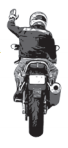
Q.49.
What does this signal mean?
Follow me
Slow down
Speed up
Exit
Q.50.
When approaching a blind intersection, you should:
Ride in the portion of the lane that will bring you into other drivers' fields of vision at the earliest possible moment.
Always be in the left lane to be the farthest from oncoming traffic.
Slowly sneak up to the intersection.
Weave slightly in your lane so your headlight has a better chance of being spotted.
Support mcqgeeks.com by disabling your adblocker.
×
Please disable the adBlock and continue.
Thank you.
Reload page