MCQGeeks
CBSE
JEE
NTSE
NEET
English
UK Quiz
Quiz
Driving Test
Practice
Games
Driving Test
New Mexico
New Mexico Car Driving Permit Test-19
Answers
Q.1.
When a curb is painted ____, it indicates fire zone parking restrictions.
Yellow
Blue
White
Red
Q.2.
It is necessary to use your low beams any time you are:
On a lighted street.
On a freeway.
In fog.
Q.3.
You are crossing an intersection and an emergency vehicle is approaching while using its siren and flashing lights. You should:
Stop immediately in the intersection until it passes.
Pull to the right of the intersection and stop.
Continue through the intersection, pull to the right, and stop.
Q.4.
When driving on gravel or dirt roads:
Your tires grip the road better than when you are driving on pavement.
Your tires do not have as much traction as they do on pavement, so you must slow down.
Visibility is better than on pavement.
Q.5.
At a railroad crossing, you must:
Watch for vehicles that must stop at all railroad crossings (school buses, trucks carrying hazardous materials, etc.).
Watch for multiple trains.
Both of the above.
Q.6.
What do speed limit signs indicate?
Potential driving speeds for the area
The maximum or minimum speed that is legally allowed to be driven
The speed drivers should drive in heavy traffic
The speed drivers should drive under poor conditions
Q.7.
The most effective thing you can do to reduce your risk of being injured or killed in a traffic crash is to:
Wear your seat belt.
Limit your driving to weekdays.
Stay in the right lane on multilane highways.
Limit your driving to hours between 3:00 p.m. and 6:00 p.m.
Q.8.
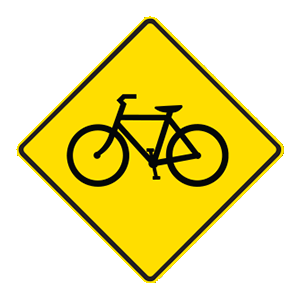
This sign means:
Bicycle crossing.
Stop.
Fines double in a work zone.
Stop ahead.
Q.9.
Drive below the posted speed limit when:
Anything makes conditions less than perfect.
You see a police car.
Entering a highway where there are other cars.
You are on a four-lane road.
Q.10.
Before changing lanes or attempting to pass another vehicle, you should:
Check your blind spots and mirrors.
Signal your intention before changing lanes.
All of the above.
Q.11.
If your vehicle starts to lose traction because of water on the road, you should:
Drive at a constant speed to gain better traction.
Apply the brakes firmly to prevent your vehicle from sliding.
Slow down gradually and not apply the brakes.
Q.12.
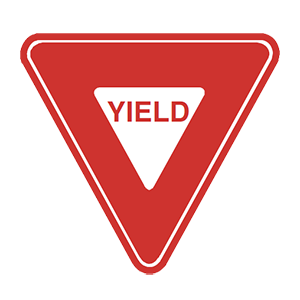
This sign means:
Yield the right-of-way.
No passing zone.
Reduction in lanes.
Q.13.
When driving on major highways:
Stay alert.
Keep your eyes moving.
Be ready to react to road hazards.
All of the above.
Q.14.
You are driving up a hill and are approaching a heavy truck from the rear. You should know that:
The truck may be traveling at a speed slower than the posted speed limit.
You may not be able to safely pass the truck.
You may not be able to legally pass the truck.
All of the above.
Q.15.
To reduce the effects of headlight glare at night, you should look:
Straight ahead.
Over your shoulder.
At the center of the road
To the right edge of the road.
Q.16.
Wearing both your lap belt and shoulder belt increases your protection in an accident.
True
False
Q.17.
Traffic signals sometimes display arrows to control turns from specific lanes. A solid yellow arrow:
Is never used as a traffic signal.
Has the same meaning as a circular yellow traffic light.
Means that drivers may turn in the direction indicated by the arrow.
Tells drivers that a green arrow is about to be shown.
Q.18.
Should you always drive more slowly than other traffic?
No, you can block traffic when you drive too slowly.
Yes, it is a good defensive driving technique.
Yes, it is always safer than driving faster than other traffic.
Q.19.
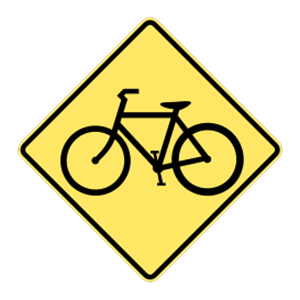
This sign means:
Watch for bicycles.
Bicycles not allowed.
Bicycle repair shop ahead.
Bicycles have the right-of-way.
Q.20.
When driving on a slippery surface, such as snow or ice:
Shift to a low gear before going down steep hills.
Maintain traction by following other vehicles closely.
Pump your brakes to keep them from freezing.
Q.21.
You may avoid the risks of alcohol-related crashes by:
Deciding before you start drinking that you are not going to drive.
Simply saying, "No thanks, I'm driving," if someone offers you a drink.
Calling a taxi.
Doing any of the above.
Q.22.
Who must yield when a driver is turning and a pedestrian is crossing without a traffic light?
Whoever started moving last
The driver
Whoever is slower
The pedestrian
Q.23.
If you want to get off the freeway but you have missed your exit, you should:
Go to the next exit.
Make a U-turn through the median.
Pull onto the shoulder and back your car to the exit.
Flag down a police officer for an escort back to your exit.
Q.24.
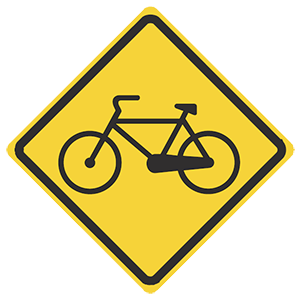
This sign means:
Watch for bicycles.
Bicycles not allowed.
Bicycle repair shop ahead.
Q.25.
You must yield for emergency vehicles:
Under no circumstances.
When you see a flashing red or blue light or hear a siren.
Only when other vehicles yield.
None of the above.
Support mcqgeeks.com by disabling your adblocker.
×
Please disable the adBlock and continue.
Thank you.
Reload page