MCQGeeks
CBSE
JEE
NTSE
NEET
English
UK Quiz
Quiz
Driving Test
Practice
Games
Driving Test
New Mexico
New Mexico Car Driving Permit Test-20
Answers
Q.1.
A leaky exhaust system in your vehicle is dangerous because it can cause:
A loss of hearing.
Pollution.
Carbon monoxide poisoning.
Poor engine performance.
Q.2.
When approaching a disabled pedestrian using a guide dog, white cane, or other assistive device, a driver should yield the right-of-way.
True
False
Q.3.
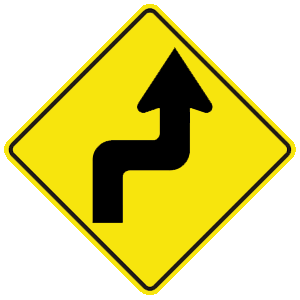
This road sign means:
Sharp right turn.
A road joins from the right.
The road ahead turns sharply right, then sharply left.
Winding road ahead.
Q.4.
You should not make sudden stops in front of large trucks and buses because:
Small vehicle drivers cannot adequately see large trucks and buses in their rearview mirrors.
Large trucks and buses, due to their size and weight, require longer distances to stop than smaller passenger vehicles.
Large trucks and buses travel at a higher speeds than small vehicles.
Q.5.
Compared to driving during the day, driving at night is:
Less dangerous.
No more or less dangerous.
More dangerous.
Easier on your eyes.
Q.6.
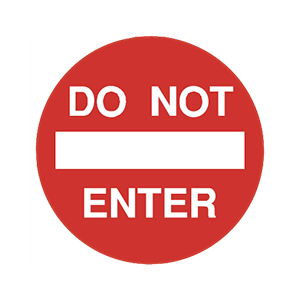
This sign means:
Do not enter.
Yield the right-of-way.
Reserved parking for persons with disabilities.
Q.7.
Driving while being distracted by any activity:
Is never dangerous.
Usually causes the driver to react more slowly to hazards.
Usually causes the driver to drive faster.
Is only dangerous for young drivers.
Q.8.
When changing lanes you should not:
Check your side and rearview mirrors.
Give a turn signal to signal your intentions.
Check for other drivers who may be moving into the same lane as you.
Use your cell phone to contact the police to determine if the road ahead is clear.
Q.9.
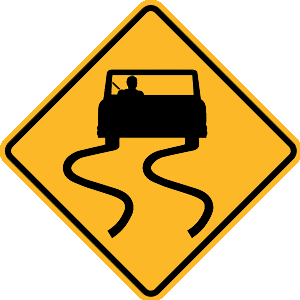
This sign means:
Don't drink if you are going to drive.
Slippery when wet.
Road curves ahead.
You are approaching a hill.
Q.10.
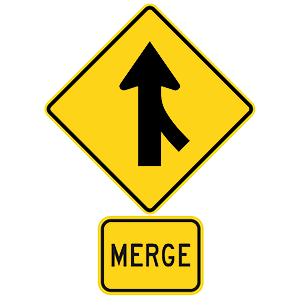
What does this road sign mean?
Be ready to merge with traffic entering your lane.
Always stop.
Divided highway ahead.
Q.11.
When you see this black and yellow sign, it means:
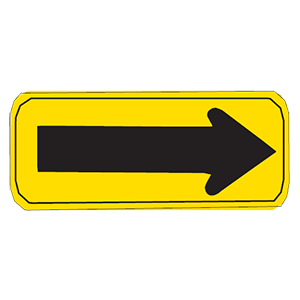
The road to the right is for one-way traffic only.
There is a detour to the right due to road construction.
The road ahead changes direction at an extreme angle.
Q.12.
If you find yourself in a skid:
Brake lightly.
Stay off the brakes.
Brake abruptly.
Q.13.
If you are driving near a motorcycle, you must:
Allow the motorcycle to use a complete lane.
Drive on the shoulder beside the motorcycle.
Allow the motorcycle to use only half of a lane.
Pass using the same lane as the motorcycle.
Q.14.
Make room for cars that are entering the freeway by:
Slowing down.
Merging into a different lane.
Maintaining your speed and position.
Q.15.
When entering the interstate on a short entrance ramp where there is no acceleration lane, you should:
Immediately enter the far-right traffic lane on the interstate and speed up to match the flow of traffic.
Use the shoulder of the main road to get up to the speed of traffic.
Speed up and enter the interstate only after you have identified a gap in traffic.
Q.16.
Traffic signals sometimes display arrows to control turns from specific lanes. A green arrow:
Is used only on one-way streets.
Has the same meaning as a circular green traffic light, but traffic must turn in the direction indicated by the arrow.
Means that you may proceed, but only if the green arrow is accompanied by a circular green light.
Points the way to an airport.
Q.17.
Railroad crossings should always be considered:
Safe to cross, as it is unlikely that a train will be coming.
Dangerous.
Safe locations to park a car.
A place where it is required to stop
Q.18.
If there is a deep puddle on the road ahead, you should:
Maintain the posted speed to make it through the water.
Avoid the puddle if possible.
Shift into neutral as you drive through the water.
Q.19.
Drivers are always required to stop for a stopped school bus when driving on a two-lane road.
TRUE
FALSE
Q.20.
A red arrow pointing to the right on a traffic light means you may:
Turn in that direction after slowing and checking for traffic.
Not turn in that direction until the light turns green.
Turn in that direction after you come to a complete stop.
Q.21.
Stop lines are solid white lines painted across traffic lanes:
In curves and on hills.
Next to churches and schools.
At intersections and pedestrian crosswalks.
On freeway on-ramps.
Q.22.
Adjust your rearview and side mirrors:
Before you start driving.
Whenever you need to use them.
Before you get into the car.
Q.23.
When you drive through a construction zone, you should:
Stop to watch the workers.
Decrease your following distance.
Pass the construction zone carefully and not “rubberneck."
Q.24.
Which of the following statements about driving speed is true?
As your speed increases, the chance of a fatality increases.
As your speed increases, so should your following distance.
Both of the above.
Q.25.
When changing lanes, you can check your blind spot by:
Using the inside rearview mirror.
Turning your head and looking over your shoulder.
Using your side mirror.
Support mcqgeeks.com by disabling your adblocker.
×
Please disable the adBlock and continue.
Thank you.
Reload page