MCQGeeks
CBSE
JEE
NTSE
NEET
English
UK Quiz
Quiz
Driving Test
Practice
Games
Driving Test
New Mexico
New Mexico Car Driving Permit Test-22
Answers
Q.1.
If traffic ahead of you is blocking an intersection, you should:
Drive closely to the car directly in front of you, just in case the light turns red.
Honk to get traffic to move.
Wait to enter the intersection until you can cross the intersection entirely.
Q.2.
To avoid collisions with vehicles in your blind spots, you should:
Quickly turn your head to see if your blind spot is clear before changing lanes.
Adjust your rearview mirrors every few minutes.
Honk your horn right before turning or changing lanes.
None of the above.
Q.3.
Double solid yellow lane markings mean that:
Neither lane may pass.
Both lanes may pass.
The lane to the right may pass.
Q.4.
If you are driving on a one-way street and an emergency vehicle using its flashing lights approaches your vehicle, you must:
Drive with your flashers turned on.
Drive toward the nearest roadside and stop.
Speed up and take the nearest exit.
Slow down until the vehicle passes you.
Q.5.
To safely pass a bicycle, you should:
Honk at the bicyclist to let them know you're trying to pass.
Drive in the bicycle lane until you get a chance to pass.
Slow down and give them as much space as possible.
Rush ahead to pull in front of the bicyclist.
Q.6.
You are waiting in the intersection to complete a left turn. You should:
Signal and keep your wheels turned to the left.
Signal and keep your wheels straight.
Flash your headlights so drivers will let you through.
Drive around the rear of a car if it blocks you.
Q.7.
Which is the most common cause of traffic crashes?
New drivers
Human error
Bad weather
Bad roads
Q.8.
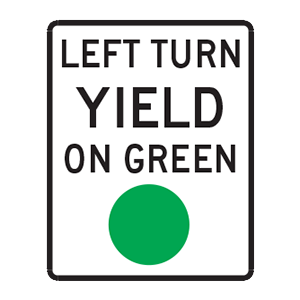
This sign means:
Left turn yield on green.
One-way.
Cattle crossing.
Two-way left turn.
Q.9.
Slowing down just to look at collisions or anything else out-of-the-ordinary:
Causes traffic congestion.
Prevents rear-end collisions.
Improves traffic flow by preventing collisions.
Q.10.
When stopped for a traffic violation or at an equipment check, the driver must produce:
Proof of insurance.
Their license.
Proof of registration.
All of the above.
Q.11.
What should you do when you see this sign?
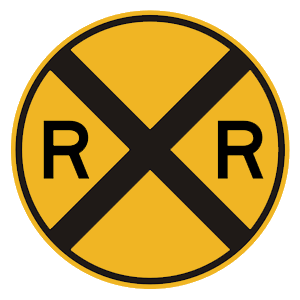
Look for a train station ahead.
Signal before going any further.
Slow down and yield to trains.
Q.12.
A person who drives much slower than the speed limit:
Is a very safe driver.
Always has the right-of-way.
Should not let following cars pass.
May create a dangerous driving environment.
Q.13.
It is illegal for a vehicle to drive on a sidewalk, except to cross it.
True
False
Q.14.
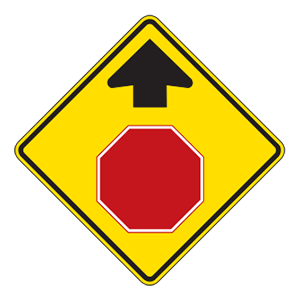
This sign means:
Stop ahead.
Buggy warning.
Limited parking.
Do not block intersection.
Q.15.
It is illegal for a personyears of age or older to drive with a minimum blood alcohol concentration (BAC) of:
0.05 percent.
0.08 percent.
0.02 percent.
0.1 percent.
Q.16.
While driving, you come upon a sign displaying the words “Reduced speed,mph." This means:
That the new 35 mph speed limit begins at this sign.
That the new 35 mph speed limit begins at the next speed limit sign.
That you have plenty of time to slow down before the reduced speed zone.
That you should reduce your speed to 35 mph, but only under poor weather conditions.
Q.17.
HOV lanes are reserved for:
Vehicles with multiple passengers.
Motorcycles.
Government vehicles.
Vehicles with one occupant.
Q.18.
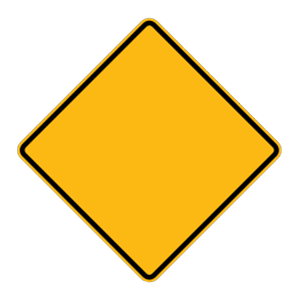
This sign is a:
Service sign.
Regulatory sign.
Warning sign.
Q.19.
You may drive around the gates at a railroad crossing:
When the train has passed.
Under no circumstances.
When the lights have stopped flashing.
When other drivers drive around the gates.
Q.20.
Distracted driving may be caused by:
Eating, drinking, or smoking.
Talking or texting on a cellular phone.
Changing a radio station or CD.
All of the above.
Q.21.
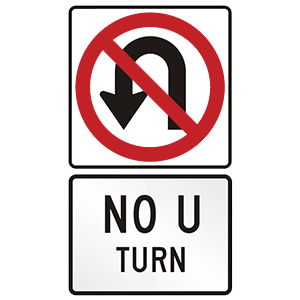
This sign means:
U-turns are prohibited.
U-turns are permitted.
Winding road ahead.
Sharp left turn ahead.
Q.22.
When should you drive in a reversible lane that is below a lane use control signal showing a red X?
When there is no visible oncoming traffic.
When you are passing the car in front of you.
Never.
Between sunset and sunrise.
Q.23.
If you can see that the roadway up ahead is covered by heavy smoke, you should:
Turn on your four-way flashers and continue.
Reduce your speed, move as far to the right as possible, and stop off the roadway.
Turn on your high beam headlights and continue.
Q.24.
Always signal when:
Changing lanes.
Pulling into or out of a parking space.
Pulling into traffic from an alley or parking area.
All of the above.
Q.25.
At a red traffic light with a green arrow, you may proceed in the direction of the arrow if:
You first come to a complete stop.
You wait until the light changes.
You are in the proper lane and the roadway is clear.
Support mcqgeeks.com by disabling your adblocker.
×
Please disable the adBlock and continue.
Thank you.
Reload page