MCQGeeks
CBSE
JEE
NTSE
NEET
English
UK Quiz
Quiz
Driving Test
Practice
Games
Driving Test
New Mexico
New Mexico Motorcycle Driving Permit Test-12
Answers
Q.1.
To provide the best protection to the wearer, boots or shoes should:
Be made of a soft material.
Have long laces that are not tucked in.
Cover the ankle and provide support.
Have tall heels.
Q.2.
When following a car, usually the best portion of the lane to ride in is:
The left portion.
The center portion.
The right portion.
The left or right portions.
Q.3.
A larger cushion of space may not be necessary if:
The pavement is slippery.
You cannot see through the vehicle ahead of you.
Weather and traffic conditions are perfect.
Traffic is heavy.
Q.4.
Convex mirrors make cars seem:
Larger.
Farther away.
Faster.
Narrower.
Q.5.
Goggles will:
Protect only your eyes.
Be an equally as effective as a face shield.
Offer the same protection as a windshield.
Provide protection for your entire face.
Q.6.
When braking on a slippery surface, you should:
Use only the rear brake.
Use only the front brake.
Use both brakes.
Not use any brakes, but downshift.
Q.7.
During acceleration, a sidecar attached to a motorcycle will:
Feel like it is lagging behind.
Feel like it is accelerating faster than the motorcycle.
Vibrate uncontrollably.
Make acceleration seem faster.
Q.8.
It is important to flash your brake light when:
Approaching a police officer.
Someone is following too closely.
There is a stop sign ahead.
Your signals are not working.
Q.9.
A way to lower the risk of being involved in a crash is to:
Communicate your intentions to other road users.
Not look ahead while riding.
Wear dark clothes.
Ride in the parts of a lane that make it difficult to be seen.
Q.10.
Which of the following is not an example of a slippery surface?
A gravel road
A patch of leaves
An ice patch
Dry concrete
Q.11.
Most motorcycle crashes happen:
On short trips.
On long trips.
After at least an hour of riding.
After more than 8 hours of riding.
Q.12.
When carrying a passenger on a motorcycle, you must:
Have a seat that is large enough for two riders.
Only have one set of footrests.
Not encourage the passenger to wear protective clothing.
Put a sticker on the brake light to warn other motorists that a passenger is on the motorcycle.
Q.13.
Riding in cold weather for long periods of time could result in all of the following, except:
Fatigue.
Hypothermia.
Severe chills.
Hot flashes.
Q.14.
In the context of group riding, what does the hand signal pictured mean?
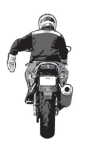
Speed up.
Danger ahead.
Stop.
Merge.
Q.15.
When stopping:
The rear brake should be applied first.
The front brake should be applied first.
Both brakes should be applied at the same time.
Only one brake, front or rear, should be used.
Q.16.
A wobble, or shaking of the front wheel and handlebars, may be caused by:
Incorrect tire pressure.
Brakes that are not working properly.
A balanced load.
Excessive wind.
Q.17.
If a tire goes flat while you are riding and you must stop, it is usually best to:
Relax on the handle grips.
Shift your weight toward the good tire.
Brake on the good tire and steer to the side of the road.
Use both brakes and stop quickly.
Q.18.
In any crash, you have a better chance of avoiding serious injury if you do all of the following, except:
Wear an approved helmet.
Wear face or eye protection.
Wear protective clothing.
Have a windshield.
Q.19.
You have been drinking alcohol. If you wait an hour for each drink before riding your motorcycle:
You cannot be arrested for drinking and riding.
Your riding skills will not be affected.
Side effects from the drinking may still remain.
You will be okay as long as you ride slowly.
Q.20.
How does the stopping distance for motorcycles compare to the stopping distance for cars?
Cars need much longer to stop.
Cars need a little longer to stop.
Motorcycles need longer to stop.
Both motorcycles and cars take about the same amount of time to stop.
Q.21.
When carrying a passenger in a sidecar, you should:
Begin slowing sooner than usual.
Begin slowing later than usual.
Apply the brakes more firmly than usual to stop quickly.
Apply the brakes more softly than usual to keep from overworking them.
Q.22.
When it is raining, it is usually best to:
Ride in the center of the lane.
Pull off to the side of the road until the rain stops.
Ride in the tire tracks left by cars.
Increase your speed.
Q.23.
If you think stopping your motorcycle will take longer than usual, you should:
Lengthen your following distance.
Shorten your following distance.
Leave the road.
Speed up.
Q.24.
How do headache, cold, and hay fever medications usually affect your body?
They make you drowsy.
They make you more alert.
They make you hungry.
They make you unable to concentrate.
Q.25.
When you park a motorcycle next to a curb, it should be:
Parked at a 90-degree angle with the rear wheel touching the curb.
Parked at a 45-degree angle with the front tire touching the curb.
Parked like a car, with the front and rear wheels the same distance from the curb.
Parked at the left edge of the parking space so approaching drivers can more easily see the motorcycle.
Support mcqgeeks.com by disabling your adblocker.
×
Please disable the adBlock and continue.
Thank you.
Reload page