MCQGeeks
CBSE
JEE
NTSE
NEET
English
UK Quiz
Quiz
Driving Test
Practice
Games
Driving Test
North Carolina
North Carolina Car Driving Permit Test-10
Answers
Q.1.
When changing lanes, you can check your blind spots by:
Using the inside rearview mirror.
Using the outside rearview mirror.
Using both inside and outside rearview mirrors.
Turning your head and looking over your shoulder.
Q.2.
Drivers should try to see ____ ahead on the road.
Three seconds
Five seconds
Eight seconds
10 to 15 seconds
Q.3.
If you come to a roadway covered in water, you should:
Drive until you think the water is too deep.
Turn around and find another way to go.
Drive through, as it is unlikely the standing water will become too deep.
Walk out into the water to determine its depth.
Q.4.
If a crossing guard is directing traffic in a school zone, you must:
Follow the directions given by the crossing guard.
Copy what surrounding traffic is doing, despite the crossing guard's instructions.
Assume the guard is not supposed to be directing traffic.
Follow rules that would be in place if no children were present.
Q.5.
When driving in fog, you should use your:
Low beam headlights.
High beam headlights.
Parking lights.
Hazard flashers.
Q.6.
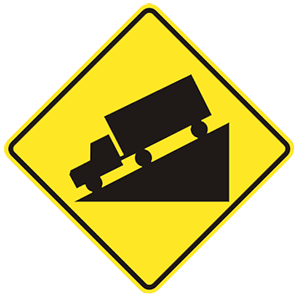
This road sign means:
Intersection ahead.
Steep grade ahead.
Winding road.
Merging traffic.
Q.7.
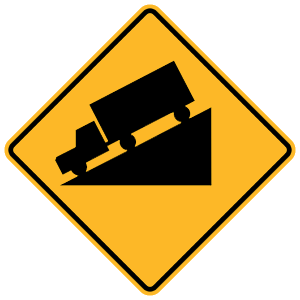
This sign means:
Trucks under 18,000 lbs. allowed.
Hill ahead.
Truck stop ahead.
No trucks allowed.
Q.8.
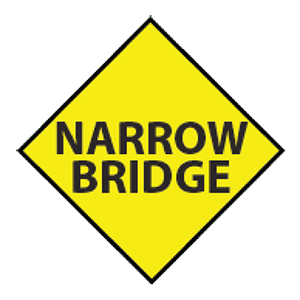
This sign means:
Trucks are permitted on an upcoming narrow bridge.
The bridge ahead is open to one-way traffic only.
The bridge ahead is wide enough for only one car at a time.
The bridge ahead may be too narrow to meet or pass a truck.
Q.9.
If your car breaks down on a highway, you should:
Sit in your car and wait for help.
Use your four-way flashers to warn other drivers.
Sound your horn at passing motorists.
Flash your headlights at oncoming traffic.
Q.10.
A steady yellow traffic signal means that a ____ light will soon appear.
Flashing yellow
Steady green
Steady red
Flashing red
Q.11.
A driver who is taking a non-prescription drug should:
Read the labels on the drug before driving.
Drink alcohol instead.
Continue to drive regardless of any warning labels.
Drive only during daylight hours.
Q.12.
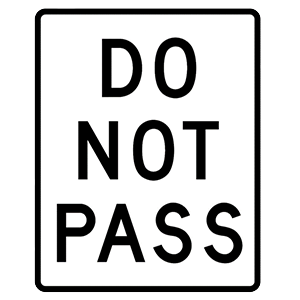
If you see this sign, you:
Must not pass another vehicle.
May pass a slow-moving vehicle if you can do so quickly.
May pass if you know the road ahead.
May pass, but only at night.
Q.13.
You may pass another vehicle:
In a curve or on a hill because the chance is small that another vehicle is coming.
By using the shoulder of the highway.
If your lane is next to a solid yellow line and the passing lane is clear ahead.
None of the above.
Q.14.
What should you be most concerned about when you see this sign?
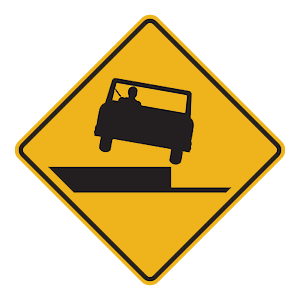
Driving with your headlights out of alignment because one side of your car is higher than the other.
Damaging a tire from drifting onto the shoulder.
Hydroplaning, if the shoulder has water on it.
Losing control of the vehicle if you drift onto the shoulder.
Q.15.
Which of the following is a safe way to drive through a curve?
Slow down as you enter, speed up as you exit.
Maintain a constant speed throughout the curve.
Speed up as you enter, slow down as you exit.
Stay near the right edge of your lane.
Q.16.
This sign means:
Divided highway ends.
One-way traffic ahead.
Two-way traffic ahead.
Keep to the right.
Q.17.
A speed restriction sign:
May be ignored in rainy, snowy, or icy conditions.
Has a triangular shape.
Is blue with black lettering.
Shows a recommended speed for a curve or turn.
Q.18.
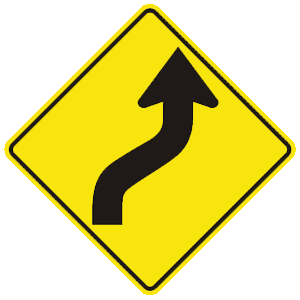
This sign means:
The highway ahead curves only to the right.
The highway ahead turns sharply to the right.
The highway ahead curves to the right and then to the left.
The highway ahead curves to the left and then to the right.
Q.19.
When you see or hear an emergency vehicle coming, you should:
Stop immediately and let the vehicle pass.
Drive as far toward the right side of the road as is safe and stop.
Proceed slowly and permit the vehicle to pass.
Keep moving slowly, staying to the right side of the road.
Q.20.
Many crashes are caused by:
Drivers traveling too fast for conditions.
Drivers consistently checking their mirrors and blind spots.
Drivers yielding the right-of-way.
Drivers maintaining a four-second following distance.
Q.21.
You may cross double solid yellow lines:
To pass a slow-moving truck.
To turn into a driveway.
To pass another car.
Under no conditions.
Q.22.
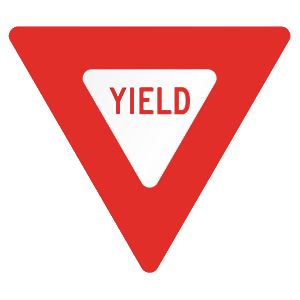
This is a ____ sign.
Stop
Wrong way
Yield
Do not enter
Q.23.
On a freeway, you realize you missed your turn or exit. You should:
Make the turn quickly from your lane of travel.
Stop and back up.
Continue driving until you reach the next turn, exit, or other location where you can safely turn around.
Signal other drivers to stop so you can turn.
Q.24.
Highway markings:
Are usually not important.
Are only found in construction zones.
Provide information for drivers.
Are usually red and blue in color.
Q.25.
You will lose your license if you are convicted of:
Driving without a license.
Passing a stopped school bus.
Failing to yield the right-of-way.
Driving at speeds higher than 75 mph.
Q.26.
When you see other drivers around you acting or reacting in anger:
Don’t make eye contact.
Don't react with hand gestures.
Distance yourself from the situation.
All of these.
Q.27.
Distracted driving is:
Very uncommon.
Extremely risky behavior.
Nothing to be concerned about.
No less safe than driving under any other conditions.
Q.28.
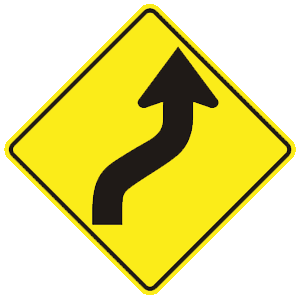
This road sign means:
Road construction ahead.
The road ahead curves left, then right.
The road ahead curves right, then left.
Steep grade ahead.
Q.29.
You approach an emergency vehicle that is stopped with its lights flashing. You must:
Slow down. If possible, change lanes so you will not drive next to the stopped emergency vehicle.
Drive to the right side of the road and stop.
Stay in your lane and continue to drive at the same speed.
Accelerate to quickly pass the stopped vehicle.
Q.30.
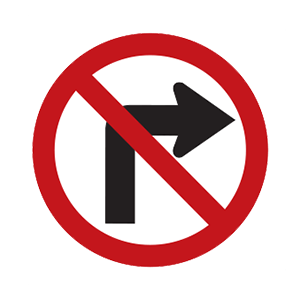
This sign means:
No right turn.
Keep right.
No U-turn.
Left lane must turn left.
Q.31.
The correct way to use a freeway exit ramp is to:
Slow down before entering the exit ramp.
Slow down once moving onto the exit ramp.
Keep your speed constant once in the exit ramp.
Pass slower traffic in the exit ramp.
Q.32.
You are driving when it starts to sleet or snow. You should:
Keep your windshield and mirrors clear.
Allow additional distance between your vehicle and the vehicles that you are following.
Approach all vehicles with caution.
All of the above.
Q.33.
To prevent hydroplaning, you should:
Ensure that your tires have good tread depth.
Ensure that your tires are properly inflated.
Reduce your speed when driving in the rain.
All of the above.
Q.34.
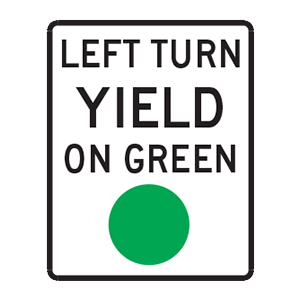
This sign means:
Left turn yield on green.
One-way.
Cattle crossing.
Two-way left turn.
Q.35.
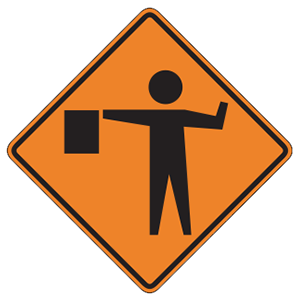
This sign means:
Pedestrians ahead.
End of construction zone.
School crossing ahead.
Flagger ahead.
Q.36.
When adjusting your inside mirror, you should be able to clearly see:
The entire rear window.
The passengers in the backseat.
Your own reflection.
The back seat.
Q.37.
Which of the following about winter driving is not true?
Winter is the most difficult driving season.
Checking your vehicle's antifreeze and windshield washer fluid levels is especially important during the winter.
Using cruise control in winter weather is a safe thing to do.
It is best to use snow tires on your vehicle.
Support mcqgeeks.com by disabling your adblocker.
×
Please disable the adBlock and continue.
Thank you.
Reload page