MCQGeeks
CBSE
JEE
NTSE
NEET
English
UK Quiz
Quiz
Driving Test
Practice
Games
Driving Test
North Carolina
North Carolina Car Driving Permit Test-16
Answers
Q.1.
You may not park within ____ of a fire hydrant.
10 feet
15 feet
30 feet
45 feet
Q.2.
Night driving can be more difficult than driving during the day because:
Cars overheat more quickly at night.
Visibility is reduced in the dark.
It is more likely to be raining at night.
You are more likely to encounter a motorcycle at night.
Q.3.
This sign is a:
Service sign.
Regulatory sign.
Warning sign.
Stop sign.
Q.4.
If your vehicle begins to skid, you should:
Overcorrect.
Turn your steering wheel into traffic.
Turn your steering wheel in the direction you want to go.
Release the steering wheel.
Q.5.
____ greatly increase stopping distances and severity of crashes.
High speeds
Slow speeds
Night drives
Uphill inclines
Q.6.
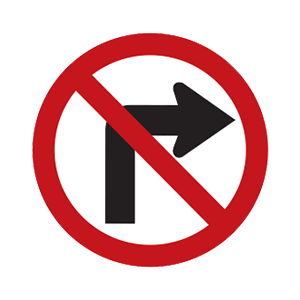
This sign means:
No right turn.
Keep right.
No U-turn.
Left lane must turn left.
Q.7.
Anything that requires you to ____ could cause you to crash.
Take your eyes off the road
Take your hands off the wheel
Take your attention away from the task of driving
All of the above
Q.8.
Alcohol causes:
Loss of concentration.
Poor coordination.
Slower judgment.
All of the above.
Q.9.
If someone is driving aggressively behind you, you should:
Try to get out of the aggressive driver’s way.
Stare at the driver as he or she is passing you.
Speed up as he or she is passing you.
Block the passing lane.
Q.10.
As you near an intersection, the traffic light changes from green to yellow. Your best action is to:
Speed up to beat the red light.
Apply the brakes sharply to stop.
Be prepared to stop in the center of the intersection.
Be prepared to stop before the intersection.
Q.11.
When approaching a steady yellow traffic light, drivers should:
Accelerate to avoid a red light.
Continue driving, as they have the right-of-way.
Slow to a stop, unless they are already within the intersection.
Check to see what the cars next to them are doing.
Q.12.
If it has not previously been suspended, your license will be suspended for accumulating ____ within a three-year period.
10 points
12 points
15 points
20 points
Q.13.
A work zone:
May be moving or stationary.
Is marked with black and white signs.
Does not require a driver to slow down and pay extra attention.
All of the above.
Q.14.
When you see this sign, it means:
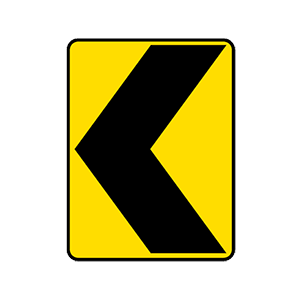
There is an object on the roadway.
Traffic is coming from the right.
The road is curving sharply to the left.
There is a merge point ahead.
Q.15.
If possible, before beginning down a steep hill, you should:
Come to a complete stop.
Switch into a higher gear.
Switch into a lower gear.
Accelerate.
Q.16.
This sign means:
Slow down if an emergency vehicle is approaching.
Look both ways as you cross the intersection.
Always come to a full stop at the intersection.
Slow down and be prepared to stop if necessary.
Q.17.
If two drivers arrive at the same time to an open intersection:
The driver on the right has the right-of-way.
The driver on the left has the right-of-way.
One driver may continue driving without stopping.
One driver should honk to indicate that they are giving up the right-of-way.
Q.18.
The fastest a driver should drive when backing up is:
25 mph.
20 mph.
10 mph.
15 mph.
Q.19.
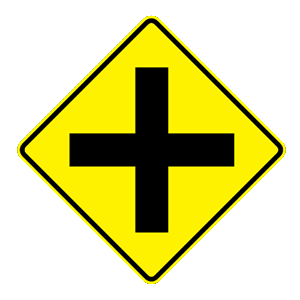
This road sign means:
A steep grade is ahead.
You must turn left ahead.
Do not enter.
A four-way intersection is ahead.
Q.20.
You may drive around the gates at a railroad crossing:
When the train has passed.
Under no circumstances.
When the lights have stopped flashing.
When other drivers drive around the gates.
Q.21.
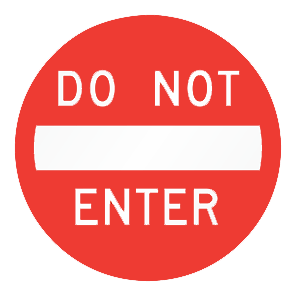
This sign is used to prevent:
Entrance to full parking lots.
Entrance to road construction areas.
Entrance to dead-end streets.
Entrances from the wrong direction on one-way streets and expressway ramps.
Q.22.
To prepare for anything coming up on the road ahead, you should:
Continually scan the entire road and all roadsides.
Stare straight ahead at all times.
Drive with your left foot resting lightly on the brake pedal.
Maintain focus toward the middle of the road.
Q.23.
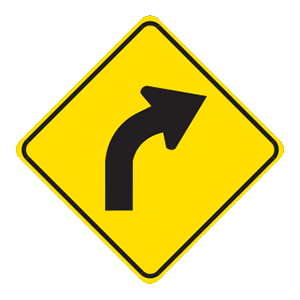
This sign means:
Curve ahead.
Roadwork ahead.
Merging traffic.
No left turn.
Q.24.
On a two-lane street, your vehicle is being followed by a fire engine that is not using its emergency signals. You should:
Continue to drive in a normal manner.
Stop as quickly as you can.
Speed up to get out of its way.
Slow down, move as far to the right as possible, and stop.
Q.25.
When approaching a steady green traffic light, drivers should:
Continue driving, unless there are vehicles or pedestrians already in the intersection.
Stop if a police officer is nearby.
Treat the intersection like a four-way stop.
Come to a complete stop before proceeding.
Q.26.
When faced with an oncoming car to the left and a bicyclist to the right, you should:
Pull onto the shoulder.
Split the difference.
Let the car pass and then pass the bike.
Pass the bike quickly.
Q.27.
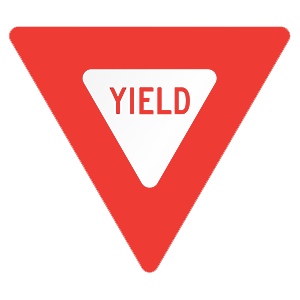
A red and white triangular sign at an intersection means:
Slow down if an emergency vehicle is approaching.
Look both ways as you cross the intersection.
Always come to a full stop at the intersection.
Slow down and be prepared to stop if necessary.
Q.28.
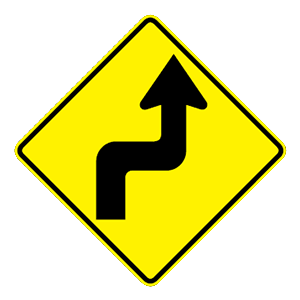
This road sign means:
The road ahead turns sharply right, then left.
The road ahead turns sharply left, then right.
The road ahead curves to the left.
Construction ahead.
Q.29.
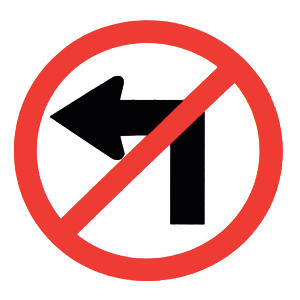
This sign means:
All traffic must turn left.
No left turn.
No U-turn.
Truck route to the left.
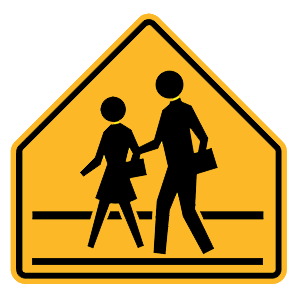
Q.30.
This sign means:
Pedestrians only.
Intersection ahead.
Hiking trails ahead.
School crossing ahead.
Q.31.
You are driving on a busy street and your vehicle’s accelerator sticks open. You should:
Blow your horn.
Slam on your brakes.
Turn on your four-way flashers.
Turn off your ignition, taking care not to engage the steering wheel locking mechanism.
Q.32.
When getting ready to change lanes, you should:
Check your side view mirror.
Check your rearview mirror.
Quickly turn your head to check for other vehicles.
All of the above.
Q.33.
Drivers should try to see ____ ahead on the road.
Three seconds
Five seconds
Eight seconds
10 to 15 seconds
Q.34.
When the road is marked with a solid yellow line and a broken yellow line, with the broken line next to your lane, you may pass:
Only in an emergency.
If you are on an expressway.
If traffic is clear.
Only at an intersection.
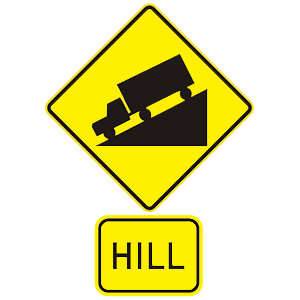
Q.35.
This sign means:
Trucks only.
Trucks are entering the highway.
Upcoming hill.
Trucks have the right-of-way.
Q.36.
What is the first thing you should adjust, if needed, when you get into a car to drive?
Your seat belt
The steering wheel
Your rearview mirror
Your seat
Q.37.
Hydroplaning is usually caused by:
Excessive stops.
Sudden stops.
Sudden turns.
Excessive speed.
Support mcqgeeks.com by disabling your adblocker.
×
Please disable the adBlock and continue.
Thank you.
Reload page