MCQGeeks
CBSE
JEE
NTSE
NEET
English
UK Quiz
Quiz
Driving Test
Practice
Games
Driving Test
North Carolina
North Carolina Motorcycle Driving Permit Test-6
Answers
Q.1.
To control a motorcycle properly, you should:
Sit so you can use your arms to steer, not to hold yourself up.
Sit far enough back on the seat that you can keep your arms straight.
Keep your knees away from the gas tank.
Drag your feet on the ground.
Q.2.
If you are riding when it starts to rain, it is a good idea to:
Ride down the center of the lane.
Increase your speed.
Ride in the tire tracks left by cars.
Pull onto the shoulder of the road.
Q.3.
When riding, you should:
Turn your head and shoulders to look through turns.
Keep your arms straight.
Keep your knees away from the gas tank.
Turn just your head and eyes to look where you are going.
Q.4.
Since most crashes happen during daylight hours, you should:
Not ride during the day.
Wear bright clothing all the time.
Ride on the shoulder and stay out of traffic.
Wear dark clothing all the time.
Q.5.
The gear shift lever is located:
In front of the left footrest.
In front of the right footrest.
Behind the left footrest.
Behind the right footrest.
Q.6.
Where should a load be placed?
As low as possible
As high as possible
Behind the rear axle
On one side of the motorcycle
Q.7.
In the context of group riding, what does the hand signal pictured mean?
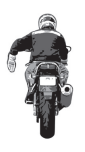
Speed up.
Danger ahead.
Stop.
Merge.
Q.8.
A danger of riding next to a row of parked cars is:
You may not find a parking spot.
A driver may unexpectedly pull out from the row into your path.
Others may be driving slowly while looking for a parking spot.
The road may be uneven.
Q.9.
If you are being chased by a dog, you should:
Kick it away.
Stop until the animal loses interest.
Swerve around the animal.
Approach the animal slowly, then speed up.
Q.10.
Which of the following will protect your eyes from the wind?
Goggles
Windshield
Sunglasses
Eyeglasses
Q.11.
Which of the following is not a type of protective riding gear?
A leather jacket
Boots that go above the ankle
Hearing protection
Pants made of a soft material
Q.12.
What may help if you experience slippage of your drive chain?
Tightening the chain
Loosening the chain
Using the throttle more
Applying the rear brake
Q.13.
Just like cars, motorcycles have blind spots. When switching lanes, you should:
Turn your head and check your blind spot.
Look only at your mirrors.
Rely on your peripheral vision.
Slow down so any vehicle in your blind spot can pass you.
Q.14.
All of the following will lessen your chances of being involved in an accident, except:
Remaining alert.
Identifying hazards and prioritizing risks.
Riding without a headlight.
Maintaining a space cushion.
Q.15.
Your lane position should do all of the following, except:
Help you avoid road hazards.
Help you avoid other drivers’ blind spots.
Help you avoid being seen by other drivers.
Increase your ability to be seen by others.
Q.16.
More than half of all crashes:
Occur at speeds greater than 35 mph.
Are caused by worn tires.
Happen in the dark.
Involve riders who have little experience on their motorcycles.
Q.17.
Shifting to a lower gear produces an effect similar to:
Accelerating.
Braking.
Swerving.
Turning.
Q.18.
Your motorcycle’s brake light is:
More noticeable than a car’s brake lights.
Less noticeable than a car’s brake lights.
Less important than a car’s brake lights.
More easily seen than a car’s brake lights.
Q.19.
A proper lane position should do all of the following, except:
Increase your ability to see and be seen.
Help you avoid surface hazards.
Help you avoid traffic signals.
Communicate your intentions to other road users.
Q.20.
If you are feeling tired while riding, you should:
Keep going and hope to wake up.
Ride faster.
Ride on the shoulder.
Get off the road and rest.
Q.21.
Drivers on an entrance ramp may not see you on the highway. What should you do to help an entering driver merge safely?
Stay in your lane, as it is not your responsibility to be seen.
Change to a lane away from the entrance ramp, if possible.
Move to the shoulder.
Weave within your lane to be more obvious to the entering driver.
Q.22.
How much of a motorcycle's total braking power can the front brake supply?
About 10 percent
About 25 percent
About 50 percent
About 70 percent
Q.23.
Which types of brakes do most motorcycles have?
Front and emergency
Rear and emergency
Front and rear
Only a front brake
Q.24.
Usually, a good way to handle a tailgater is to:
Move onto the shoulder to get out of their way.
Speed up and put distance between you and the tailgater.
Ignore them.
Change lanes and let them pass.
Q.25.
If a driver is following you too closely, you should:
Flash your brake light before you slow to warn the other driver.
Accelerate.
Pull over to the side of the road.
Slow down.
Support mcqgeeks.com by disabling your adblocker.
×
Please disable the adBlock and continue.
Thank you.
Reload page