MCQGeeks
CBSE
JEE
NTSE
NEET
English
UK Quiz
Quiz
Driving Test
Practice
Games
Driving Test
North Carolina
North Carolina Motorcycle Driving Permit Test-7
Answers
Q.1.
A thorough check of your motorcycle:
Is useless unless done by a mechanic.
Should not be done before a ride.
Should be done only after a ride.
Can help you identify any mechanical defects or equipment failures.
Q.2.
When riding behind a car, you should:
Ride in a position that will allow the other driver to see you in their rearview mirror.
Assume the driver sees you.
Ride in the far left portion of the lane.
Ride in the far right portion of the lane.
Q.3.
When an operator's left arm is bent at the elbow and pointing upward, it means the operator:
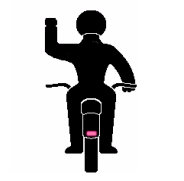
Plans to turn left.
Is about to stop.
Plans to turn right.
Is about to slow down.
Q.4.
When riding a motorcycle, you should:
Not wear a jacket if it's warm out.
Always wear a jacket, even if it’s warm out.
Wear shorts in warm weather.
Not be concerned about long shoelaces.
Q.5.
A properly-fitted motorcycle:
Allows the rider to touch the ground with their feet while seated.
Has a seat even with the rider's waist.
Has a seat that is 10 inches above the rider's waist.
Has a seat that is 10 inches below the rider's waist.
Q.6.
Intersections are usually:
Safe since there is so much traffic there.
A dangerous spot for riders.
Difficult to figure out.
Safer than the open road.
Q.7.
When you are being passed by another vehicle, which part of the lane should you ride in?
The left
The center
The right
It doesn’t matter.
Q.8.
The proper clothing for riding a motorcycle should:
Cover your arms and legs completely.
Cover your arms completely, but leave your legs exposed.
Cover your legs completely, but leave your arms exposed.
Be whatever makes you most comfortable, regardless of safety.
Q.9.
To receive maximum protection, wear a helmet that is certified by the:
U.S. Department of Transportation.
Federal Trade Commission.
Federal Transportation Network.
National Association of Helmets.
Q.10.
A passenger should never:
Wear a helmet.
Lean when the operator leans.
Wear clothing that is tight.
Ride sidesaddle.
Q.11.
You will ______ hear a tire going flat.
Always
Usually
Frequently
Seldom
Q.12.
When making an ordinary stop, you should:
Use both the front and rear brakes.
Use only the rear brake to save the front brake for special situations.
Use only the front brake to save the rear brake for special situations.
Sharply squeeze the front brake only.
Q.13.
You should use a larger cushion of space:
When roads are slippery.
When it is sunny outside.
When it is colder than usual.
When you are following other motorcycles.
Q.14.
To lessen your chances of being involved in a crash, you should:
Be visible to other drivers.
Keep your intentions unknown from other drivers.
Always stay within a foot of another vehicle.
Ride on the shoulder.
Q.15.
Riding gloves are often:
Made of leather.
Made of wool.
Not pre-curved.
Unsafe for the rider.
Q.16.
What is the best lane position for a motorcycle?
The left position
The center position
The right position
There is no single best lane position.
Q.17.
Which portion of the lane should be avoided?
The left portion of the lane
The center portion of the lane
The right portion of the lane
No portion of the lane should always be avoided.
Q.18.
What does this signal mean?
Rest stop
High beams on
Turn right
Hazard
Q.19.
If attempting to brake in a curve, you should:
Brake more gradually than you would on a straightaway.
Brake as hard as you would on a straightaway.
Wait until you are not in the curve to brake.
Only use the rear brake.
Q.20.
The middle portion of the lane usually contains an oily strip. You should:
Try to avoid the oily strip when it is raining.
Ride only on the oily strip, as it provides increased traction.
Avoid the entire center portion of the lane.
Not worry about oil or other items in a lane.
Q.21.
Long-term exposure to wind noise:
Is recommended.
Can cause hearing loss.
Is not harmful.
Is less damaging than listening to music.
Q.22.
If the chain or belt of your motorcycle breaks, you will:
Experience a sudden increase in power to the rear wheel.
Experience a sudden loss of power to the rear wheel.
Experience a sudden loss of power to the front wheel.
Experience a sudden increase in power to the front wheel.
Q.23.
When riding at night, you should do all of the following, except:
Use your high beam.
Use the headlights of vehicles ahead to help you see.
Be visible.
Ride only in the left portion of your lane.
Q.24.
If your motorcycle begins to weave while you are riding over rain grooves or bridge gratings, you should:
Relax, maintain a steady speed, and ride straight across the surface.
Tighten your hold on the handle grips and increase your speed to get past the hazard.
Travel in a zigzag motion.
Ride on the shoulder instead of on the grooves.
Q.25.
When riding in a group, it is best to put inexperienced riders near the front because:
Experienced riders can more easily keep an eye on them.
They will get lost if they are leading.
They may slow the group down as the leaders.
They will ride too fast in any other position.
Support mcqgeeks.com by disabling your adblocker.
×
Please disable the adBlock and continue.
Thank you.
Reload page