MCQGeeks
CBSE
JEE
NTSE
NEET
English
UK Quiz
Quiz
Driving Test
Practice
Games
Driving Test
North Dakota
North Dakota Car Driving Permit Test-20
Answers
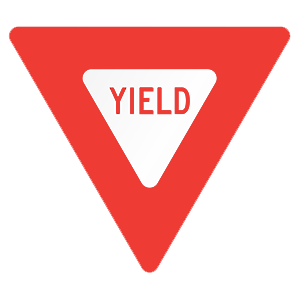
Q.1.
The sign with this shape and color is a ____ sign.

No passing zone
Wrong way
Railroad crossing
Stop
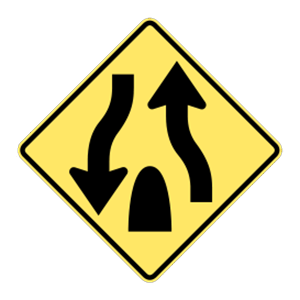
Q.2.
This sign means:
Curves ahead.
Divided highway starts.
Divided highway ends.
Bumps in the road.
Q.3.
To help relieve fatigue on a long trip, it is a good idea to:
Stop and rest every two hours.
Do arm exercises every hour.
Drive with one eye open at a time.
Change feet on the gas pedal.
Q.4.
Which of the following does not happen after drinking?
Your reflexes and reaction time slow down.
Your judgement of speed and distance is distorted.
You are less alert.
You calm down and can concentrate better.
Q.5.
Larger vehicles have:
Larger blind spots.
Smaller blind spots.
No blind spots.
The same blind spots as smaller vehicles.
Q.6.
When approaching railroad tracks, you should:
Look, listen, slow down, and be prepared to stop.
Speed up to cross the tracks before the gate is lowered.
Try to drive around a lowered gate.
Not pay attention to how many tracks there are to cross.
Q.7.
A broken yellow line alongside a solid yellow line means:
Passing on the left is permitted from either direction.
Passing is permitted from the lane next to the broken line.
Passing is permitted from the lane next to the solid line.
Passing is not allowed from either direction.
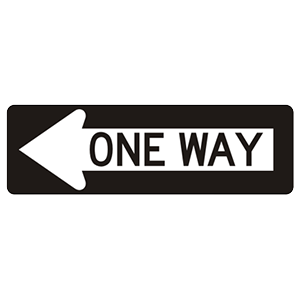
Q.8.
This road sign means:
No right turn.
Curve.
Turn right or left.
Traffic flows only in the direction of the arrow.
Q.9.
You check your blind spots:
By looking in your side mirrors.
By turning your head and looking over your shoulders.
By looking in your rearview mirror.
By staring straight ahead.
Q.10.
Anything that requires you to ____ could cause you to crash.
Take your eyes off the road
Take your hands off the wheel
Take your attention away from the task of driving
All of the above
Q.11.
When approaching a flashing yellow light, drivers should:
Increase their speed.
Come to a complete stop.
Turn on their headlights.
Slow down and proceed with caution.
Q.12.
If you are following a school bus or tank truck, you should:
Pass them on the right.
Be prepared to stop at all railroad crossings.
Decrease your following distance.
Honk to let them know you are there.
Q.13.
To safely pass a bicycle, you should:
Honk at the bicyclist to let them know you're trying to pass.
Drive in the bicycle lane until you get a chance to pass.
Slow down and give them as much space as possible.
Rush ahead to pull in front of the bicyclist.
Q.14.
An inattentive driver is a driver who:
Stares at objects off the roadway or daydreams while driving.
Maintains eye contact during a conversation with a passenger while driving.
Only watches the vehicle ahead of their vehicle.
All of the above.
Q.15.
Emergency vehicles:
Have the right-of-way when using sirens, horns, and/or flashing lights.
May use a loudspeaker to give instructions.
May follow each other.
All of the above.
Q.16.
You are driving in the right lane of a multilane highway and want to move into the left lane. You should:
Look in your rearview mirror for traffic behind you before changing lanes.
Look over your left shoulder for traffic in your blind spot before changing lanes.
Look in your side mirror for traffic and turn on your directional signal.
All of the above.
Q.17.
When approaching a traffic signal displaying a steady yellow arrow, drivers:
Should merge into a lane in the direction of the arrow.
Should slow to a stop, if it is safe to do so.
May turn left after yielding to oncoming traffic and pedestrians.
Have the right-of-way and may expect oncoming traffic to stop for them.
Q.18.
A leaky exhaust system in your vehicle is dangerous because it can cause:
A loss of hearing.
Pollution.
Carbon monoxide poisoning.
Poor engine performance.
Q.19.
You are driving on a divided multilane highway and see or hear the signal of an approaching emergency vehicle. You should:
Disregard the signal if there are other lanes available for the emergency vehicle.
Stop as quickly as you can.
Slow down, move your vehicle to provide a clear path for the emergency vehicle, and stop.
Increase your speed to get out of the way of the emergency vehicle.
Q.20.
Distracted drivers are at a greater risk of a crash when they are using which of the following?
Cell phone
CD player
Radio
All of the above
Q.21.
What can you do to avoid the need to make emergency stops while driving in traffic?
Honk your horn to make others aware of your presence.
Look ahead and maintain a safe following distance.
Drive in the right lane only.
Drive more slowly than the flow of traffic.
Q.22.
This sign means:
Slow down if an emergency vehicle is approaching.
Look both ways as you cross the intersection.
Always come to a full stop at the intersection.
Slow down and be prepared to stop if necessary.
Q.23.
To ensure that your physical condition does not cause you to drive in an unsafe manner, you should:
Keep physically fit and have regular physical examinations.
Know the effect of any medicine on your driving ability.
Drive within your physical limitations.
All of the above.
Q.24.
When parallel parking between two cars, you should first:
Turn your wheels to the left.
Turn your wheels to the right.
Pull up even with the car in front of your desired parking space.
Back slowly.
Q.25.
The correct way to use a freeway exit ramp is to:
Slow down before entering the exit ramp.
Slow down once moving onto the exit ramp.
Keep your speed constant once in the exit ramp.
Pass slower traffic in the exit ramp.
Support mcqgeeks.com by disabling your adblocker.
×
Please disable the adBlock and continue.
Thank you.
Reload page