MCQGeeks
CBSE
JEE
NTSE
NEET
English
UK Quiz
Quiz
Driving Test
Practice
Games
Driving Test
North Dakota
North Dakota Car Driving Permit Test-23
Answers
Q.1.
To check your blind spot when changing lanes to the left, you should glance:
Over your right shoulder.
At your side mirror.
Over your left shoulder.
At your rearview mirror.
Q.2.
What should you do if your accelerator sticks while you are driving?
Reach down and attempt to pull it up.
Shift to park.
Shift to neutral and apply steady pressure on the brake.
Turn the engine off.
Q.3.
You are driving on a highway divided by two solid yellow lines. You may:
Cross these lines only to make a left turn into or from an alley, private road, or driveway.
Cross these lines to pass other vehicles, but only if there is no oncoming traffic.
Cross these lines under no circumstances.
Cross these lines only to make a U-turn.
Q.4.
A driver who is taking a non-prescription drug should:
Read the labels on the drug before driving.
Drink alcohol instead.
Continue to drive regardless of any warning labels.
Drive only during daylight hours.
Q.5.
A double solid yellow line down the center of a two-lane road indicates:
Lanes are moving in opposite directions and drivers are not permitted to pass.
Lanes are moving in opposite directions and drivers are permitted to pass when it is safe to do so.
Lanes are moving in the same direction and drivers are not permitted to pass.
Lanes are moving in the same direction and drivers are permitted to pass when it is safe to do so.
Q.6.
When driving on slippery roads, you should:
Use alternate routes.
Drive as you would on dry roads.
Increase your following distance.
Avoid crossing bridges or intersections.
Q.7.
Your brake lights tell other drivers that you:
Are making a turn.
Have your emergency brake on.
Are changing lanes.
Are slowing down or stopping.
Q.8.
Pentagonal signs indicate:
No passing zones.
School zones.
Speed limits.
Railroad crossings.
Q.9.
You are approaching a railroad crossing and you do not see or hear a train. You must stop:
If a stop sign is posted.
If a crossing gate is lowered.
If the crossing lights are flashing.
All of the above.
Q.10.
You are entering a crowded freeway. What should you do to merge into traffic?
Use your side and rearview mirrors and check your blind spots.
Use the acceleration lane to adjust your speed to match the speed of freeway traffic.
Yield to traffic already on the freeway.
All of the above.
Q.11.
When driving on roads that may be slippery:
Always drive at the maximum speed limit.
Use cruise control to maintain a steady speed.
Reduce your following distance.
Do not make any sudden changes in speed or direction.
Q.12.
You may continue carefully through an intersection with a yellow light if:
There is an emergency vehicle crossing your lane.
There are pedestrians crossing.
You are turning right.
You are already within the intersection when the light changes to yellow.
Q.13.
If a transit vehicle is signaling to re-enter the main roadway following a stop, you must:
Honk to let them know you’re there.
Move to the left lane.
Yield.
Speed up to pass.
Q.14.
A regulatory sign containing a red circle with a slash through the middle indicates:
That drivers should come to a complete stop.
That an action is forbidden.
That some drivers should yield to other drivers.
That drivers should drive under the speed limit.
Q.15.
Stress can affect your driving by:
Lowing your ability to focus on driving.
Decreasing your chances of an accident.
Causing you to fall asleep at the wheel.
Making you more aware of others around you.
Q.16.
You may pass another vehicle if the line dividing your lane from the lane you wish to enter is a ____ line.
Broken white
Double solid yellow
Solid yellow
Solid white
Q.17.
What should you do if your vehicle’s right wheels leave the pavement?
Stop quickly.
Immediately pull all the way off of the road and get back on when it is safe.
Accelerate and steer back on the road quickly.
Take your foot off the accelerator, slow down, then ease back onto the road when it is safe to do so.
Q.18.
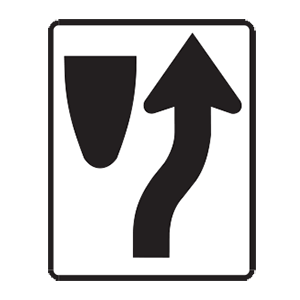
This sign means:
Keep right.
Low shoulder.
No parking at any time.
Lane ends.
Q.19.
You are driving up a hill and are approaching a heavy truck from the rear. You should know that:
The truck may be traveling at a speed slower than the posted speed limit.
You may not be able to safely pass the truck.
You may not be able to legally pass the truck.
All of the above.
Q.20.
When approaching a steady yellow traffic light, drivers should:
Accelerate to avoid a red light.
Continue driving, as they have the right-of-way.
Slow to a stop, unless they are already within the intersection.
Check to see what the cars next to them are doing.
Q.21.
Round signs indicate:
No passing zones.
School zones.
Upcoming railroad crossings.
Hospitals.
Q.22.
When encountering an aggressive driver, you should:
Avoid eye contact, slow down, and let them pass.
Cut them off to slow them down.
Retaliate by tailgating them.
Make sure they know you disapprove of their behavior.
Q.23.
When parking uphill next to a curb, set the parking brake and:
Keep the rear tires against the curb.
Keep the front tires straight ahead.
Turn your steering wheel away from the curb.
Turn your steering wheel toward the curb.
Q.24.
You are involved in an accident and another person is injured. You should:
Moved the injured away from the scene immediately.
Always leave the injured where they are.
Not move the injured unnecessarily. Keep the injured warm and administer first aid.
Stay away from the injured.
Q.25.
If a green arrow turns into a solid green light, you:
May still turn, but you must yield to oncoming traffic.
May no longer turn and must proceed straight.
Still have the right-of-way to turn.
No longer have to turn in the direction that the arrow indicated.
Support mcqgeeks.com by disabling your adblocker.
×
Please disable the adBlock and continue.
Thank you.
Reload page