MCQGeeks
CBSE
JEE
NTSE
NEET
English
UK Quiz
Quiz
Driving Test
Practice
Games
Driving Test
North Dakota
North Dakota Car Driving Permit Test-3
Answers
Q.1.
What is a "No zone?"
A designated no passing zone
A one-way traffic area
The blind spot of a large vehicle
An area designated for motor vehicles
Q.2.
What might happen when alcohol is combined with another drug?
The effects of the alcohol and the drug may both be increased.
Nothing will happen.
The effects of the alcohol and the drug may both be reduced.
The effects of only the alcohol may be reduced.
Q.3.
A person who drives much slower than the speed limit:
Is a very safe driver.
Always has the right-of-way.
Should not let following cars pass.
May create a dangerous driving environment.
Q.4.
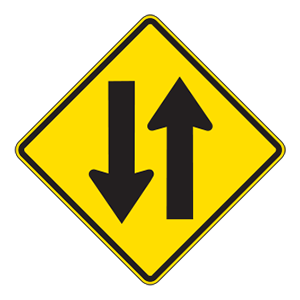
This sign means:
Two-way traffic.
Lane shifting.
Low clearance.
Added lane.
Q.5.
Which of the following must you obey over the other three?
A stop sign
A flashing red light
A steady red light
A police officer
Q.6.
You may not park within ____ of a crosswalk or intersection.
10 feet
25 feet
50 feet
100 feet
Q.7.
Under ideal weather and traffic conditions, keep a minimum following distance of:
One second.
Two seconds.
Three seconds.
Four seconds.
Q.8.
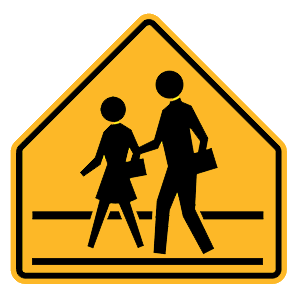
This sign means:
Pedestrians only.
Intersection ahead.
Hiking trails ahead.
School crossing ahead.
Q.9.
Driving while being distracted by any activity:
Is never dangerous.
Usually causes the driver to react more slowly to hazards.
Usually causes the driver to drive faster.
Is only dangerous for young drivers.
Q.10.
If you are driving on the interstate and pass your exit, you should:
Quickly cut across traffic to make your turn.
Make a U-turn to go back to the exit.
Continue driving and use the next exit.
Put your vehicle in reverse to go back to the exit.
Q.11.
When you approach a railroad crossing without flashing warning signals or crossing gates, you should:
Cross the tracks immediately and as quickly as possible.
Always stop before crossing the tracks.
Prepare to yield to any train at the crossing.
Speed up to beat any oncoming train.
Q.12.
____ limit your concentration, perception, judgment, and memory.
Only a blood alcohol level greater than the legal limit can
Alcohol does not
Even the smallest amount of alcohol can
Only a blood alcohol level greater than 0.05 percent can
Q.13.
When approaching a roundabout, you should always:
Increase your speed.
Maintain your speed.
Come to a complete stop.
Decrease your speed.
Q.14.
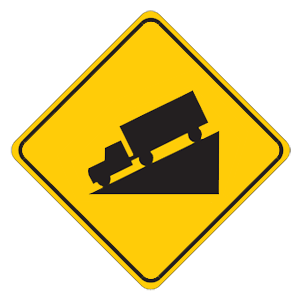
This sign indicates that:
There is a steep hill ahead.
No trucks are allowed on an upcoming hill.
A logging road is ahead.
There are trucks on an upcoming hill.
Q.15.
If you experience a tire blowout:
Take your foot of the gas.
Do not immediately use your brakes.
Gradually slow down and pull off the side of the road.
All of the above.
Q.16.
You check your blind spots:
By looking in your side mirrors.
By turning your head and looking over your shoulders.
By looking in your rearview mirror.
By staring straight ahead.
Q.17.
Increase your following distance when:
Driving behind a large vehicle that blocks your vision.
Exiting an expressway.
Following a motorcycle.
All of the above.
Q.18.
The most effective safety restraints in a traffic crash are:
Only a lap and shoulder belt.
Only an airbag.
Both a lap/shoulder belt and an airbag.
No safety restraints.
Q.19.
Certain highway signs contain information about hazardous conditions. Such signs are known as:
Regulatory signs.
Warning signs.
Information signs.
Guide signs.
Q.20.
When you see an emergency vehicle with flashing lights, you must:
Slow down and keep moving in your lane.
Keep driving in your lane.
Pull to the right curb and stop.
Stop exactly where you are.
Q.21.
Drivers must yield to a pedestrian:
Even if the pedestrian crosses the street carelessly.
Only when the pedestrian is in a crosswalk.
Only if the pedestrian is on the same side of the road as the driver.
If the pedestrian uses a hand signal to ask oncoming drivers to stop.
Q.22.
A good rule to remember for passing is:
Pass on the right whenever possible.
Drive with the flow of traffic and pass only as needed.
Try to get to the front of any slow-moving traffic so that you can see better.
Always flash your lights and sound your horn to alert other drivers to your intentions.
Q.23.
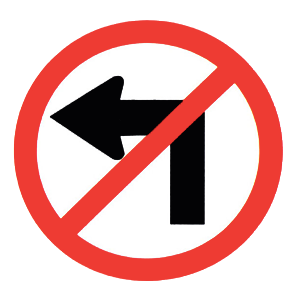
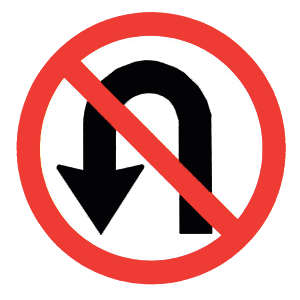
This sign means:
All traffic must turn left.
No left turn.
No U-turn.
Truck route to the left.
Q.24.
When you park uphill on a street with a curb:
Keep the front wheel straight and set the parking brake.
Turn the front wheels away from the curb.
Turn the front wheels toward the curb.
Turn the back wheels into the curb.
Q.25.
This sign means:
No left turn.
No stopping.
No U-turn.
Detour ahead.
Support mcqgeeks.com by disabling your adblocker.
×
Please disable the adBlock and continue.
Thank you.
Reload page