MCQGeeks
CBSE
JEE
NTSE
NEET
English
UK Quiz
Quiz
Driving Test
Practice
Games
Driving Test
North Dakota
North Dakota Motorcycle Driving Permit Test-3
Answers
Q.1.
Before changing lanes, you should:
Turn your head to check for vehicles in your blind spot.
Rely on your mirrors to show you all of your surroundings.
Point in the direction of the lane change.
Speed up to get ahead of other vehicles.
Q.2.
Shifting into a lower gear causes an effect similar to:
Using the brakes.
Accelerating.
Swerving.
Turning.
Q.3.
If your motorcycle starts to wobble, it is best to:
Downshift.
Accelerate.
Grip the handlebars firmly and close the throttle gradually.
Gradually apply your brakes.
Q.4.
Riding between two vehicles moving in the same direction:
Is illegal.
Is encouraged if traffic is heavy.
Is encouraged during the day to prevent traffic jams.
Is acceptable if the motorcyclist is comfortable with the move.
Q.5.
In any crash, you have a better chance of avoiding serious injury if you do all of the following, except:
Wear an approved helmet.
Wear face or eye protection.
Wear protective clothing.
Have a windshield.
Q.6.
Where is the horn button usually located?
By the left handgrip
By the right handgrip
By the left footrest
By the right footrest
Q.7.
The single most important thing you can do to improve your chances of surviving a crash is to:
Wear a high-quality helmet that is securely fastened.
Wear shorts.
Wear sneakers.
Wear goggles.
Q.8.
A plastic, shatter-resistant face shield:
Is not necessary if you have a windshield.
Only protects your eyes.
Protects more than just your eyes.
Does not protect your face as well as goggles.
Q.9.
Which of the following statements is true?
The front brake is more powerful than the rear brake.
The rear brake is more powerful than the front brake.
Both the front and rear brakes are equally powerful.
Q.10.
To lower the chance of a crash, you should do all of the following, except:
Be visible.
Communicate your intentions.
Be prepared to react to hazards.
Hope another driver sees you.
Q.11.
If the chain or belt of your motorcycle breaks, you will:
Experience a sudden increase in power to the rear wheel.
Experience a sudden loss of power to the rear wheel.
Experience a sudden loss of power to the front wheel.
Experience a sudden increase in power to the front wheel.
Q.12.
How is the accelerator controlled?
With the right hand
With the left hand
With the right foot
With the left foot
Q.13.
When an operator's left arm is extended straight out to the left, it means the operator:
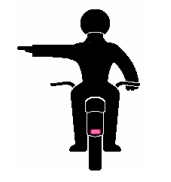
Plans to turn left.
Is about to stop.
Plans to turn right.
Is about to slow down.
Q.14.
If you find yourself riding alongside another vehicle, you should:
Speed up or slow down.
Wave at the other driver.
Stay alongside the vehicle until the next exit and then exit.
Let the other driver worry about it.
Q.15.
Where is the clutch lever usually located?
On the left handgrip
On the right handgrip
Near the left footrest
Near the right footrest
Q.16.
Swerving a motorcycle:
Requires a lot of traction.
Requires little traction.
Is a slow maneuver.
Should be done to avoid a hazard on a slippery road.
Q.17.
Which types of brakes do most motorcycles have?
Front and emergency
Rear and emergency
Front and rear
Only a front brake
Q.18.
When someone follows you too closely, you should:
Speed up.
Not worry about them and just focus on the road in front of you.
Change lanes and let them pass.
Ride on the shoulder and let them pass.
Q.19.
Taking a turn too fast:
Is acceptable as long as you stay under the speed limit.
Is safer on a motorcycle than in a car.
Is acceptable as long as no vehicles are near you.
Can cause you to end up in another lane or leave the road.
Q.20.
When a group of riders is passing another vehicle on a two-lane road, the riders should:
Pass in pairs.
Pass in a staggered formation with several riders passing at the same time.
Pass one at a time.
Avoid passing.
Q.21.
Mirror checks:
Should be part of your normal scanning routine.
Should be avoided because they will distract you.
Should be avoided since other drivers will see you easily.
Are only recommended in bad weather.
Q.22.
If a tire goes flat while riding and you must stop, it is usually best to:
Relax on the handgrips.
Shift your weight toward the good tire.
Brake on the good tire and steer to the side of the road.
Use both brakes and stop quickly.
Q.23.
The front brake:
Should only be used when you need to stop quickly.
Should be used only under slippery conditions.
Is not as effective as the rear brake.
Is safe to use, if used properly.
Q.24.
The center portion of a lane:
Is always the best part of the lane for a motorcycle.
Often contains oil and grease, but is usually safe for riding.
Often contains oil and grease, and is never safe for riding.
Is the smoothest part of the lane.
Q.25.
If your motorcycle is being chased by a dog, you should:
Kick the dog away.
Ride alongside the dog.
Stop until the dog loses interest.
Approach the dog slowly, then speed up.
Support mcqgeeks.com by disabling your adblocker.
×
Please disable the adBlock and continue.
Thank you.
Reload page