MCQGeeks
CBSE
JEE
NTSE
NEET
English
UK Quiz
Quiz
Driving Test
Practice
Games
Driving Test
Ohio
Ohio Motorcycle Driving Permit Test-1
Answers
Q.1.
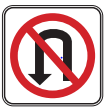
What does this sign mean?
No left turn
No U-turn
No right turn
Q.2.
When starting your motorcycle, the engine should be in:
First gear.
Neutral.
Third gear.
Q.3.
A pre-ride inspection should be done:
Before every ride.
Once a week.
Once a month.
Twice a month.
Q.4.
You should operate the engine cut-off switch and pull in the clutch when:
The throttle is stuck and you cannot free it.
You start to lose control in a curve.
The motorcycle starts to wobble.
Q.5.
To swerve correctly, you should:
Shift your weight quickly.
Turn the handlebars quickly.
Press the handgrip in the direction of the turn.
Q.6.
Compared to a car, a motorcycle needs _____ attention.
Less frequent
The same amount of
More frequent
Q.7.
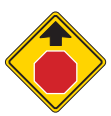
What does this sign mean?
Stop.
Yield to other drivers.
A stop sign is ahead.
Q.8.
When approaching an intersection, a motorcyclist should not:
Choose a lane position that increases their visibility.
Speed up to cross the intersection quickly.
Cover the clutch and brakes to reduce their reaction time.
Q.9.
When riding a motorcycle, you should:
Wear half-fingered gloves.
Wear full-fingered gloves.
Not wear gloves.
Q.10.
If a motorcycle rider takes a turn too fast, they may:
Have increased control of their motorcycle.
Experience a more stable ride.
Unintentionally leave the road.
Q.11.
Most motorcycle/automobile accidents occur:
At intersections.
On the open road.
In parking lots.
Q.12.
What does a flashing red traffic light mean?
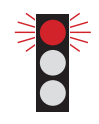
Come to a complete stop and proceed when it is safe to do so.
Only stop to yield to other traffic.
Vehicles will be entering the roadway.
Q.13.
Upshifting or downshifting in a curve:
Should only be done if it can be done smoothly.
Is better than shifting before the curve.
Is the best way to control your speed.
Q.14.
Making eye contact with another driver:
Means that they see you.
Doesn’t mean that they will properly yield to you.
Guarantees that they will properly yield to you.
Q.15.
When it starts to rain, it is usually best to:
Ride in the center of the lane.
Pull onto the shoulder and wait for it to stop raining.
Ride in the tire tracks left by other vehicles.
Q.16.
How many alcoholic drinks need to be consumed before the drinker's riding ability is affected?
One
Two
Three
Q.17.
If another driver makes eye contact with you:
You know that they have seen you.
It doesn’t always mean they've actually seen you.
They will properly yield to you.
Q.18.
To make it easier to be seen by other motorists, you should:
Wear brightly-colored clothing while riding.
Wear darkly-colored clothing while riding.
Wave your arms while riding.
Q.19.
If vehicles or other potential hazards are to your right, you should ride on which side of your lane?
Right
Left
Either side
Q.20.
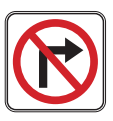
What does this sign mean?
No right turn
No left turn
No U-turn
Q.21.
If passing another vehicle:
You may exceed the speed limit until the pass is complete.
You may disregard no passing zone markings if you began the pass in a passing zone.
You must observe the posted speed limit.
Q.22.
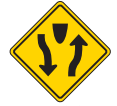
What does this sign mean?
Signal ahead
Crossroad ahead
Divided roadway ahead
Q.23.
A pre-ride inspection should include all of the following, except:
A tire check.
A test of the turn signals.
A paint inspection.
Q.24.
Which of the following is not a factor in determining a person's blood alcohol content (BAC)?
The amount of alcohol consumed
How quickly the alcohol is consumed
How often the person consumes alcohol
Q.25.
If your front wheel locks while you are braking, you should:
Keep the tire locked until your next stop.
Continue squeezing the front brake lever.
Release the front brake and immediately re-apply it.
Q.26.
If you are being chased by a dog, you should:
Stop your motorcycle until the animal loses interest.
Approach the animal slowly, then quickly accelerate away from the dog as it approaches.
Swerve around the animal.
Q.27.
Use your mirrors when stopping at an intersection:
To determine if drivers behind you are aware that you are stopping.
To watch for pedestrians ahead.
To look for dark clouds that may indicate poor weather conditions.
Q.28.
When entering a turn, you should:
Slow down.
Speed up.
Come to a complete stop.
Q.29.
When wearing a helmet at the time of a crash, a rider is:
Less likely to survive than a person who is not wearing helmet.
Just as likely to survive as a person not wearing a helmet.
More likely to survive than a person not wearing helmet.
Q.30.
A plastic, shatter-resistant face shield:
Protects your face, but not your eyes.
Protects your eyes, but not your whole face.
Helps protect your whole face.
Q.31.
If you get a flat tire while riding, you should:
Hold the handle grips firmly and stay off the brakes.
Shift your weight toward the good wheel and brake normally.
Brake on the good wheel while immediately pulling off the road.
Q.32.
If your rear wheel locks up while you are stopping on a surface with good traction, you should:
Keep the wheel locked until you have stopped completely.
Release the rear brake and only use the front brake.
Release the rear brake and then quickly re-apply the brake.
Q.33.
If you approach an uncontrolled intersection at the same time as another vehicle:
The vehicle on the left should yield to the vehicle on the right.
You should flash your headlight to signal that the other vehicle should proceed.
You should continue through the intersection and expect the other vehicle to stop.
Q.34.
Lanes of traffic moving in the same direction are separated by:
White lines.
Yellow lines.
Road signs.
Q.35.
Unlike other beverages, alcohol:
Is absorbed into the bloodstream right away.
Needs to be digested.
Doesn’t affect humans.
Q.36.
While riding, you should wear:
Hearing protection to prevent damage from long-term exposure to engine and wind noise.
A helmet to protect your hearing.
A baseball cap.
Q.37.
You should use a larger cushion of space:
When roads are slippery.
When it is sunny outside.
When it is colder than usual.
When you are following other motorcycles.
Q.38.
If you are transporting a passenger, they should:
Lean as you lean.
Hold onto the motorcycle seat.
Sit as far back as possible.
Never hold onto you.
Q.39.
A motorcyclist should attempt to avoid obstacles on the roadway. If avoiding an obstacle is not possible, the motorcyclist should:
Speed up before coming into contact with the object.
Stay seated so the seat can cushion some of the impact.
Try to approach the obstacle at as close to a 90-degree angle as possible.
Q.40.
To avoid confusing other drivers, you should:
Increase your following distance.
Turn off your turn signal after you complete a turn or lane change.
Use your horn only in emergency situations.
Support mcqgeeks.com by disabling your adblocker.
×
Please disable the adBlock and continue.
Thank you.
Reload page