MCQGeeks
CBSE
JEE
NTSE
NEET
English
UK Quiz
Quiz
Driving Test
Practice
Games
Driving Test
Ohio
Ohio Motorcycle Driving Permit Test-15
Answers
Q.1.
Helmets are:
Required for all riders.
Not required, but recommended.
Only required for inexperienced motorcycle users.
Q.2.
To reduce the chances of a collision, a motorcyclist should:
Stare straight in front of their motorcycle.
Be unwilling to move to avoid a potential hazard.
Scan their path of travel, looking at least 10 to 15 seconds ahead of their motorcycle.
Q.3.
When it starts raining, it is best to:
Get off the road.
Ride in the tire tracks left by other vehicles.
Ride in the center portion of the lane.
Q.4.
If your front wheel locks while you are braking, you should:
Keep the tire locked until your next stop.
Continue squeezing the front brake lever.
Release the front brake and immediately re-apply it.
Q.5.
Your motorcycle should fit you, meaning:
Your fingertips should barely reach the handlebars when you are seated on the motorcycle.
The seat should be one foot higher than your waist when you are standing next to the motorcycle.
Your feet should comfortably reach the ground when you are seated on the motorcycle.
Q.6.
To reduce your reaction time, you should:
Ride more slowly than the speed limit.
Shift into neutral when slowing.
Cover the clutch and the brakes.
Q.7.
Which of the following is not recommended as protective apparel for motorcycle users?
Long pants
Gloves
A baseball cap
Q.8.
Most motorcycle/automobile accidents occur:
At intersections.
On the open road.
In parking lots.
Q.9.
The best clothing for a motorcyclist:
Feels uncomfortable.
Provides protection in a crash.
Should not stand out to other motorists.
Q.10.
When carrying a passenger, a motorcycle responds to directional changes:
More slowly than usual.
More quickly than usual.
Normally.
Q.11.
If you will be carrying a passenger on your motorcycle, you will likely have to:
Reduce the tire pressure.
Make no tire pressure adjustments.
Increase the tire pressure.
Q.12.
To reduce the chances of a collision, a motorcycle rider should:
Maintain an adequate space cushion.
Ride very slowly.
Ride the centerline.
Q.13.
When you are being passed on the left, you should:
Speed up.
Ride in the right portion of the lane.
Ride in the center portion of the lane.
Q.14.
If a dog is chasing your motorcycle, you should:
Swerve around the dog.
Slow down, let the dog approach, and accelerate away from the animal.
Park and wait for the dog to lose interest.
Q.15.
As you consume more alcohol, your ability to safely ride:
Increases.
Stays the same.
Decreases.
Q.16.
How do convex mirrors differ from regular mirrors?
They provide a more narrow view of the road.
They provide a wider view of the road.
They provide a better view of the road.
Q.17.
Before starting a turn, a motorcyclist should change gears to:
Prevent a change in power in the middle of the turn.
Be able to keep both hands on the handle grips during the turn.
Prevent the motorcycle from slowing down.
Q.18.
Unlike other substances, alcohol:
Is very quickly absorbed into the bloodstream.
Needs to be digested to enter the bloodstream.
Can improve your riding ability.
Q.19.
When crossing angled railroad tracks, it is usually best to:
Use the shoulder of the road to slow down before crossing the tracks.
Walk your motorcycle across the tracks.
Continue straight within your lane to cross the tracks.
Q.20.
When riding near a truck:
If you cannot see the truck’s mirrors, the driver cannot see you.
You should not be able to see the truck’s mirrors.
You should concentrate on operating your motorcycle and not worry about the truck’s mirrors.
Q.21.
Hearing protection is:
Not recommended.
Recommended only for long rides.
Recommended for all rides.
Q.22.
A good way to handle a tailgater is to:
Speed up.
Allow them to get in front of you.
Make gestures at them.
Q.23.
If your rear wheel locks up while you are stopping on a surface with good traction, you should:
Keep the wheel locked until you have stopped completely.
Release the rear brake and only use the front brake.
Release the rear brake and then quickly re-apply the brake.
Q.24.
To minimize the potential for fatigue on a long trip, you should:
Drink coffee.
Limit your riding per day.
Play loud music.
Q.25.
Riding on ______ may provide poor traction.
Pavement markings
Dry pavement
The roadway under a bridge
Q.26.
When riding at night:
Only ride in the left portion of the lane to better see around other vehicles ahead.
Ride closely to the vehicle in front of you to most effectively use their headlights.
Reduce your speed to increase your chances of avoiding an unexpected hazard.
Q.27.
When riding behind a car, you should:
Ride in a position that will allow the other driver to see you in their rearview mirror.
Assume the driver sees you.
Ride in the far left portion of the lane.
Ride in the far right portion of the lane.
Q.28.
A plastic, shatter-resistant face shield:
Is not necessary if you have a windshield.
Only protects your eyes.
Helps protect your whole face.
Does not protect your face as effectively as goggles.
Q.29.
When being followed by a tailgater, you should:
Change lanes and let them pass or slow down to allow for more space ahead of your motorcycle.
Ignore them.
Increase your speed.
Q.30.
If you must brake and swerve to avoid danger, you should:
Use only the front brake while swerving.
Brake and swerve at the same time.
Either brake then swerve or swerve then brake.
Q.31.
When riding on a slippery surface, you should:
Avoid making sudden moves, as doing so could cause a skid.
Travel on the shoulder to be out of the way of traffic.
Use only the rear brake because the front brake is ineffective on slippery surfaces.
Q.32.
On a motorcycle, which brake provides the most stopping power?
The front brake
The rear brake
The emergency brake
Q.33.
Which of the following is not a potential problem?
An upcoming change in road surface characteristics
Surrounding traffic
Conditions that do not appear to change as you approach
Q.34.
If you must stop quickly, you should:
Use the front brake only.
Use the front brake first.
Use the front brake at the same time as the rear brake.
Q.35.
More than half of all crashes:
Occur at speeds greater than 35 mph.
Happen at night.
Are caused by worn tires.
Involve riders who have operated the involved motorcycle for less than six months.
Q.36.
To lessen the chances of a crash occurring, you should:
Not use turn signals.
Use proper lane positions.
Follow other vehicles closely.
Q.37.
When riding in a group on a straight road, motorcyclists should:
Ride in a single-file formation.
Pair up.
Stagger their formation.
Q.38.
When other vehicles are slowed or stopped:
A motorcyclist should not weave between lanes of traffic.
It is acceptable for a motorcyclist to weave in and out of traffic lanes.
A motorcyclist should ride in a straight line between two lanes.
Q.39.
As your motorcycle increases speed, you will:
Need to shift up through the gears.
Need to shift down through the gears.
Need to put the motorcycle into neutral.
Q.40.
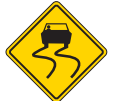
What does this sign mean?
Slippery when wet
Lanes shift
Yield
Support mcqgeeks.com by disabling your adblocker.
×
Please disable the adBlock and continue.
Thank you.
Reload page