MCQGeeks
CBSE
JEE
NTSE
NEET
English
UK Quiz
Quiz
Driving Test
Practice
Games
Driving Test
Ohio
Ohio Motorcycle Driving Permit Test-16
Answers
Q.1.
A passenger should sit:
In front of the operator.
Sidesaddle.
Behind the operator.
Q.2.
When a motorcyclist needs to stop quickly, they should:
Apply both brakes at the same time.
Use only the front brake.
Use only the rear brake.
Q.3.
When parked on the road, a motorcycle should:
Create an angle with the curb that is between 45 and 90 degrees.
Be parked without a wheel or fender touching the curb.
Be parked parallel to the curb.
Q.4.
Noise created by wind:
Is easy to get used to.
May cause irreversible hearing damage.
Is never a danger.
Q.5.
You should conduct a safety inspection of your motorcycle:
Before every ride.
Every week.
Once a month.
Q.6.
If a motorcycle is towing a trailer, the motorcyclist's following distance should:
Increase.
Decrease.
Be the same as it normally would be.
Q.7.
If you get a flat tire while riding, you should:
Hold the handle grips firmly and stay off the brakes.
Shift your weight toward the good wheel and brake normally.
Brake on the good wheel while immediately pulling off the road.
Q.8.
Who is required to wear a helmet on a moving motorcycle?
Only passengers
All motorcycle riders and passengers
No one
Q.9.
How should you brake?
With the front brake only
With the rear brake only
With both brakes
Q.10.
When approaching a blind intersection, you should:
Move into the portion of the lane that will bring you into another driver’s field of vision at the earliest possible moment.
Stop at the stop sign or signal and then proceed normally.
Flash your lights and sound your horn to alert other drivers to your presence.
Q.11.
To improve your chances of being seen, you should:
Use your headlight only at night or when conditions reduce visibility.
Always use your headlight.
Add an orange tint to your headlight.
Q.12.
Pick a lane position that:
Helps you avoid road hazards.
Hides you from other road users.
Places you directly next to another vehicle.
Q.13.
To avoid confusing other drivers, you should:
Increase your following distance.
Turn off your turn signal after you complete a turn or lane change.
Use your horn only in emergency situations.
Q.14.
When riding on a slippery surface, you should:
Handle your motorcycle roughly.
Not make sudden movements, if possible.
Use only your front brake.
Q.15.
Part of your normal scanning routine while riding should include:
Constantly looking in the rearview mirror.
Frequent rearview mirror checks.
Not using the rearview mirror.
Q.16.
Before riding, a motorcycle operator should check the clutch. A properly working clutch should feel:
Loose and rough.
Tight and smooth.
Loose and smooth.
Q.17.
An ideal lane position should:
Increase your ability to see and be seen.
Place you in other drivers’ blind spots.
Invite others to share your lane.
Q.18.
Increase your following distance if:
It is raining.
There is light traffic.
It is sunny.
Q.19.
You should flash your brake light to:
Tell other motorists that you are riding near them.
Help other motorists see your motorcycle while traveling in slow traffic.
Tell other motorists that you are going to slow down or stop where they don't expect you to do so.
Q.20.
Locking your brakes can:
Be helpful in most situations.
Improve steering.
Cause control problems.
Q.21.
After riding over an object on the road, you should:
Continue riding because the danger has passed.
Pull to the side of the road and check your tires and rims for damage.
Stop to remove the object from the road.
Q.22.
In areas where dangers could be present, a motorcyclist should:
Maintain their speed.
Assume they will be safe.
Cover the clutch and both brake levers to reduce their reaction time.
Q.23.
When positioning your body on the motorcycle:
You should hold yourself up with your arms.
Your arms should be used to steer the motorcycle.
You should have to stretch to reach the handgrips.
Q.24.
When approaching a blind intersection, riders should:
Stop at the stop line before moving forward to improve their view of cross traffic.
Ignore the stop line and move forward to get a better look.
Stop at the stop line then proceed through the intersection.
Q.25.
A sign that your rear tire has suddenly gone flat is that:
The back of your motorcycle is swaying from side to side.
You heard a loud noise.
A discharge of air can be seen.
Q.26.
It is illegal to operate a motorcycle with a minimum blood alcohol content (BAC) of:
0.08 percent.
0.1 percent.
0.3 percent.
Q.27.
A plastic, shatter-resistant face shield:
Protects your face, but not your eyes.
Protects your eyes, but not your whole face.
Helps protect your whole face.
Q.28.
Which of the following is not a benefit of maintaining a space cushion between your motorcycle and other vehicles?
You will have time to react to hazards.
You will have space to maneuver.
You will have more time to accelerate when entering a curve.
Q.29.
When riding a motorcycle, your lane position:
Has little impact on whether or not other drivers can see you.
Is very important because it may affect whether or not other drivers can see you.
Cannot protect you from wind blasts from other vehicles.
Q.30.
To swerve correctly, you should:
Shift your weight quickly.
Turn the handlebars quickly.
Press the handgrip in the direction of the turn.
Q.31.
What does a traffic signal displaying a solid red arrow mean?
Drivers must come to a complete stop.
Drivers may proceed through the intersection with caution.
Drivers must yield to oncoming traffic.
Q.32.
You have an improved chance of surviving a crash if you wear:
A DOT-compliant helmet.
A baseball cap.
Comfortable shoes.
Q.33.
If bright sunlight makes it difficult for drivers to see a motorcycle's mechanical turn signals, the rider should:
Continue to use the mechanical turn signals.
Honk their horn to inform other drivers of any upcoming turns.
Use hand signals.
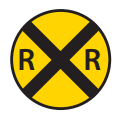
Q.34.
What does this sign mean?
Railroad crossing ahead
Yield
Reduce speed
Q.35.
When riding over grooved pavement in a work zone, you should:
Look down to watch for changes in the road surface.
Keep your head and eyes up.
Move to the edge of the roadway.
Q.36.
A motorized scooter can:
Only be operated during the day.
Be operated without a driver license.
Be operated with any class of driver license.
Q.37.
To minimize the potential for fatigue, you should:
Turn on the radio.
Take frequent rest breaks.
Drink caffeine.
Q.38.
If you have a passenger aboard your motorcycle, you should do all of the following, except:
Ride at speeds that are slower than usual.
Allow more distance to stop than usual.
Tell the passenger to hold onto the back of the bike.
Q.39.
A motorcycle’s brake light is _________ a passenger vehicle’s brake light.
More noticeable than
Just as noticeable as
Not as noticeable as
Q.40.
The single most important thing you can do to improve your chances of surviving a crash is to:
Wear a high-quality helmet that is securely fastened.
Wear shorts.
Wear sneakers.
Wear goggles.
Support mcqgeeks.com by disabling your adblocker.
×
Please disable the adBlock and continue.
Thank you.
Reload page