MCQGeeks
CBSE
JEE
NTSE
NEET
English
UK Quiz
Quiz
Driving Test
Practice
Games
Driving Test
Ohio
Ohio Motorcycle Driving Permit Test-2
Answers
Q.1.
You are most likely to get into a collision:
At an intersection.
When riding in a group.
Traveling on the expressway.
Q.2.
When preparing to ride with a passenger, instruct the passenger to:
Get onto the motorcycle before you.
Sit as far back as possible.
Hold firmly onto your waist, hips, or belt.
Q.3.
A plastic, shatter-resistant face shield:
Is not necessary if you have a windshield.
Only protects your eyes.
Helps protect your whole face.
Q.4.
Which of the following materials provides the best protection for motorcycle riders?
Fleece
Leather
Denim
Q.5.
When carrying a passenger, a motorcycle takes:
Less time than usual to stop and speed up.
The same amount of time to stop and speed up as it usually does.
More time than usual to stop and speed up.
Q.6.
Helmets are:
Required for all riders.
Not required, but recommended.
Only required for inexperienced motorcycle users.
Q.7.
When sitting on a motorcycle, you should:
Use your arms to hold up your body.
Sit at an angle so your arms can support your weight.
Sit so you can use your arms to control the motorcycle.
Q.8.
When consumed together, the effects of alcohol and drugs:
Are less dangerous than when either is consumed alone.
Often balance out.
Can be more pronounced than when either is consumed alone.
Q.9.
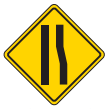
What does this sign mean?
Right lane ends
Left lane ends
Traffic control device ahead
Q.10.
What should be your first consideration when buying a motorcycle helmet?
Appearance
Protection
Price
Q.11.
A windshield:
Is a good substitute for a face shield.
Does not completely protect your eyes from the wind.
Is required on all motorcycles.
Should be used on windy days.
Q.12.
When riding behind another vehicle, you should position yourself:
To be seen in the vehicle’s side mirror.
To be seen in the vehicle’s rearview mirror.
To be seen through the vehicle's passenger window.
Q.13.
When carrying a passenger, a motorcycle responds to directional changes:
More slowly than usual.
More quickly than usual.
Normally.
Q.14.
Before starting out, you should make sure the fuel valve is:
Open.
Closed.
Covered.
Q.15.
Which factor does not play a major role in affecting your blood alcohol content (BAC)?
Age
The amount of alcohol consumed
Body weight
Q.16.
Passengers should:
Look over their shoulder when taking a turn or curve.
Never hold onto the rider.
Sit as far back as possible.
Q.17.
On a motorcycle, which brake provides the most stopping power?
The front brake
The rear brake
The emergency brake
Q.18.
Hearing protection is:
Not recommended.
Recommended only for long rides.
Recommended for all rides.
Q.19.
When riding in the rain, you should:
Ride down the center of your lane.
Ride on the right side of your lane.
Ride in tire tracks left by other cars.
Q.20.
When riding during the day, you should:
Wear dark clothes since it is light outside.
Wear bright clothes so other motorists can see you better.
Be comfortable, wearing shorts if it is hot.
Q.21.
Part of your normal scanning routine while riding should include:
Constantly looking in the rearview mirror.
Frequent rearview mirror checks.
Not using the rearview mirror.
Q.22.
Your lane position should do all of the following, except:
Increase your ability to be seen.
Help you avoid surface hazards.
Invite other road users into your lane.
Q.23.
When riding a motorcycle, you should:
Always wear a jacket.
Only wear a jacket at night.
Only wear a jacket if it is cold outside.
Q.24.
When it starts to rain, it is usually best to:
Ride on the right side of the lane.
Ride on the edge of the road.
Ride in the tire tracks left by cars.
Q.25.
If bright sunlight makes it difficult for drivers to see a motorcycle's mechanical turn signals, the rider should:
Continue to use the mechanical turn signals.
Honk their horn to inform other drivers of any upcoming turns.
Use hand signals.
Q.26.
Who is required to wear a helmet on a moving motorcycle?
Only passengers
All motorcycle riders and passengers
No one
Q.27.
The human body removes alcohol at a rate of:
About one drink per hour.
About two drinks per hour.
About three drinks per hour.
Q.28.
When riding in a group, mirrors:
Should be checked frequently by all riders.
Should be used only by the lead rider.
Should not be checked frequently because they can be a distraction.
Q.29.
Which of the following is not a benefit of maintaining a space cushion between your motorcycle and other vehicles?
You will have time to react to hazards.
You will have space to maneuver.
You will have more time to accelerate when entering a curve.
Q.30.
When riding at night, maintain a minimum following distance of:
Two seconds.
Three seconds.
Four seconds.
Q.31.
Noise created by wind:
Is easy to get used to.
May cause irreversible hearing damage.
Is never a danger.
Q.32.
The single most important thing you can do to improve your chances of surviving a crash is to:
Wear a high-quality helmet that is securely fastened.
Wear shorts.
Wear sneakers.
Wear goggles.
Q.33.
When riding at night, you should:
Move closer to the vehicle in front of you so you can use its lights to see farther down the road.
Keep riding at your normal speed to lower the risk of being struck from behind.
Reduce your speed and increase your following distance.
Q.34.
There is the greatest potential for conflict between a motorcycle and other traffic:
On the highway.
At intersections.
On rural roads.
Q.35.
To lessen the chances of a crash occurring, you should:
Not use turn signals.
Use proper lane positions.
Follow other vehicles closely.
Q.36.
To help others see your motorcycle, you should:
Use your headlight.
Weave in your lane.
Maintain eye contact with other road users.
Q.37.
Oil drippings and debris often collect in ______ of a lane.
The left portion
The middle portion
The right portion
Q.38.
A sign that your front tire has gone flat is that your steering suddenly feels:
Heavy.
Loose.
Soft.
Q.39.
When riding a motorcycle, your feet should be:
On the footrests for balance.
Pointed with your toes aiming downward.
Relaxed.
Q.40.
When attempting to pass another vehicle, you should:
Ride within the posted speed limits.
Exceed the posted speed limit to complete the pass, but not by more than 10 mph.
Pass more than one vehicle at a time.
Support mcqgeeks.com by disabling your adblocker.
×
Please disable the adBlock and continue.
Thank you.
Reload page