MCQGeeks
CBSE
JEE
NTSE
NEET
English
UK Quiz
Quiz
Driving Test
Practice
Games
Driving Test
Ohio
Ohio Motorcycle Driving Permit Test-7
Answers
Q.1.
There may be less traction available for braking when:
A motorcycle is leaning.
A motorcycle is straight up and down.
A motorcycle is on dry pavement.
Q.2.
Which material provides the best protection in the case of a crash?
Denim
Leather or synthetic materials
Wool
Q.3.
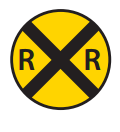
What does this sign mean?
Railroad crossing ahead
Yield
Reduce speed
Q.4.
When approaching a blind intersection, riders should:
Stop at the stop line before moving forward to improve their view of cross traffic.
Ignore the stop line and move forward to get a better look.
Stop at the stop line then proceed through the intersection.
Q.5.
How can you get sober after drinking alcohol?
Wait.
Drink coffee.
Exercise.
Q.6.
To properly control a motorcycle, you should:
Allow your feet to hang off the footrests.
Sit so your arms hold up your body.
Keep your knees against the gas tank.
Q.7.
When selecting a helmet, make sure it is all of the following, except:
Designed to meet U.S. Department of Transportation standards.
Snug.
Defect-free.
Attractive.
Q.8.
Which of the following is not recommended as protective apparel for motorcycle users?
Long pants
Gloves
A baseball cap
Q.9.
If using saddlebags to carry a load, you should:
Load the bags as evenly as possible.
Unevenly distribute weight into the saddlebags.
Place as much weight as possible into one saddlebag.
Q.10.
When riding behind a car, traveling in the center portion of the lane:
Allows you to be seen in its rearview mirror.
Usually makes it difficult for the driver to see you.
Should be avoided.
Q.11.
Which lane position is usually best for minimizing the risk of other vehicles sharing your lane?
The left portion of the lane
The center portion of the lane
The right portion of the lane
Q.12.
The front brake:
Should only be used when you need to stop quickly.
Should be used only under slippery conditions.
Is not as effective as the rear brake.
Is safe to use, if used properly.
Q.13.
When positioning your body on the motorcycle:
You should hold yourself up with your arms.
Your arms should be used to steer the motorcycle.
You should have to stretch to reach the handgrips.
Q.14.
Under normal conditions, a motorcyclist should maintain a following distance of at least:
Two seconds.
Three seconds.
Four seconds.
Q.15.
When riding in a group, riders should:
All maintain safe following distances.
Follow each other as closely as possible.
Not worry about distances between members.
Q.16.
When motorcyclists ride in a group:
Inexperienced riders should lead the group.
Inexperienced riders should be near the front of the group.
Inexperienced riders should be in the back of the group.
Q.17.
The gearshift is located:
By the left footrest.
By the right footrest.
By the right handle grip.
Q.18.
When riding in a group, inexperienced riders should be:
In the front.
Just behind the lead rider.
In the rear.
Q.19.
If you need to react to a hazard in the road, do not:
Avoid communicating with other drivers.
Adjust your speed accordingly.
Make your presence known by sounding your horn and/or using lights or signals.
Q.20.
Having only one alcoholic drink before riding:
Will not lead to a DUI conviction.
Will never affect your riding skills.
Can affect your ability to operate a motorcycle.
Q.21.
Long-term exposure to wind noise:
Is not a danger.
Can cause irreversible hearing damage.
Is just part of riding a motorcycle.
Q.22.
The best way to avoid fatigue when riding your motorcycle on a long trip is to:
Take frequent breaks to rest.
Ride as fast as possible.
Take artificial stimulants.
Q.23.
If wearing a jacket for protection while riding in hot weather, you should:
Take frequent breaks to cool off.
Remove the jacket to stay cool while in the sun.
Keep the jacket on to protect you from the heat.
Q.24.
Of the following, which is not a reason to keep a cushion of space between your motorcycle and the vehicle in front of you?
It allows you more time to respond to hazards.
It prevents you from finding an escape route.
It provides space to maneuver your motorcycle.
Q.25.
If possible, do not ride directly next to another vehicle because:
Another driver may want to use your lane to pass.
You may be in the vehicle’s blind spot.
You may have access to escape routes.
Q.26.
During normal turns:
The motorcycle and rider should lean in the same direction.
The motorcycle and rider should lean in opposite directions.
The motorcycle should not lean.
Q.27.
You approach an emergency vehicle that is stopped on the side of the road while using its flashing lights. You should:
Stop on the roadway behind the emergency vehicle.
Stop and wait until the emergency vehicle begins moving again.
Merge into a lane away from the emergency vehicle.
Q.28.
When slowing or stopping a motorcycle, you should:
Not change gears.
Shift up through the gears.
Shift down through the gears.
Q.29.
It is most important to flash your brake light when:
Switching into a neutral gear.
You will be slowing suddenly.
There is a stop sign ahead.
Your signals are not working.
Q.30.
Before riding, a motorcycle operator should check the clutch. A properly working clutch should feel:
Loose and rough.
Tight and smooth.
Loose and smooth.
Q.31.
In the center of a traffic lane, there is usually an oily strip. Motorcyclists should:
Avoid riding on the oil and grease buildup.
Not worry about the oil and grease buildup.
Search for the lane with the smallest amount of oil and grease buildup.
Q.32.
If vehicles are present on both sides of you motorcycle, which lane position is usually the best option?
Left
Right
Center
Q.33.
To reduce your reaction time, you should:
Ride more slowly than the speed limit.
Shift into neutral when slowing.
Cover the clutch and the brakes.
Q.34.
A solid white line on the side of the road indicates:
No parking is permitted.
The right edge of a traffic lane.
Traffic must merge.
Q.35.
If you borrow a motorcycle, you should:
Assume all controls are in the same location as they are on your motorcycle.
Immediately take it out on the highway.
Get familiar with it in a controlled area.
Q.36.
When traveling at night, it is:
Easier to judge distances than it is during the day.
About as easy to judge distances as it is during the day.
More difficult to judge distances than it is during the day.
Q.37.
If you have only one drink before riding:
You cannot be arrested for drinking and riding.
Your riding skills will not be affected.
It can affect your ability to operate a motorcycle.
Q.38.
If a dog is chasing your motorcycle, you should:
Swerve around the dog.
Slow down, let the dog approach, and accelerate away from the animal.
Park and wait for the dog to lose interest.
Q.39.
The formation you should take when riding in a group:
Is always single-file.
Depends on the situation.
Is always staggered.
Q.40.
A passenger should sit:
In front of the operator.
Sidesaddle.
Behind the operator.
Support mcqgeeks.com by disabling your adblocker.
×
Please disable the adBlock and continue.
Thank you.
Reload page