MCQGeeks
CBSE
JEE
NTSE
NEET
English
UK Quiz
Quiz
Driving Test
Practice
Games
Driving Test
Ohio
Ohio Motorcycle Driving Permit Test-8
Answers
Q.1.
When riding a motorcycle:
The mirrors provide a perfect view.
The mirrors do not show your blind spots.
The mirrors should not be used, except when parking.
Q.2.
Alcohol reaches the brain ________ being consumed.
Within minutes of
About an hour after
About two hours after
Q.3.
To be effective, eye or face shield protection must:
Fasten securely.
Restrict your vision to the sides so you can focus on the road ahead.
Not allow eyeglasses or sunglasses to be worn.
Q.4.
Which brake is more powerful on a motorcycle?
The front brake
The rear brake
Both brakes are equally powerful.
Q.5.
If your front wheel locks while you are braking, you should:
Keep the tire locked up, as it will help you stop more quickly.
Release the front brake and only use the rear brake.
Release the front brake immediately and re-apply it.
Q.6.
Convex mirrors:
Provide a narrow view of the road behind you.
Provide a wide view of the road behind you.
Are illegal.
Q.7.
When you are being passed, you should:
Ride in the left portion of the lane.
Ride in the center portion of the lane.
Ride in the right portion of the lane.
Q.8.
The best way to stay out of trouble while riding a motorcycle is to:
Look well ahead of your motorcycle.
Avoid high-density traffic areas.
Ride at speeds faster than the speed limit.
Q.9.
Your motorcycle should fit you, meaning:
Your fingertips should barely reach the handlebars when you are seated on the motorcycle.
The seat should be one foot higher than your waist when you are standing next to the motorcycle.
Your feet should comfortably reach the ground when you are seated on the motorcycle.
Q.10.
A person with a minimum blood alcohol content (BAC) of ____ is considered intoxicated.
0.02 percent
0.04 percent
0.08 percent
Q.11.
The risk of a head or neck injury is reduced:
By wearing a helmet.
By riding more slowly.
By reading the owner’s manual.
Q.12.
When carrying a load, it should be:
Secured as high as possible.
Secured as low as possible.
Secured on a sissy bar.
Q.13.
When riding, jackets and pants should:
Fit loosely enough to allow the wind to catch the fabric.
Be snug enough to keep from flapping in the wind.
Be tight enough to prevent you from moving freely.
Q.14.
When riding at night, you should:
Increase your speed.
Increase your following distance.
Decrease your following distance.
Q.15.
When buying a motorcycle helmet, you should be most concerned about the helmet's:
Price.
Protection.
Appearance.
Q.16.
A passenger on a motorcycle should:
Put their feet on the ground when the motorcycle is stopped.
Not ride without a back rest.
Sit as far forward as possible without crowding the operator.
Q.17.
When it is raining, it is usually best to:
Ride in the center of the lane.
Pull off to the side of the road until the rain stops.
Ride in the tire tracks left by cars.
Increase your speed.
Q.18.
To lessen your chances of an accident, you should:
Only ride in the afternoon.
Follow the vehicle in front of you as closely as possible.
Not look ahead and focus only on your controls.
Communicate your intentions to other drivers.
Q.19.
The safest part of the lane:
Is always the left portion of the lane.
Is always the right portion of the lane.
Changes depending on the situation.
Q.20.
Improper braking:
Usually has no consequences.
Is a significant contributing factor to many motorcycle crashes.
Should not be a concern, since the motorcycle has two brakes.
Q.21.
If your front wheel locks while you are stopping, you should:
Continue to apply the front brake.
Release the front brake and only use the rear brake.
Immediately release the front brake, then re-apply the brake firmly.
Q.22.
A driver making eye contact with you:
Means that they see you.
Will never happen.
Does not mean that they will properly yield to you.
Guarantees that they will properly yield to you.
Q.23.
As a rider, you can lessen your chances of being involved in an accident by:
Not looking ahead for hazards.
Refraining from using turn signals, as doing so could distract other drivers.
Being visible to other drivers.
Q.24.
When traveling in a group, riders should generally be:
In a single-file formation.
Paired up.
In a staggered formation.
Q.25.
When it starts raining, it is best to:
Get off the road.
Ride in the tire tracks left by other vehicles.
Ride in the center portion of the lane.
Q.26.
When traveling at night, you should:
Ride as fast as you would if riding during the day.
Ride more slowly than you would if riding during the day.
Ride faster than you would if riding during the day.
Q.27.
The best way to stop quickly is to:
Use the front brake only.
Use the front brake first.
Throttle down and use the front brake.
Use both brakes at the same time.
Q.28.
You are riding over bridge gratings and your motorcycle has begun to weave. You should:
Speed up to get over the surface faster.
Ride in a zigzagging motion.
Maintain a steady speed and ride straight across the gratings.
Q.29.
When parked on the road, a motorcycle should:
Create an angle with the curb that is between 45 and 90 degrees.
Be parked without a wheel or fender touching the curb.
Be parked parallel to the curb.
Q.30.
When braking on a motorcycle:
The rear brake should be applied first.
The front brake should be applied first.
The front and rear brakes should be applied at the same time.
Q.31.
If you have a passenger aboard your motorcycle, you should do all of the following, except:
Ride at speeds that are slower than usual.
Allow more distance to stop than usual.
Tell the passenger to hold onto the back of the bike.
Q.32.
If you are riding behind another vehicle at night, you can determine if there are bumps on the road ahead by:
Listening for the other vehicle scraping against the pavement.
Noticing the other vehicle’s taillights bouncing up and down.
Looking at the rear bumper of the vehicle ahead and trying to determine if it is bouncing.
Q.33.
More than half of all crashes:
Occur at speeds greater than 35 mph.
Happen at night.
Are caused by worn tires.
Involve riders who have operated the involved motorcycle for less than six months.
Q.34.
You have an improved chance of surviving a crash if you wear:
A DOT-compliant helmet.
A baseball cap.
Comfortable shoes.
Q.35.
In general, which position within a lane is the best to ride in?
The left position
The right position
There is no single best lane position.
Q.36.
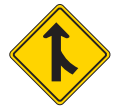
What does this sign mean?
Two-way traffic
Right lane ends
Merge
Q.37.
When choosing a helmet, you should ensure that it:
Has no cracks or defects.
Looks nice.
Fits loosely.
Q.38.
If the front wheel locks, you should:
Release the front brake immediately, then re-apply the brake.
Release the front brake immediately and only use the rear brake.
Keep the front wheel locked until you come to a stop.
Q.39.
A plastic, shatter-resistant face shield can protect you from:
Noise.
Dust.
Glare.
Q.40.
When changing lanes, you should:
Use your mirrors and look over your shoulder.
Use your mirrors. You do not need to look over your shoulder unless you notice something unusual.
Either use your mirrors or look over your shoulder.
Support mcqgeeks.com by disabling your adblocker.
×
Please disable the adBlock and continue.
Thank you.
Reload page