MCQGeeks
CBSE
JEE
NTSE
NEET
English
UK Quiz
Quiz
Driving Test
Practice
Games
Driving Test
Oklahoma
Oklahoma Car Driving Permit Test-18
Answers
Q.1.
This sign means:
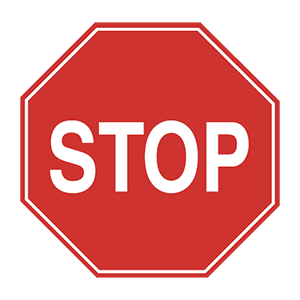
Stop.
Merge.
Upcoming change in direction.
Q.2.
Every motor vehicle in the state of Oklahoma is required to be covered by liability insurance.
True
False
Q.3.
If the driver of an oncoming vehicle fails to dim their headlights:
Look toward the center of the roadway.
Look toward the right side of the road.
Look straight ahead.
Q.4.
Double solid yellow lines painted down the middle of the road mean:
Railroad crossing ahead.
Pedestrian crossing ahead.
Passing is not permitted from either direction.
Passing is permitted from either direction.
Q.5.
Before turning, you should:
Use your signal.
Turn the wheel.
Increase your speed.
Change lanes.
Q.6.
The maximum posted speed limit should be driven only:
During the night.
During the day.
Under ideal conditions.
Q.7.
When two vehicles arrive to an intersection at the same time, which one has the right-of-way when no signs or signals indicate rules?
The car approaching from the right has the right-of-way.
The car approaching from the left has the right-of-way.
The car in which the driver sounds his horn first has the right-of-way.
The car that is traveling the fastest has the right-of-way.
Q.8.
When driving past a vehicle that has just stopped in a parked position on the side of the road, you should:
Assume that the driver will open the car door as you approach.
Speed up.
Slam on your brakes.
Assume that the driver will wait for you to pass before opening the door.
Q.9.
In a vehicle equipped with airbags, the safest place for children ageand under to ride is in:
The front seat.
The back seat.
The bed of a pick-up truck.
Q.10.
If you plan to pass another vehicle, you should:
Not assume the other driver will make space for you to return to your lane.
Assume the other driver will let you pass if you use your turn signal.
Assume the other driver will maintain a constant speed.
Q.11.
Unless otherwise posted, the speed limit on country roads is:
25 mph.
35 mph.
45 mph.
55 mph.
Q.12.
You must stop at a railroad crossing when:
Directed to do so by a flagger.
It is controlled by a stop sign.
Flashing red signals and gates are present and operating.
All of the above.
Q.13.
The driver's left arm and hand are extended upward. This hand signal means that the driver plans to:
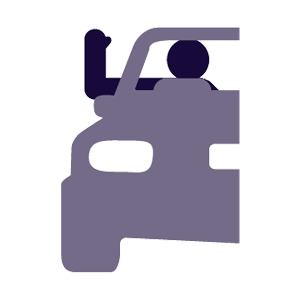
Turn left.
Turn right.
Come to a stop.
Go straight ahead.
Q.14.
If you parallel park facing downward on a hill:
Turn your wheels sharply toward the side of the road.
Turn your wheels away from the side of the road.
Keep your wheels straight.
Q.15.
You come to an intersection that is blocked by other traffic. You should:
Go slowly until the traffic ahead moves.
Get as close as possible to the car in front of you.
Stay out of the intersection until you can pass through.
Sound your horn to make the cars move up.
Q.16.
Alcohol in any concentration is:
A stimulant.
A depressant.
Neither of the above.
Q.17.
If an approaching train is near enough or going fast enough to be a danger, you must:
Slow down and proceed with caution.
Not cross the tracks until the train has completely passed.
Cross the tracks at your own risk.
Find an alternative route across tracks.
Q.18.
Which is the most common cause of traffic crashes?
New drivers
Human error
Bad weather
Bad roads
Q.19.
Because driving involves some risk, it is wise to continually improve your driving and observation skills.
True
False
Q.20.
A driver approaching a flashing red traffic signal must:
Slow down at the light.
Drive carefully without stopping.
Merge to the right.
Stop before entering the intersection.
Support mcqgeeks.com by disabling your adblocker.
×
Please disable the adBlock and continue.
Thank you.
Reload page