MCQGeeks
CBSE
JEE
NTSE
NEET
English
UK Quiz
Quiz
Driving Test
Practice
Games
Driving Test
Oregon
Oregon Car Driving Permit Test-20
Answers
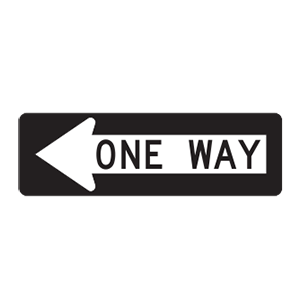
Q.1.
If you’re going to turn left onto a one-way street, you should complete the turn into:
The right lane.
The lane closest to your previous lane.
Either lane.
Neither lane.
Q.2.
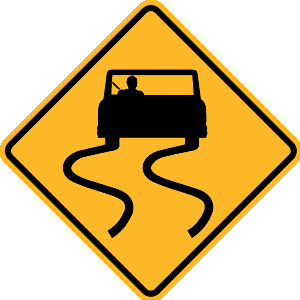
This sign means:
Don't drink if you are going to drive.
Slippery when wet.
Road curves ahead.
You are approaching a hill.
Q.3.
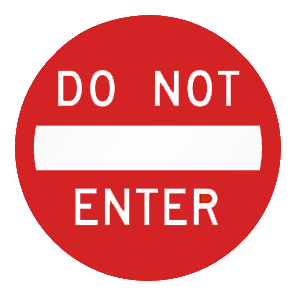
This sign means:
Stop.
No U-turn.
Yield.
Do not enter.
Q.4.
You have the right-of-way when turning left on which of the following traffic signals?
A solid green light
A flashing yellow light
A green arrow pointing left
A flashing red light
Q.5.
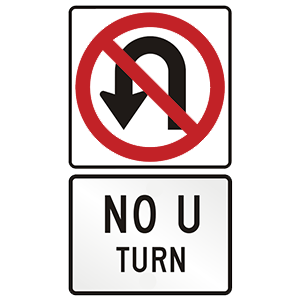
This sign means:
U-turns are prohibited.
U-turns are permitted.
Winding road ahead.
Sharp left turn ahead.
Q.6.
Which of the following is true about driving on a wet roadway?
As you drive faster, your tires become less effective.
Water does not affect cars with good tires.
Deep water is less dangerous than shallow water.
As you decrease your speed, the roadway becomes more slippery.
Q.7.
A bicyclist who doesn’t obey traffic laws:
Is in the right because bicyclists don’t have to obey traffic laws.
Can be ticketed.
Will always receive a warning from law enforcement.
Will have their bicycle impounded.
Q.8.
Lanes of traffic moving in the same direction are divided by ____ lines.
Yellow
White
Red
Black
Q.9.
Traffic signals sometimes display arrows to control turns from specific lanes. A green arrow:
Is used only on one-way streets.
Has the same meaning as a circular green traffic light, but traffic must turn in the direction indicated by the arrow.
Means that you may proceed, but only if the green arrow is accompanied by a circular green light.
Points the way to an airport.
Q.10.
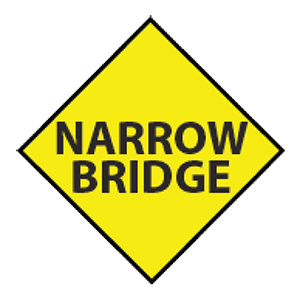
This sign means:
Trucks are permitted on an upcoming narrow bridge.
The bridge ahead is open to one-way traffic only.
The bridge ahead is wide enough for only one car at a time.
The bridge ahead may be too narrow to meet or pass a truck.
Q.11.
If you are driving on the interstate and pass your exit, you should:
Quickly cut across traffic to make your turn.
Make a U-turn to go back to the exit.
Continue driving and use the next exit.
Put your vehicle in reverse to go back to the exit.
Q.12.
A person who drives much slower than the speed limit:
Is a very safe driver.
Always has the right-of-way.
Should not let following cars pass.
May create a dangerous driving environment.
Q.13.
You are involved in an accident and another person is injured. You should:
Moved the injured away from the scene immediately.
Always leave the injured where they are.
Not move the injured unnecessarily. Keep the injured warm and administer first aid.
Stay away from the injured.
Q.14.
This sign means:
One-way traffic.
Two-way left turn.
Two-way traffic.
Minimum speed limit.
Q.15.
On the freeway, you see a "Merging traffic“ sign. You should:
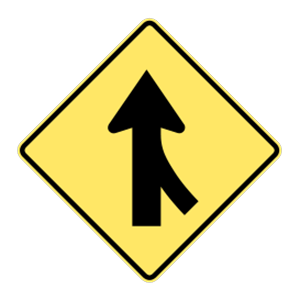
Honk at incoming traffic.
Always remain at your present speed.
Speed up to avoid congesting traffic.
Move to another lane, if safe, to let traffic enter.
Q.16.
A driver should be extra alert to motorcyclists, bicyclists, and pedestrians because:
They’re difficult to see in traffic.
They obey different traffic laws than larger motor vehicles.
They always have the right-of-way.
They don’t have rearview mirrors.
Q.17.
By driving a motor vehicle on the roadways in Oregon, you have agreed to:
Maintain liability insurance for as long as you drive.
Take a breath, blood, or urine test if arrested for driving under the influence.
Post bail or appear in court if arrested for a traffic violation.
Keep your vehicle’s equipment in safe operating condition.
Q.18.
Do not pass:
On a hill or curve.
When school bus lights are flashing.
When approaching an intersection.
All of the above.
Q.19.
If two drivers arrive at the same time to a four-way intersection controlled by stop signs:
The driver on the right has the right-of-way.
The driver on the left has the right-of-way.
One driver may continue driving without stopping.
One driver should honk to indicate that they are giving up the right-of-way.
Q.20.
Which of the following is a safe way to drive through a curve?
Slow down as you enter, speed up as you exit.
Maintain a constant speed throughout the curve.
Speed up as you enter, slow down as you exit.
Stay near the right edge of your lane.
Q.21.
At an intersection with a stop sign, you should stop and:
Check your rearview mirror for cars tailgating.
Move when the vehicle ahead of you moves.
Look right first, then left, then right again.
Look left first, then right, then left again.
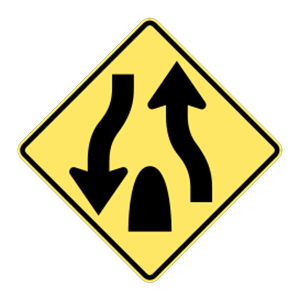
Q.22.
This sign means:
Curves ahead.
Divided highway starts.
Divided highway ends.
Bumps in the road.
Q.23.
A speed limit is:
The maximum or minimum legal speed you can travel on a road under dangerous conditions.
The maximum or minimum legal speed you can travel on a road under ideal conditions.
The suggested speed to travel on a road under ideal conditions.
None of the above.
Q.24.
Downward-facing triangular signs:
Indicate school zones.
Tell drivers to yield.
Indicate construction zones.
Indicate railroad crossings.
Q.25.
Crossbuck signs indicate:
Railroad crossings.
School zones.
No passing zones.
Hospitals.
Q.26.
A driver entering public traffic from a driveway or private road:
Has the right-of-way.
Should yield to drivers already on the public road.
May force their way into traffic.
Can assume that other drivers will change lanes to make room.
Q.27.
If your vehicle begins to skid, you should:
Overcorrect.
Turn your steering wheel into traffic.
Turn your steering wheel in the direction you want to go.
Release the steering wheel.
Q.28.
Round signs indicate:
No passing zones.
School zones.
Upcoming railroad crossings.
Hospitals.
Q.29.
When may you proceed through an intersection that has a stop sign but no stop line or crosswalk?
After slowing down to verify that there is no cross traffic
After coming to a complete stop and verifying that it is safe to proceed
After you have stopped at least 20 feet prior to the intersection
After slowing down to a speed of 10 mph
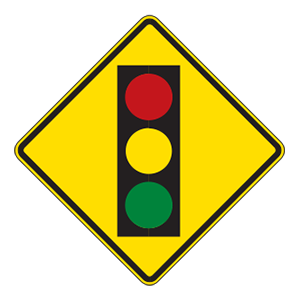
Q.30.
This sign means:
Traffic signal.
Fire station.
T intersection.
Left turn signal.
Q.31.
A single broken white line down the center of a two-lane road indicates:
Lanes are moving in opposite directions and drivers are not permitted to pass.
Lanes are moving in opposite directions and drivers are permitted to pass when it is safe to do so.
Lanes are moving in the same direction and drivers are not permitted to pass.
Lanes are moving in the same direction and drivers are permitted to pass when it is safe to do so.
Q.32.
To help prevent crashes, you should:
Communicate with other road users.
Ignore other drivers on the road.
Drive only on side streets and back roads.
Avoid driving during rush hour.
Q.33.
From the center lane, which maneuver(s) can you perform?
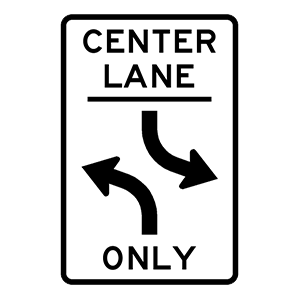
You may make left turns.
You may make U-turns.
You may pass slow-moving traffic.
All of the above.
Q.34.
When approaching an uncontrolled intersection, a driver should:
Maintain their speed and proceed.
Stop at the intersection, check in all directions, and proceed.
Yield to all other drivers.
Be prepared to yield.
Q.35.
Which is the most common cause of traffic crashes?
New drivers
Human error
Bad weather
Bad roads
Support mcqgeeks.com by disabling your adblocker.
×
Please disable the adBlock and continue.
Thank you.
Reload page