MCQGeeks
CBSE
JEE
NTSE
NEET
English
UK Quiz
Quiz
Driving Test
Practice
Games
Driving Test
Oregon
Oregon Car Driving Permit Test-21
Answers
Q.1.
What is the only way to reduce your blood alcohol concentration (BAC)?
Drink coffee.
Exercise.
Allow your body time to get rid of the alcohol.
Take a cold shower.
Q.2.
You may not park:
On a hill.
In a parking lot.
On a crosswalk or in a marked bicycle lane.
Within 12 inches of the right side of the road.
Q.3.
When you see an emergency vehicle with flashing lights, you must:
Slow down and keep moving in your lane.
Keep driving in your lane.
Pull to the right curb and stop.
Stop exactly where you are.
Q.4.
What does a flashing yellow traffic light mean?
Merging traffic
Proceed with caution.
Pedestrian crossing
Come to a full stop.
Q.5.
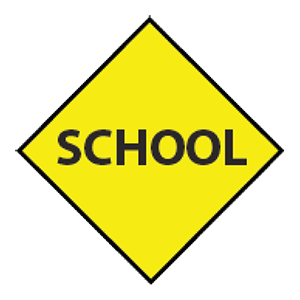
This sign means:
You must drive slowly and sound your horn.
A bus stop is ahead.
You are entering a school's parking lot.
A school zone is ahead.
Q.6.
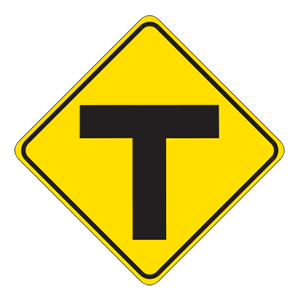
This sign means:
T intersection.
Lane shifting.
Side road.
Do not block intersection.
Q.7.
You are driving when it begins to rain. You should:
Drive faster than surrounding traffic.
Drive at the maximum posted speed limit.
Slow down.
Drive closely behind the vehicle in front of you.
Q.8.
When passing on a multilane highway:
Be sure the passing lane is clear.
Pass only on the right.
Watch for oncoming traffic.
There is no need to signal.
Q.9.
When approaching a school bus stopped with its stop arm extended, drivers should:
Come to a complete stop and wait to proceed.
Honk their horn before passing the bus on its left.
Continue driving when they think most kids are probably done exiting the bus.
Pass the bus before its door opens.
Q.10.
If you need to stop quickly and your vehicle is not equipped with an Anti-Lock Braking System (ABS), you should:
Hold down the brake pedal.
Firmly pump your brakes.
Lightly tap the brakes.
Release the brake pedal.
Q.11.
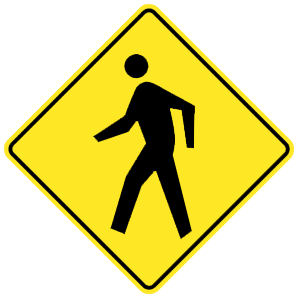
This road sign means:
School crossing.
Pedestrian crossing.
Jogging trail.
Busy sidewalk.
Q.12.
Double solid yellow lines painted down the middle of the road mean:
Railroad crossing ahead.
Pedestrian crossing ahead.
Passing is not permitted from either direction.
Passing is permitted from either direction.
Q.13.
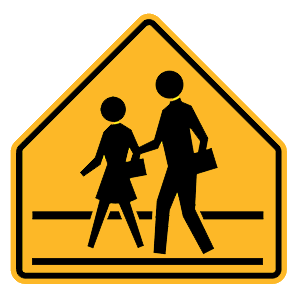
This sign means:
Pedestrians only.
Intersection ahead.
Hiking trails ahead.
School crossing ahead.
Q.14.
Many crashes are caused by:
Drivers traveling too fast for conditions.
Drivers consistently checking their mirrors and blind spots.
Drivers yielding the right-of-way.
Drivers maintaining a four-second following distance.
Q.15.
Before switching on the ignition, you should:
Be sure only backseat passengers have buckled their seat belts.
Be sure only adult passengers have buckled their seat belts.
Be sure only child passengers have buckled their seat belts.
Be sure all of the vehicle's occupants have buckled their seat belts.
Q.16.
What will happen if you crash and you do not have liability insurance?
You will be fined $50.
Your driving privileges will be revoked for six months.
Your driving privileges will be suspended for one year.
You will be fined $100.
Q.17.
To reduce the effects of headlight glare at night, you should look:
Straight ahead.
Over your shoulder.
At the center of the road
To the right edge of the road.
Q.18.
You must pull over to the edge of the road and allow an emergency vehicle to pass:
Regardless of your direction.
Only if it is following you.
Only if it is approaching you from the opposite direction.
None of the above.
Q.19.
As a pedestrian, you should:
Always insist on the right-of-way over a vehicle when using a crosswalk.
Never enter a street or crosswalk when vehicles are approaching.
Enter a crosswalk at any time because it is the vehicle driver’s responsibility to stop.
Use crosswalks only if they are convenient.
Q.20.
When changing lanes, you should:
Rely on your mirrors.
Begin signaling as you move into the next lane.
Signal at least 500 feet before your lane change when driving on residential streets.
Always check your blind spot.
Q.21.
What does this road sign mean?
Slow down and prepare to stop if cars are approaching you.
Come to a full stop and go when it is safe to do so.
Proceed carefully through the intersection, not always stopping.
Stop only for traffic on an intersecting road.
Q.22.
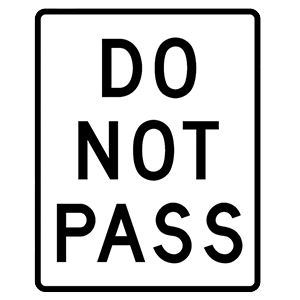
If you see this sign, you:
Must not pass another vehicle.
May pass a slow-moving vehicle if you can do so quickly.
May pass if you know the road ahead.
May pass, but only at night.
Q.23.
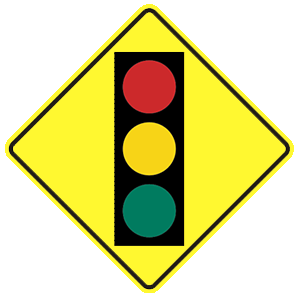
This road sign means:
Roundabout ahead.
No passing zone.
Left turn yield on green.
Traffic signal ahead.
Q.24.
When changing lanes, you can check your blind spots by:
Using the inside rearview mirror.
Using the outside rearview mirror.
Using both inside and outside rearview mirrors.
Turning your head and looking over your shoulder.
Q.25.
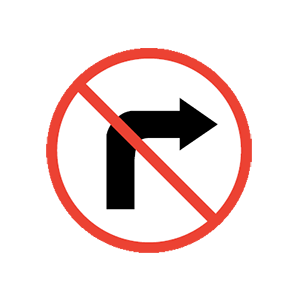
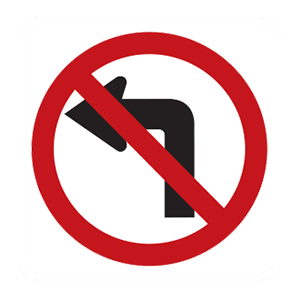
This road sign means:
Turn right after making a complete stop.
Right turns are not permitted.
Left turns are permitted.
None of the above.
Q.26.
Pennant-shaped signs indicate:
School zones.
No passing zones.
Speed limits.
Railroad crossings.
Q.27.
Drinking coffee after drinking alcohol:
Decreases blood alcohol concentration.
Cancels the effect of the alcohol.
Has no effect on blood alcohol concentration.
Increases blood alcohol concentration.
Q.28.
You should honk your horn when you:
Are traveling through an intersection.
Are passing a bicyclist.
See a child who is about to run into the street.
Are parallel parking.
Q.29.
Signaling your intentions before turning, changing lanes, or driving away from a curb:
Is necessary only if other traffic is present.
Is a good driving habit and is required by law.
Is necessary only during the maneuver, not before.
Is not necessary if the maneuver is done slowly.
Q.30.
If you are driving in another driver's blind spot, you should:
Move forward or drop back so the other driver can see you.
Keep a steady pace.
Stay in the driver's blind spot.
Honk to let them know you are there.
Q.31.
This sign means:
No left turn.
Flagger ahead.
Two-way left turn.
Turn right or go through.
Q.32.
You are turning onto a two-lane road divided by a broken yellow line. You know immediately that:
You are on a two-way road.
You are on a one-way road.
The road is under repair.
You must stay to the left of the broken yellow lines.
Q.33.
As you near an intersection, the traffic light changes from green to yellow. Your best action is to:
Speed up to beat the red light.
Apply the brakes sharply to stop.
Be prepared to stop in the center of the intersection.
Be prepared to stop before the intersection.
Q.34.
What are the colors of signs that tell you the distance to the next exit on a highway?
Yellow with black letters
Black with white letters
Red with white letters
Green with white letters
Q.35.
The most effective safety restraints in a traffic crash are:
Only a lap and shoulder belt.
Only an airbag.
Both a lap/shoulder belt and an airbag.
No safety restraints.
Support mcqgeeks.com by disabling your adblocker.
×
Please disable the adBlock and continue.
Thank you.
Reload page