MCQGeeks
CBSE
JEE
NTSE
NEET
English
UK Quiz
Quiz
Driving Test
Practice
Games
Driving Test
Oregon
Oregon Car Driving Permit Test-9
Answers
Q.1.
This road sign means:
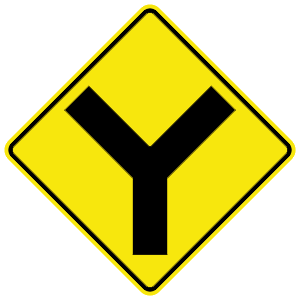
Your current roadway ends ahead.
You must bear either right or left.
A four-way intersection is ahead.
A road joins from the right.
Q.2.
You are driving on a highway divided by two solid yellow lines. You may:
Cross these lines only to make a left turn into or from an alley, private road, or driveway.
Cross these lines to pass other vehicles, but only if there is no oncoming traffic.
Cross these lines under no circumstances.
Cross these lines only to make a U-turn.
Q.3.
You are driving in the left lane and want to move into the right lane. You should:
Check your mirrors, signal, and look over your left shoulder for other vehicles before changing lanes.
Check your mirrors, signal, and look over your right shoulder for other vehicles before changing lanes.
Check your mirrors, signal, and look over both shoulders for other vehicles before changing lanes.
Check your mirrors, signal, and change lanes.
Q.4.
You are driving when it starts to sleet or snow. You should:
Keep your windshield and mirrors clear.
Allow additional distance between your vehicle and the vehicles that you are following.
Approach all vehicles with caution.
All of the above.
Q.5.
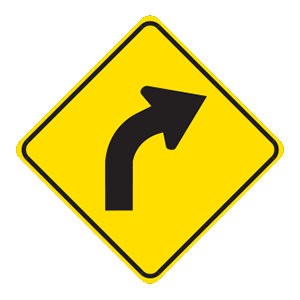
This sign means:
Curve ahead.
Roadwork ahead.
Merging traffic.
No left turn.
Q.6.
What might happen when alcohol is combined with another drug?
The effects of the alcohol and the drug may both be increased.
Nothing will happen.
The effects of the alcohol and the drug may both be reduced.
The effects of only the alcohol may be reduced.
Q.7.
Who is most likely to be killed in a work zone crash?
Bicyclists
Workers and flaggers
Drivers and passengers
Motorcyclists
Q.8.
At night, it is hardest to see:
Road signs.
Pedestrians.
Other motorists.
Street lights.
Q.9.
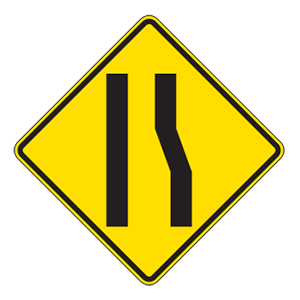
This sign means:
Lane ends.
No right turn.
Slippery when wet.
Two-way traffic.
Q.10.
Another driver is trying to pass your car. You should:
Pull off the road.
Signal to the other driver when it is safe for them to pass.
Check for oncoming traffic and adjust your speed to allow safe passing.
Speed up.
Q.11.
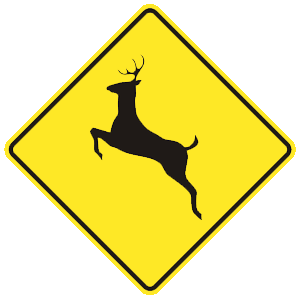
This road sign means:
Hunting area.
State park.
Deer crossing.
Wildlife preserve.
Q.12.
If two vehicles arrive to an uncontrolled intersection at the same time:
The largest vehicle has the right-of-way.
The car on the left has the right-of-way.
The car on the left shall yield to the car on the right.
The car on the right shall yield to the car on the left.
Q.13.
You may park or stop along the shoulder of the freeway:
As long as you turn on your four-way (emergency) flashers.
If no part of your vehicle is on the road.
If you need to look at a map for directions.
Only if you have an emergency.
Q.14.
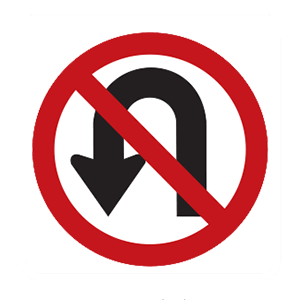
This sign means:
No U-turn.
Two-way left turn.
Minimum speed limit.
No parking.
Q.15.
It is best to keep a space cushion:
Only in back of your vehicle.
Only on the left and right sides of your vehicle.
Only in front of the vehicle.
On all sides of the vehicle.
Q.16.
This sign is used to warn drivers about:
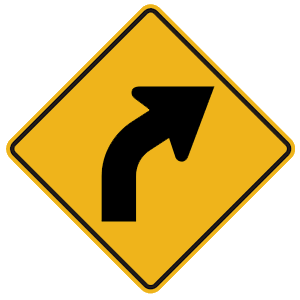
Upcoming intersections.
Road construction.
An upcoming curve in the road.
Changes in traffic lanes.
Q.17.
Crossbuck signs indicate:
Railroad crossings.
School zones.
No passing zones.
Hospitals.
Q.18.
To avoid collisions with vehicles in your blind spots, you should:
Quickly turn your head to see if your blind spot is clear before changing lanes.
Adjust your rearview mirrors every few minutes.
Honk your horn right before turning or changing lanes.
None of the above.
Q.19.
This sign means:
Stop.
Side road.
Two-way left turn.
Farm machinery.
Q.20.
A good defensive driver:
Drives slowly at all times.
Looks out for the actions of other drivers.
Travels at a constant speed.
Only drives in familiar areas.
Q.21.
This sign means:
Heavy traffic ahead.
Do not enter.
Railroad crossing.
Yield.
Q.22.
At dusk or on overcast days, you should:
Drive using your four-way flashers.
Drive using your parking lights.
Not turn on any vehicle lights.
Turn on your headlights.
Q.23.
If you need to drive in foggy weather:
Turn on your low beam headlights.
Turn on your hazard lights.
It is okay to drive at the maximum speed limit.
Do not drive at a speed above 10 miles per hour.
Q.24.
The most effective safety restraints in a traffic crash are:
Only a lap and shoulder belt.
Only an airbag.
Both a lap/shoulder belt and an airbag.
No safety restraints.
Q.25.
Signs indicating areas of public recreation are:
Orange.
Red.
Green.
Brown.
Q.26.
To help prevent crashes, you should:
Communicate with other road users.
Ignore other drivers on the road.
Drive only on side streets and back roads.
Avoid driving during rush hour.
Q.27.
When approaching a traffic signal displaying a steady yellow arrow, drivers:
Should merge into a lane in the direction of the arrow.
Should slow to a stop, if it is safe to do so.
May turn left after yielding to oncoming traffic and pedestrians.
Have the right-of-way and may expect oncoming traffic to stop for them.
Q.28.
Regulatory signs are usually ____ and should always be obeyed.
White
Blue
Green
Orange
Q.29.
You must stop at a railroad crossing when:
Directed to do so by a flagger.
It is controlled by a stop sign.
Flashing red signals and gates are present and operating.
All of the above.
Q.30.
When approaching a traffic signal displaying a steady green arrow, drivers:
Should merge into a lane in the direction of the arrow.
Should slow to a stop, if it is safe to do so.
May turn in the direction of the arrow after yielding to traffic and pedestrians already in the intersection.
May drive straight through the intersection.
Q.31.
A diamond-shaped sign:
Warns of existing or possible hazards.
Alerts drivers to school zones.
Alerts drivers to public recreation areas.
Alerts drivers to upcoming food and gas locations.
Q.32.
If a transit vehicle is signaling to re-enter the main roadway following a stop, you must:
Honk to let them know you’re there.
Move to the left lane.
Yield.
Speed up to pass.
Q.33.
If there are two railroad tracks next to each other:
It is always safe to proceed after one train passes.
You must always stop before crossing the tracks.
When one train passes, look for another train on the other track before proceeding.
Honk your horn as you cross the tracks.
Q.34.
When you hear a fire engine siren behind you, you must:
Slow down until it passes you.
Drive with your flashers on.
Pull over to the side of the road and stop.
Speed up and take the nearest exit.
Q.35.
When approaching a flashing red traffic light, drivers should:
Drive through the intersection if there is no crossing traffic.
Continue driving, as they have the right-of-way.
Stop if a police officer is nearby.
Treat the light like a stop sign.
Support mcqgeeks.com by disabling your adblocker.
×
Please disable the adBlock and continue.
Thank you.
Reload page