MCQGeeks
CBSE
JEE
NTSE
NEET
English
UK Quiz
Quiz
Driving Test
Practice
Games
Driving Test
Oregon
Oregon Motorcycle Driving Permit Test-12
Answers
Q.1.
A potential danger of braking too hard is:
Losing traction on one or both wheels.
Coming to a complete stop before you expect to.
Popping a tire.
Taking too long to stop.
Q.2.
Just like cars, motorcycles have blind spots. When switching lanes, you should:
Turn your head and check your blind spot.
Look only at your mirrors.
Rely on your peripheral vision.
Slow down so any vehicle in your blind spot can pass you.
Q.3.
If your friend has been drinking alcohol, it is a good idea to do any of the following, except:
Arrange for a safe ride home for your friend.
Occupy your friend with activities to distract them from drinking.
Keep your friend from leaving until they are sober.
Allow your friend to ride their motorcycle.
Q.4.
Mirror checks:
Are unimportant.
Should only be done on long trips.
Should be part of your normal scanning routine.
Are not helpful since you can’t do anything about what is behind you.
Q.5.
When you are being passed by a vehicle on your left, you should:
Help the other driver by moving as far to the right as possible.
Help the other driver by moving to the shoulder.
Ride in the center portion of your lane.
Ride in the left portion of your lane
Q.6.
When riding downhill or shifting into first gear, you may need to:
Use your brakes to slow down before downshifting safely.
Speed up before downshifting safely.
Swerve to the left.
Flash your brakes to ensure that drivers behind you know you are downshifting.
Q.7.
Taking corners too fast:
Can cause the rider to go into another lane.
Is better than going too slowly.
Often causes the rider to stay in their lane.
Is acceptable because motorcycles are smaller than other types of vehicles.
Q.8.
To lessen your chances of being involved in a crash, you should:
Use your turn signals to indicate that you plan to change lanes.
Tailgate other drivers.
Keep your eyes focused no more than 15 feet in front of your motorcycle.
Not use a headlight during the day.
Q.9.
After entering a turn, you should roll on the throttle and:
Always slow down.
Maintain a steady speed or accelerate gradually.
Accelerate drastically.
Not worry about your speed.
Q.10.
When riding at night, you should travel:
More slowly than you would during the day under similar conditions.
At the speed you would travel during the day under similar conditions.
Faster than you would during the day under similar conditions.
On the shoulder of the road so other vehicles can see you.
Q.11.
The best way to handle tailgaters is to:
Change lanes and let them pass.
Use your horn and make obscene gestures.
Speed up to put distance between you and the tailgater.
Come to a complete stop.
Q.12.
If you must brake and swerve to avoid a hazard, you should:
Do one, then the other.
Do both at the same time.
Always apply the brakes first, then swerve.
Try instead to use only the brakes.
Q.13.
A way to lower the risk of being involved in a crash is to:
Communicate your intentions to other road users.
Not look ahead while riding.
Wear dark clothes.
Ride in the parts of a lane that make it difficult to be seen.
Q.14.
Passengers should:
Lean with the operator.
Never come into contact with the operator.
Sit as far back on their seat as possible.
Hold onto their seat.
Q.15.
A DOT-compliant helmet has all of the following, except:
An impact-resistant outer shell.
An impact-absorbing inner liner.
A chinstrap retention system.
Bright colors painted on the outside.
Q.16.
When in traffic, motorcycles need:
Much less distance to stop than cars.
Less distance to stop than cars.
As much distance to stop as cars.
More distance to stop than cars.
Q.17.
When riding in a group, inexperienced riders should position themselves:
Just behind the leader.
In front of the group.
At the tail end of the group.
Beside the leader.
Q.18.
What does this hand signal mean?
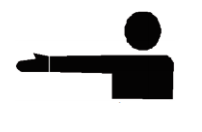
Slow or stop
Left turn
Right turn
Backing up
Q.19.
When braking, you should use:
Only the front brake.
Only the rear brake.
Both brakes.
Either brake, but never both at the same time.
Q.20.
Where is the greatest potential for conflict between a motorcycle and other traffic?
Intersections
Highways
Parking lots
Residential areas
Q.21.
Reflective clothing should:
Never be worn.
Be worn only during the day.
Be worn only at night.
Be worn day and night.
Q.22.
In the context of group riding, what does the hand signal pictured mean?
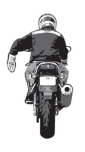
Speed up.
Danger ahead.
Stop.
Merge.
Q.23.
When braking, you should:
Squeeze the front brake and press the rear brake.
Grab at the front brake and squeeze the rear brake.
Jam on the front brake and grab at the rear brake.
Press down on the front brake and jam on the rear brake.
Q.24.
When passing a vehicle:
You may exceed the speed limit until the pass is complete.
You may disregard "No passing zone" markings if the pass was started in a passing zone.
You may pass on the shoulder.
You must complete the pass within the posted speed limits and within a legal passing zone.
Q.25.
When riding at night, how should your following distance compare to your following distance during the day?
You should allow a longer following distance when following another vehicle at night.
You should allow a shorter following distance when following another vehicle at night.
You should always maintain the same following distance regardless of the time of day.
Following distance really doesn’t matter.
Support mcqgeeks.com by disabling your adblocker.
×
Please disable the adBlock and continue.
Thank you.
Reload page