MCQGeeks
CBSE
JEE
NTSE
NEET
English
UK Quiz
Quiz
Driving Test
Practice
Games
Driving Test
Oregon
Oregon Motorcycle Driving Permit Test-15
Answers
Q.1.
When consumed together, the effects of alcohol and drugs:
Can be more pronounced than when either is consumed alone.
Are less dangerous than when either is consumed alone.
Are usually minimal.
Often balance out.
Q.2.
When riding, the best sitting position:
Requires your arms be used to hold you up.
Allows you to easily reach the controls.
Keeps your arms straight when reaching the handle grips.
Keeps your knees away from the gas tank.
Q.3.
When riding over rough surfaces, you should:
Hold the handgrips loosely to allow for movement.
Hold the handgrips firmly to maintain control.
Use lots of throttle to help you get over the rough surface.
Ride without a helmet as the helmet could become loose and cover your face.
Q.4.
When going through a turn on a motorcycle, you should:
Keep your eyes focused close to the front of the motorcycle.
Look through the turn to where you want to go.
Turn your entire body to see through the turn.
Increase your speed before the turn.
Q.5.
Your motorcycle’s brake light is:
More noticeable than a car’s brake lights.
Less noticeable than a car’s brake lights.
Less important than a car’s brake lights.
More easily seen than a car’s brake lights.
Q.6.
During acceleration, a sidecar attached to a motorcycle will:
Feel like it is lagging behind.
Feel like it is accelerating faster than the motorcycle.
Vibrate uncontrollably.
Make acceleration seem faster.
Q.7.
A motorcyclist can discourage other vehicles from lane sharing by:
Riding in the left portion of a lane.
Riding in the center portion of a lane.
Giving dirty looks if another driver moves into their lane.
Riding in a zigzag pattern to fill up a lane.
Q.8.
____ can remove alcohol and its effects from your body.
Time
Coffee
Exercise
Fresh air
Q.9.
When riding in a group, what does it mean when the lead rider raises their left arm and extends their index finger, as shown in the image?
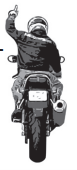
Speed up.
Slow down.
Ride in a single-file formation.
The group will pull off at the next exit.
Q.10.
A motorcycle needs:
Less frequent attention than a car.
More frequent attention than a car.
To have pre-ride checks performed only by a mechanic.
To be serviced only at a dealer.
Q.11.
What can you do to increase your chances of being seen at an intersection?
Ride while using your headlight.
Swerve within your lane to draw attention to your motorcycle.
Raise your arms.
Avoid using your brakes.
Q.12.
Without a helmet, a motorcycle rider is ________ more likely to suffer a critical head injury in a crash.
Three times
Four times
Five times
Six times
Q.13.
When riding with a heavy load, you will want to adjust the:
Brakes.
Seat.
Suspension.
Brake light.
Q.14.
Of the following, which is not considered protective clothing?
A leather jacket
Full-fingered gloves
Long pants made of denim
Athletic shoes
Q.15.
The single most important thing you can do to improve your chances of surviving a crash is to:
Wear a high-quality helmet that is securely fastened.
Wear shorts.
Wear sneakers.
Wear goggles.
Q.16.
If drinking alcohol, you should:
Decide if you are still fit to ride based on how you feel after you finish drinking.
Set a limit beforehand so you can still safely ride.
Not ride.
Not be concerned about your riding abilities if you feel fine.
Q.17.
Your lane position should not:
Increase your ability to see.
Avoid placing you in other drivers' blind spots.
Encourage other drivers to share your lane.
Provide you with an escape route.
Q.18.
If you are not traveling slowly enough when shifting into a lower gear, the:
Motorcycle could lurch and the rear tire could skid.
Motorcycle could accelerate too quickly.
Front tire will likely skid.
Engine will make a loud noise.
Q.19.
When riding with a passenger, you should tell them to do all of the following, except:
Get on the motorcycle after the engine has been started.
Sit as far forward as they can without crowding you.
Hold firmly onto your waist, hips, or belt.
Feel free to talk whenever they want.
Q.20.
An integrated braking system:
Applies partial rear braking when the front brake is applied.
Applies partial front braking when the rear brake is applied.
Applies even braking for both the front and rear brakes when either is applied.
Learns and remembers the approximate braking force used by the rider.
Q.21.
Of the following, which should you not do to improve your safety when riding at night?
Increase your speed.
Reduce your speed.
Use your high beam headlight whenever possible.
Increase your following distance.
Q.22.
When an operator's left arm is bent at the elbow and pointing upward, it means the operator:
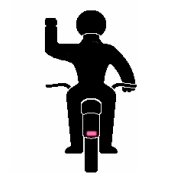
Plans to turn left.
Is about to stop.
Plans to turn right.
Is about to slow down.
Q.23.
When looking through a turn, you should:
Turn both your head and your shoulders to get a better look.
Turn just your head, not your shoulders.
Use only your mirrors.
Only move your eyes, not your head.
Q.24.
Riding directly alongside another vehicle is discouraged because:
You may have a difficult time getting to a highway exit.
You may be in the other vehicle’s blind spot.
You may block the driver's view.
It prevents other drivers from passing both of you.
Q.25.
When riding in a group, inexperienced riders should position themselves:
In front of the group.
At the rear of the group.
Just behind the leader.
Beside the leader.
Support mcqgeeks.com by disabling your adblocker.
×
Please disable the adBlock and continue.
Thank you.
Reload page