MCQGeeks
CBSE
JEE
NTSE
NEET
English
UK Quiz
Quiz
Driving Test
Practice
Games
Driving Test
Oregon
Oregon Motorcycle Driving Permit Test-2
Answers
Q.1.
To help provide space for drivers attempting to merge into your lane from an entrance ramp, you should:
Stay in your lane.
Merge into the next lane, if possible.
Not worry about it, since they are the ones trying to merge.
Ride on the far left shoulder.
Q.2.
Compared to riding during the day, a motorcycle operator who is riding at night should do all of the following, except:
Ride more slowly.
Allow more space between their motorcycle and other vehicles.
Use their high beam whenever possible.
Tailgate other vehicles.
Q.3.
Riding between two vehicles moving in the same direction:
Is illegal.
Is encouraged if traffic is heavy.
Is encouraged during the day to prevent traffic jams.
Is acceptable if the motorcyclist is comfortable with the move.
Q.4.
Where is the throttle usually located?
Near the left footrest
Near the right footrest
On the left handle grip
On the right handle grip
Q.5.
Helmets are:
Required for all motorcycle passengers.
Not required, but recommended.
Only required for passengers under the age of 21.
Only required for passengers who do not have their own motorcycle license.
Q.6.
When being passed, do not move into the portion of the lane farthest from the passing vehicle because:
The passing vehicle may re-enter your lane too early.
You may prevent another vehicle from passing you.
The portion of the lane nearest the passing vehicle is better.
You are more likely to experience a wind blast from the passing vehicle on the far side of the lane.
Q.7.
To adjust for added weight when riding with a passenger, you should:
Operate at a slower speed than usual.
Maintain a shorter following distance that you would if riding without a passenger.
Operate at a faster speed than usual.
Brake a little later than you would if riding without a passenger.
Q.8.
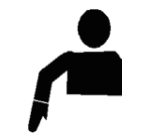
What does this hand signal mean?
Slow or stop
Left turn
Right turn
Backing up
Q.9.
When following a car, usually the best portion of the lane to ride in is:
The left portion.
The center portion.
The right portion.
The left or right portions.
Q.10.
When may you not need to increase your following distance?
When the road is slippery
When there is a lot of traffic
When you can see through the vehicle in front of you
When it is raining
Q.11.
You should increase your following distance if:
The pavement is dry.
The pavement is wet.
You can see through the vehicle ahead of you.
The sun is out.
Q.12.
A danger of riding next to a row of parked cars is:
You may not find a parking spot.
A driver may unexpectedly pull out from the row into your path.
Others may be driving slowly while looking for a parking spot.
The road may be uneven.
Q.13.
If a tire goes flat while riding and you must stop, it is usually best to:
Relax on the handgrips.
Shift your weight toward the good tire.
Brake on the good tire and steer to the side of the road.
Use both brakes and stop quickly.
Q.14.
When riding at night, you should do all of the following, except:
Use your high beam.
Use the headlights of vehicles ahead to help you see.
Be visible.
Ride only in the left portion of your lane.
Q.15.
How often should a motorcycle operator check their mirrors?
Never
Occasionally
Frequently
More often than the amount time spent looking ahead
Q.16.
Which of the following is not a possible cause of a wobble on your motorcycle?
Incorrect tire pressure
Improper loading
Unsuitable accessories
Uneven road
Q.17.
If you must stop quickly in a curve, you should:
Straighten up, square the handlebars, and stop.
Abruptly apply both brakes while leaning.
Apply only the rear brake.
Apply only the front brake.
Q.18.
Which of the following is not a way to prevent a friend from driving while intoxicated?
Arrange a safe ride home for them.
Get them involved in activities to slow their drinking and keep them busy while they sober up.
Make them wait 15 minutes after their last drink before driving.
Get other friends involved in stopping your friend from driving.
Q.19.
In Oregon, riding in pairs is:
Illegal.
Illegal when other vehicles are near.
Allowed, but not recommended.
Allowed, but should only be done if there is a lot of traffic.
Q.20.
An advantage to keeping a cushion of space between your motorcycle and other vehicles is that:
You can pass danger more quickly.
You will have a more narrow view of the road so you can stay focused.
You will have more time to react to the movements of others.
You can more easily follow the path of the next vehicle.
Q.21.
Clothing made of which type of material can offer the best protection to motorcyclists?
Leather
Wool
Polyester
Silk
Q.22.
To stop quickly, you should:
Rely only on the front brake.
Rely only on the rear brake.
Use the front brake and then the rear brake.
Use both brakes at the same time.
Q.23.
When riding in curves, turning, or entering a highway, the best group formation is:
Pairs.
Single-file.
Staggered.
Passing.
Q.24.
To avoid fatigue, you should ride for no more than:
Two hours in a day.
Four hours in a day.
Six hours in a day.
10 hours in a day.
Q.25.
You’ll have a better chance of avoiding serious injury if you wear all of the following, except:
A DOT-approved helmet.
Face or eye protection.
Ear buds.
Protective clothing.
Support mcqgeeks.com by disabling your adblocker.
×
Please disable the adBlock and continue.
Thank you.
Reload page