MCQGeeks
CBSE
JEE
NTSE
NEET
English
UK Quiz
Quiz
Driving Test
Practice
Games
Driving Test
Pennsylvania
Pennsylvania Car Driving Permit Test-13
Answers
Q.1.
Which of the following is true about the speed at which you travel?
The safest speed to drive depends on many conditions.
Driving slowly is always safest.
The speed limit is always a safe speed.
Accelerating is always dangerous.
Q.2.
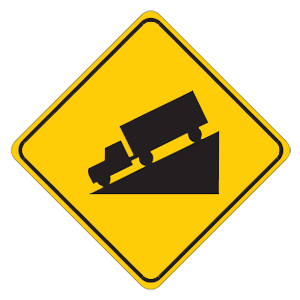
This sign indicates that:
There is a steep hill ahead.
No trucks are allowed on an upcoming hill.
A logging road is ahead.
There are trucks on an upcoming hill.
Q.3.
To turn left from multilane, one-way streets and highways, you should start from:
The middle of the intersection.
The right lane.
The left lane.
Any lane.
Q.4.
When driving in fog, you should use your:
Low beam headlights.
High beam headlights.
Parking lights.
Hazard flashers.
Q.5.
Before turning, you should:
Use your signal.
Turn the wheel.
Increase your speed.
Change lanes.
Q.6.
How can you lower the risk of hydroplaning?
Do not speed when the roads are wet.
Use tires with proper air pressure.
Replace tires with bad tread.
All of the above.
Q.7.
It is against the law for anyone under the age ofto ____ alcohol.
Serve
Wear clothing advertising
Be in the presence of
Transport
Q.8.
You should honk your horn when you:
Are traveling through an intersection.
Are passing a bicyclist.
See a child who is about to run into the street.
Are parallel parking.
Q.9.
On a two-lane road, you may pass another vehicle on the right:
When driving on a single lane entrance ramp.
When the driver you are passing is traveling more slowly than the posted speed limit.
Under no circumstances.
When the driver you are passing is making a left turn.
Q.10.
Car drivers should know that large trucks:
Have large blind spots.
Can stop more quickly than passenger vehicles.
Do not need more room to maneuver than passenger vehicles.
All of the above.
Q.11.
When driving on slippery roads, you should:
Use alternate routes.
Drive as you would on dry roads.
Increase your following distance.
Avoid crossing bridges or intersections.
Q.12.
When you see this sign, it means:
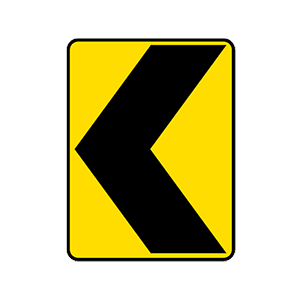
There is an object on the roadway.
Traffic is coming from the right.
The road is curving sharply to the left.
There is a merge point ahead.
Q.13.
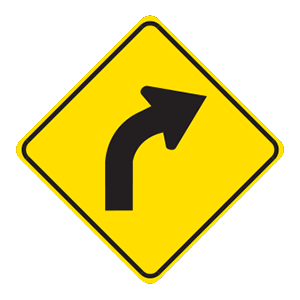
This sign means:
Curve ahead.
Roadwork ahead.
Merging traffic.
No left turn.
Q.14.
Your blind spot is the area of the road:
You cannot see without moving your head.
Directly behind your vehicle.
You see in your rearview mirror.
You see in your side mirror.
Q.15.
You must use your headlights when other vehicles are not visible from ____ feet away.
1,000
1,500
1,800
1,200
Q.16.
The most important thing to remember about speed management and curves is that you must:
Drive at the posted speed limit as you enter the curve, then slow down at the sharpest part of the curve.
Slow down before you enter the curve.
Accelerate gently before you enter the curve.
Drive at the posted speed limit before, throughout, and after the curve.
Q.17.
Which of the following is true about driving on a wet roadway?
As you drive faster, your tires become less effective.
Water does not affect cars with good tires.
Deep water is less dangerous than shallow water.
As you decrease your speed, the roadway becomes more slippery.
Q.18.
When you are in a line of traffic that is crossing a railroad track that has no signals or gates:
You have the right-of-way and do not need to check for trains.
You may pass slower drivers while crossing the track.
You need to make sure there is space for your vehicle to get all the way across the tracks without stopping.
All of the above
Support mcqgeeks.com by disabling your adblocker.
×
Please disable the adBlock and continue.
Thank you.
Reload page