MCQGeeks
CBSE
JEE
NTSE
NEET
English
UK Quiz
Quiz
Driving Test
Practice
Games
Driving Test
Pennsylvania
Pennsylvania Car Driving Permit Test-2
Answers
Q.1.
The act of turning your head and checking your blind spot before changing lanes, driving away from a curb, or merging your vehicle into traffic is:
A bad driving habit.
A good driving habit.
Unnecessary.
Not necessary if you use the rearview mirror.
Q.2.
Roads become very slippery:
When it has been raining for an hour or more.
The day after it rains.
For the first 10 to 15 minutes of a rainstorm.
Right after the rain has stopped.
Q.3.
What can you do to avoid the need to make emergency stops while driving in traffic?
Honk your horn to make others aware of your presence.
Look ahead and maintain a safe following distance.
Drive in the right lane only.
Drive more slowly than the flow of traffic.
Q.4.
A bicyclist who doesn’t obey traffic laws:
Is in the right because bicyclists don’t have to obey traffic laws.
Can be ticketed.
Will always receive a warning from law enforcement.
Will have their bicycle impounded.
Q.5.
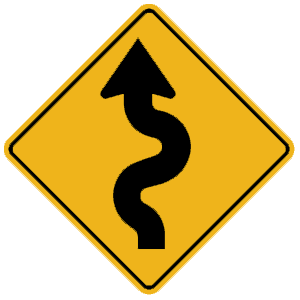
This sign tells you that:
No turns are allowed on this road.
The road narrows ahead.
There are a series of curves ahead.
The road may be slippery when wet.
Q.6.
An orange triangle on the back of a vehicle indicates that the vehicle:
Carries radioactive materials.
Takes wide turns.
Travels at slower speeds than normal traffic.
Makes frequent stops.
Q.7.
The effect that lack of sleep has on your safe driving ability is the same as:
The effect that alcohol has.
The effect that amphetamines have.
The effect that anger has.
The effect that driving with teenagers has.
Q.8.
When faced with an oncoming car to the left and a bicyclist to the right, you should:
Pull onto the shoulder.
Split the difference.
Let the car pass and then pass the bike.
Pass the bike quickly.
Q.9.
What should you be most concerned about when you see this sign?
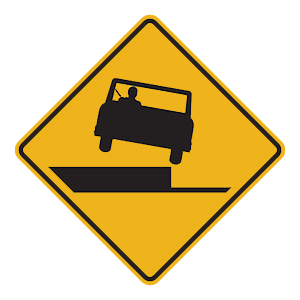
Driving with your headlights out of alignment because one side of your car is higher than the other.
Damaging a tire from drifting onto the shoulder.
Hydroplaning, if the shoulder has water on it.
Losing control of the vehicle if you drift onto the shoulder.
Q.10.
When you see this sign, you must:
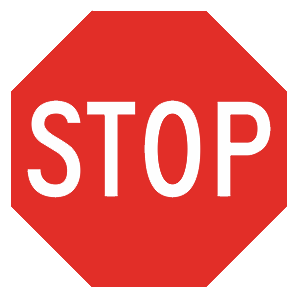
Stop completely and check for pedestrians and cross traffic.
Slow down without coming to a complete stop.
Stop completely and wait for a green light.
Slow down and check for traffic.
Q.11.
You may honk your horn when you:
Have to stop quickly.
Are passing another car.
Have lost control of your car.
Are passing a bicyclist.
Q.12.
Before changing lanes on a multilane highway, you should:
Sound your horn.
Turn on your headlights.
Reduce your speed.
Check your mirrors and blind spots.
Q.13.
If you experience a tire blowout, you should:
Allow the steering wheel to move freely.
Let the car slow to a stop.
Continue driving until you reach a garage.
Brake hard to stop the car immediately.
Q.14.
From top to bottom, the following is the proper order for traffic lights:
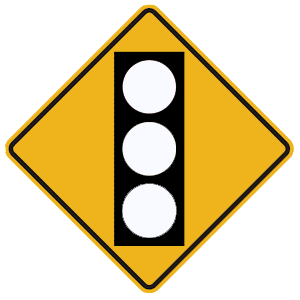
Red, yellow, green.
Red, green, yellow.
Green, red, yellow.
Green, yellow, red.
Q.15.
After an emergency vehicle passes you with its siren on, you must:
Drive closely behind the emergency vehicle.
Drive as quickly as the emergency vehicle.
Avoid driving closer than 500 feet behind the emergency vehicle.
Drive very slowly near the curb.
Q.16.
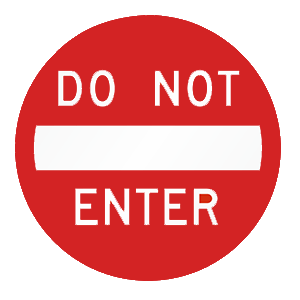
This sign means:
Stop.
No U-turn.
Yield.
Do not enter.
Q.17.
A solid white line on the right edge of the highway slants in to the left. That shows that:
There is an intersection just ahead.
You are approaching a construction area.
You will be required to turn left just ahead.
The road will get narrower.
Q.18.
Your brake lights tell other drivers that you:
Are making a turn.
Have your emergency brake on.
Are changing lanes.
Are slowing down or stopping.
Support mcqgeeks.com by disabling your adblocker.
×
Please disable the adBlock and continue.
Thank you.
Reload page