MCQGeeks
CBSE
JEE
NTSE
NEET
English
UK Quiz
Quiz
Driving Test
Practice
Games
Driving Test
Pennsylvania
Pennsylvania Car Driving Permit Test-3
Answers
Q.1.
Allowing a space cushion between your vehicle and its surroundings is important because it:
Prevents distractions from other vehicles.
Allows you time to react to unexpected situations.
Keeps traffic flowing at a safe pace.
Keeps other drivers alert.
Q.2.
When driving on an interstate:
Stop on the shoulder of the road if you are tired.
You should always use cruise control.
Signal, check mirrors, and check blind spots before changing lanes.
You should change lanes often.
Q.3.
If you are arrested for driving under the influence of alcohol and you refuse to take the blood test, you will receive a:
Drug counseling treatment.
Sentence of one day in jail.
Driver license suspension.
$300 fine.
Q.4.
Drivers who eat and drink while driving:
Make no driving errors.
Have trouble driving slowly.
Are better drivers because they are not hungry.
Have trouble controlling their vehicles.
Q.5.
When driving on wet roads, you should:
Increase your following distance to five or six seconds.
Decrease your following distance to two seconds.
Not be concerned about your following distance.
Maintain the four-second following distance rule.
Q.6.
When driving through a work zone, it is a good safety practice to:
Drive closely to the vehicle in front of you to keep traffic flowing freely.
Shorten your usual following distance by about one-half.
Turn on your cruise control.
Double your usual following distance.
Q.7.
You should honk your horn when you:
Are traveling through an intersection.
Are passing a bicyclist.
See a child who is about to run into the street.
Are parallel parking.
Q.8.
The maximum speed limit in this state is ____ miles per hour .
55
50
60
70
Q.9.
If another car is in danger of hitting you, you should:
Sound your horn.
Wave your arms.
Use your emergency lights.
Flash your headlights.
Q.10.
You are turning onto a two-lane road divided by a broken yellow line. You know immediately that:
You are on a two-way road.
You are on a one-way road.
The road is under repair.
You must stay to the left of the broken yellow lines.
Q.11.
This sign is used to warn drivers about:
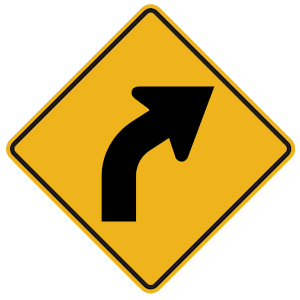
Upcoming intersections.
Road construction.
An upcoming curve in the road.
Changes in traffic lanes.
Q.12.
Defensive driving is:
Identifying dangerous driving situations and taking action to avoid accidents.
Defending yourself against poor drivers by getting ahead of them in traffic.
Following the vehicle ahead of you at a close distance.
Quickly changing lanes and shifting in and out of traffic congestion.
Q.13.
Traffic fatalities in work zones are most commonly the result of:
Tire blowouts.
Hydroplaning due to water sprayed on the roadway.
Loss of steering control after driving over wet paint.
Carelessness and speeding.
Q.14.
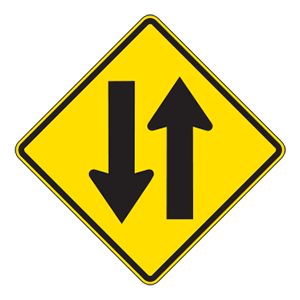
This sign means:
Two-way traffic.
Lane shifting.
Low clearance.
Added lane.
Q.15.
At an intersection with a stop sign, you should stop and:
Check your rearview mirror for cars tailgating.
Move when the vehicle ahead of you moves.
Look right first, then left, then right again.
Look left first, then right, then left again.
Q.16.
When passing a bicyclist, you should:
Blast your horn to alert the bicyclist.
Give them at least four feet of space.
Remain on the right side of your lane.
Put on your four-way flashers.
Q.17.
Your blind spot is the area of the road:
You cannot see without moving your head.
Directly behind your vehicle.
You see in your rearview mirror.
You see in your side mirror.
Q.18.
If a green arrow turns into a solid green light, you:
May still turn, but you must yield to oncoming traffic.
May no longer turn and must proceed straight.
Still have the right-of-way to turn.
No longer have to turn in the direction that the arrow indicated.
Support mcqgeeks.com by disabling your adblocker.
×
Please disable the adBlock and continue.
Thank you.
Reload page