MCQGeeks
CBSE
JEE
NTSE
NEET
English
UK Quiz
Quiz
Driving Test
Practice
Games
Driving Test
Rhode Island
Rhode Island Car Driving Permit Test-11
Answers
Q.1.
Which of the following road surfaces freezes first?
A tunnel
An intersection
A bridge
Q.2.
You are involved in an accident. You should:
Help the injured.
Stop immediately.
Call the police.
All of the above.
Q.3.
You may not cross a single broken white or yellow line:
When doing so would interfere with traffic.
When turning left into a driveway.
When the car in front of you is disabled.
When passing to the right on a one-way street.
Q.4.
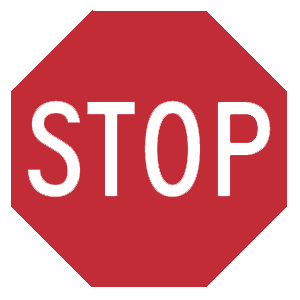
This road sign means:
Slow down or stop.
Stop, if necessary.
You must come to a complete stop.
Drive with caution and be ready to stop.
Q.5.
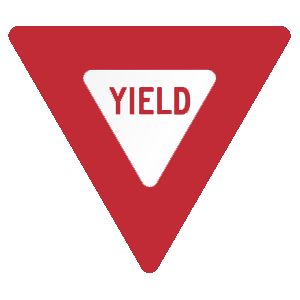
This road sign means:
Drive with caution and be ready to slow down.
Do not drive in this lane.
You must come to a complete stop and yield the right-of-way.
Slow down, be prepared to stop, and, if necessary, yield the right-of-way.
Q.6.
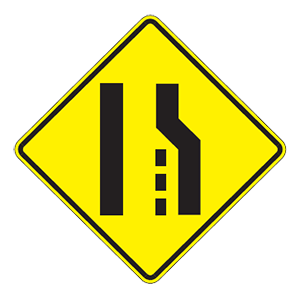
This sign means:
Merge right.
Divided highway begins.
Lane ends.
Q.7.
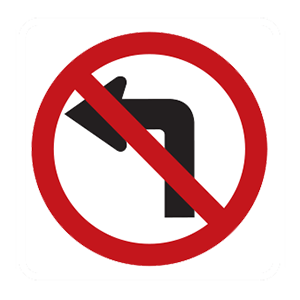
This sign means:
No left turn.
Flagger ahead.
Two-way left turn.
Turn right or go through.
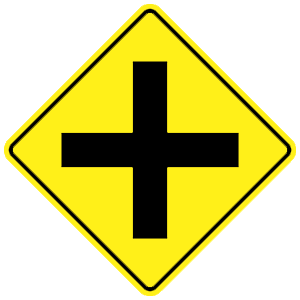
Q.8.
This sign means:
All traffic must turn.
Turn right at the intersection.
Parking area ahead.
Crossroad ahead. Watch for traffic.
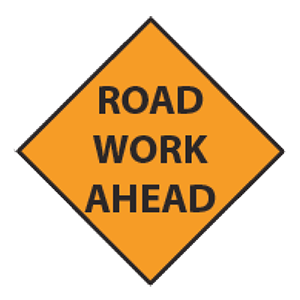
Q.9.
This sign means:
There is a detour ahead.
You must stop for flaggers.
The road ahead is closed to traffic.
The highway ahead is undergoing maintenance.
Q.10.
Nighttime is the safest time for cyclists to ride their bikes.
TRUE
FALSE
Q.11.
You reach an intersection with stop signs on all four corners at the same time as the driver on your left. Who has the right-of-way?
The driver on your left has the right-of-way.
You have the right-of-way.
Whoever is signaling to make a turn has the right-of-way.
Q.12.
Driving is a privilege, not a right.
True
False
Q.13.
Only ____ can lower blood alcohol concentration (BAC) and reduce alcohol's effects on a body.
Drinking caffeine
Eating foods high in fat
Time
Q.14.
You want to back out of your driveway. You see children playing nearby. Before you start to move your car, you should:
Rev your engine to warn the children that you are moving.
Sound your horn so the children will hear you.
Walk to the back of the car to be sure the way is clear.
Tell the children to stay away from the driveway.
Q.15.
If a road is slippery, maintain a following distance that is:
No different than normal.
Farther from the car ahead than normal.
Closer to the car ahead than normal.
Q.16.
Vehicles stopped behind a school bus with its red lights flashing must remain stopped until:
All students are off the bus.
The stop arm is retracted.
The stop arm is retracted and the bus resumes motion.
Q.17.
You may drive around the gates at a railroad crossing:
When the train has passed.
Under no circumstances.
When the lights have stopped flashing.
When other drivers drive around the gates.
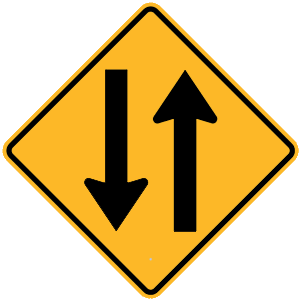
Q.18.
This sign means:
Four-lane traffic ahead.
Divided highway ahead.
Two-way traffic ahead.
Intersection ahead.
Q.19.
You are driving on the freeway behind a large truck. You should drive:
Closer behind the truck than you would if following a passenger vehicle.
Farther behind the truck than you would if following a passenger vehicle.
To the right side of the truck and wait to pass.
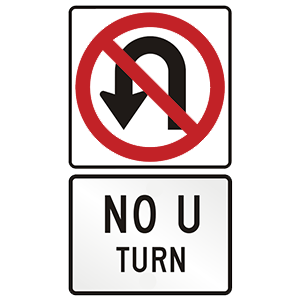
Q.20.
This road sign means:
Do not enter.
No parking.
No U-turn.
Q.21.
Make room for cars that are entering the freeway by:
Slowing down.
Merging into a different lane.
Maintaining your speed and position.
Q.22.
Sudden wind gusts on highways:
Generally affect only the movement of large vehicles.
Only cause visibility problems.
Can cause problems for all vehicles.
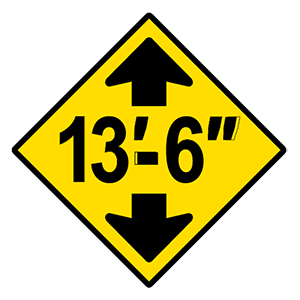
Q.23.
This road sign means:
Steep grade ahead.
Pedestrian crossing ahead.
Low ground railroad crossing.
Low clearance.
Q.24.
When driving at night, you should:
Always use your high beams.
Look directly at the headlights of an oncoming vehicle.
Increase your following distance.
Q.25.
In the winter, if a road surface seems dry, it's definitely dry.
True
False
Q.26.
A person's ability to drive can be impaired by:
Alcohol.
Any medication.
A lack of sleep.
All of the above.
Q.27.
The faster the speed of your vehicle, the longer it takes to stop when you must react to other drivers' unexpected movements.
TRUE
FALSE
Q.28.
Unless otherwise posted, the speed limit in a residential area is:
45 mph.
35 mph.
25 mph.
15 mph.
Q.29.
After you have passed a vehicle moving in the same direction, it is safe to move back into the right lane:
After about three seconds.
When you can no longer see the passed vehicle over your right shoulder.
When you can see the entire front of the passed vehicle in your rearview mirror.
Q.30.
When may you proceed through an intersection that has a stop sign but no stop line or crosswalk?
After slowing down to verify that there is no cross traffic
After coming to a complete stop and verifying that it is safe to proceed
After you have stopped at least 20 feet prior to the intersection
After slowing down to a speed of 10 mph
Support mcqgeeks.com by disabling your adblocker.
×
Please disable the adBlock and continue.
Thank you.
Reload page