MCQGeeks
CBSE
JEE
NTSE
NEET
English
UK Quiz
Quiz
Driving Test
Practice
Games
Driving Test
Rhode Island
Rhode Island Car Driving Permit Test-13
Answers
Q.1.
You are on the freeway and traffic is merging into your lane. You should:
Make room for the merging traffic, if possible.
Assert your right-of-way by driving faster.
Always maintain your position.
Q.2.
A speed restriction sign:
May be ignored in rainy, snowy, or icy conditions.
Has a triangular shape.
Is blue with black lettering.
Shows a recommended speed for a curve or turn.
Q.3.
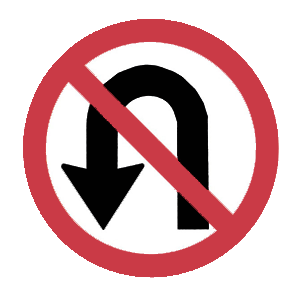
This road sign means:
Do not enter.
No parking.
No U-turn.
No left turn.
Q.4.
You may not complete a turnabout:
If it requires you to cross a double yellow line.
Where it may interfere with surrounding traffic.
Where hills and curves are nearby.
All of the above.
Q.5.
When passing a row of parked vehicles, you should:
Be prepared for a person or vehicle to unexpectedly enter your lane.
Expect all other drivers and pedestrians to respect your right-of-way.
Drive closely to the parked vehicles to allow more room for moving traffic.
Q.6.
You may not park within ____ of a fire hydrant.
20 feet
15 feet
Eight feet
Q.7.
What should you do if your accelerator sticks while you are driving?
Reach down and attempt to pull it up.
Shift to park.
Shift to neutral and apply steady pressure on the brake.
Turn the engine off.
Q.8.
Larger vehicles have:
Larger blind spots.
Smaller blind spots.
No blind spots.
The same blind spots as smaller vehicles.
Q.9.
A “No stopping” sign means that, unless directed to do so by a police officer, you may stop only:
Long enough to unload packages.
To avoid conflict with other traffic.
To discharge passengers.
For less than five minutes.
Q.10.
If you encounter an aggressive driver, you should:
Challenge them.
Get out of their way.
Speed up.
Q.11.
Drivers must be careful when passing large vehicles and should avoid driving beside large vehicles for long periods of time.
TRUE
FALSE
Q.12.
If you stop along the road at night:
Turn off all your lights.
Use your parking lights only.
Use your headlights only.
Turn on your emergency flashers and leave your low beams turned on.
Q.13.
You should not make sudden stops in front of large trucks and buses because:
Small vehicle drivers cannot adequately see large trucks and buses in their rearview mirrors.
Large trucks and buses, due to their size and weight, require longer distances to stop than smaller passenger vehicles.
Large trucks and buses travel at a higher speeds than small vehicles.
Q.14.
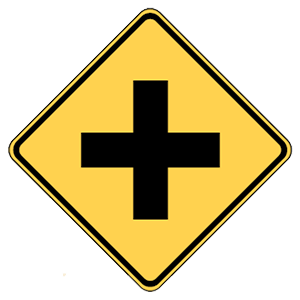
This road sign means:
Hospital.
Upcoming intersection.
Railroad crossing.
Q.15.
You notice a vehicle defect which may affect the safe operation of your vehicle. You should:
Correct the defect as soon as possible.
Correct the defect when you can afford it.
Drive the vehicle at slower speeds.
Drive normally.
Q.16.
Certain highway signs contain information about hazardous conditions. Such signs are known as:
Regulatory signs.
Warning signs.
Information signs.
Guide signs.
Q.17.
If a vehicle using high beams comes toward you, you should look toward ____ of the road.
Either side
The center
The right side
The left side
Q.18.
You cannot pass safely on a two-way, two-lane street unless:
You are able to clearly see the road ahead.
You can return to your lane before meeting oncoming traffic.
Your vehicle is capable of the speed necessary to pass.
All of the above.
Q.19.
You may cross double solid yellow lines:
To pass a slow-moving truck.
To turn into a driveway.
To pass another car.
Under no conditions.
Q.20.
Continuous hard braking on ice and snow often:
Helps you stop faster.
Locks the front wheels of a vehicle, causing a loss of steering.
Keeps the brakes from freezing.
Q.21.
You may drive across a dashed white line:
At any time.
Only during daylight hours.
When it is safe to change lanes.
Only when passing a motorcycle.
Q.22.
When you see or hear an emergency vehicle coming, you should:
Stop immediately and let the vehicle pass.
Drive as far toward the right side of the road as is safe and stop.
Proceed slowly and permit the vehicle to pass.
Keep moving slowly, staying to the right side of the road.
Q.23.
When riding in a vehicle, small children:
May be safely held by a strong adult.
Will be safe if they are standing on the floor in the back of the vehicle.
Will not be hurt in an accident because they are small.
Must never be allowed to ride while standing in the vehicle.
Q.24.
If you plan to pass another vehicle, you should:
Not assume the other driver will make space for you to return to your lane.
Assume the other driver will let you pass if you use your turn signal.
Assume the other driver will maintain a constant speed.
Q.25.
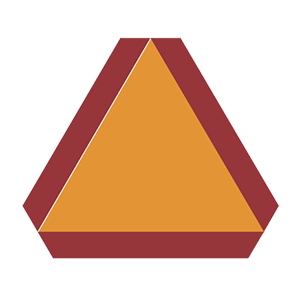
This sign means:
Slow-moving vehicle.
Road construction/maintenance area.
Traffic signal ahead.
Q.26.
Two solid white lines painted across a traffic lane show the boundaries of a crosswalk. As a driver, you should know that:
Motor vehicles have the right-of-way over pedestrians in crosswalks.
When pedestrians are in crosswalks, they should be given the right-of-way.
No one has the right-of-way in a crosswalk.
Pedestrians are responsible to stay out of the way of all traffic.
Q.27.
If you can see that the roadway up ahead is covered by heavy smoke, you should:
Turn on your four-way flashers and continue.
Reduce your speed, move as far to the right as possible, and stop off the roadway.
Turn on your high beam headlights and continue.
Q.28.
It is important to be alert to motorcycles because:
They are more difficult to see than cars.
They rarely use their headlights.
Motorcyclists are less skilled drivers than other motorists.
All of the above.
Q.29.
The act of turning your head and checking your blind spot before changing lanes, driving away from a curb, or merging your vehicle into traffic is:
A bad driving habit.
A good driving habit.
Unnecessary.
Not necessary if you use the rearview mirror.
Q.30.
When approaching a person who is crossing the street while using a white cane or guide dog, you should:
Stop until the person is well away from your path of travel.
Honk your horn as you proceed past them.
Carefully drive around them.
Support mcqgeeks.com by disabling your adblocker.
×
Please disable the adBlock and continue.
Thank you.
Reload page