MCQGeeks
CBSE
JEE
NTSE
NEET
English
UK Quiz
Quiz
Driving Test
Practice
Games
Driving Test
South Carolina
South Carolina Car Driving Permit Test-15
Answers
Q.1.
What do speed limit signs indicate?
Potential driving speeds for the area
The maximum or minimum speed that is legally allowed to be driven
The speed drivers should drive in heavy traffic
The speed drivers should drive under poor conditions
Q.2.
Double solid yellow line markings down the center of a road indicate that passing is:
Allowed from both directions.
Allowed only from your direction of travel.
Not allowed from either direction.
Q.3.
Who must wear seat belts in a moving vehicle?
Only passengers on the driver's side of the car
All passengers and not the driver
All of the vehicle's occupants, including the driver
Q.4.
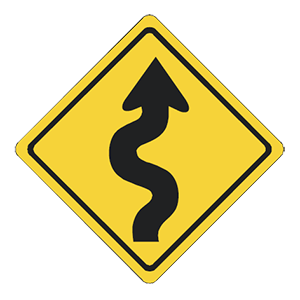
This sign indicates that the road ahead:
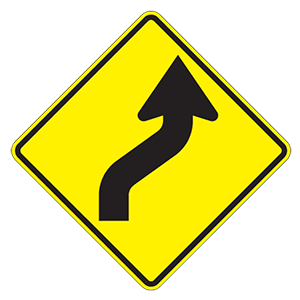
Turns sharply right, then left.
Curves right, then left.
Curves right.
Q.5.
After you have passed a vehicle moving in the same direction, it is safe to move back into the right lane:
After about three seconds.
When you can no longer see the passed vehicle over your right shoulder.
When you can see the entire front of the passed vehicle in your rearview mirror.
Q.6.
When a stop line is present at a stop sign, drivers must stop:
At the line.
On top of the line.
Only if pedestrians are in the crosswalk.
Q.7.
Broken yellow lines are used on streets and highways to:
Indicate no passing zones.
Separate lanes of traffic moving in the same direction.
Separate lanes of traffic moving in opposite directions.
Q.8.
If you see this sign above your lane, you:
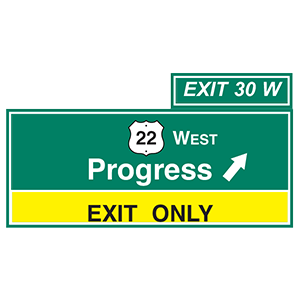
May not exit the freeway.
May either continue through the interchange or exit the freeway from your current lane.
May stay in your lane and continue through the interchange.
Must exit the freeway, if you stay in your current lane.
Q.9.
You can help keep the driver behind you a safe distance away from your vehicle by:
Driving 10 mph faster than the car behind you.
Driving 10 mph slower than the car behind you.
Maintaining a steady speed.
Q.10.
This sign means:
No left turn can be made here.
A left turn can be made only after stopping.
All traffic must turn right at the next intersection.
Q.11.
A solid yellow arrow on a traffic signal means:
You should speed up so you can make the turn before the light changes.
You do not need to signal to turn from the indicated lane.
You should prepare to stop and yield the right-of-way to oncoming traffic.
Q.12.
If a child is riding a bicycle near your vehicle:
Beep your horn.
Expect the child to be in total control of the bicycle.
Expect the unexpected.
Q.13.
Which of the following should you do after an accident?
Protect the area, notify authorities, and care for the injured.
Report the accident the following week.
Go to the nearest convenience store and call your insurance company.
Q.14.
Look over your shoulder to check your blind spot when:
Pulling toward or away from a curb.
Turning left or right.
Changing lanes.
All of the above.
Q.15.
If your car starts to skid, turn your steering wheel:
To keep the front wheels straight.
In the direction you want the vehicle to go.
In the opposite direction of the skid.
In any direction. It doesn't matter.
Q.16.
Which of the following statements about railroad crossings is true?
It is against the law to go around lowered gates at a crossing.
You must stop at a railroad crossing when directed to do so by a flagger.
Not all railroad crossings are equipped with flashing red signals and gates.
All of the above.
Q.17.
It is unlawful for a car to try to share a lane with a motorcycle.
TRUE
FALSE
Q.18.
When a school bus is stopped ahead on your side of the road with its red lights flashing, you must:
Slow to a speed no faster than 10 mph.
Stop until the lights stop flashing.
Change lanes and pass cautiously.
Q.19.
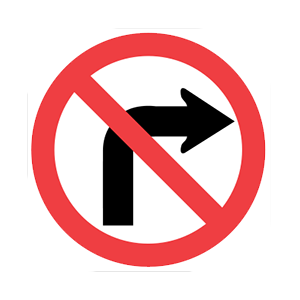
This sign means:
No right turn.
You must turn right.
Watch for traffic on your right.
Don’t park on the right side of the street.
Q.20.
When approaching railroad tracks, you should:
Look, listen, slow down, and be prepared to stop.
Speed up to cross the tracks before the gate is lowered.
Try to drive around a lowered gate.
Not pay attention to how many tracks there are to cross.
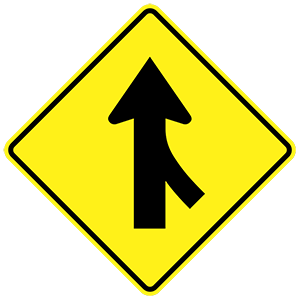
Q.21.
This road sign means:
Cars in right lane must slow down.
No left turn.
Merge.
Pass only in the right lane.
Q.22.
When changing lanes, you should never:
Cross the centerline in an intersection.
Check your blind spots by looking over your left or right shoulder.
Check for other drivers moving into the same lane.
Q.23.
Which of the following statements about driving speed is true?
As your speed increases, the chance of a fatality increases.
As your speed increases, so should your following distance.
Both of the above.
Q.24.
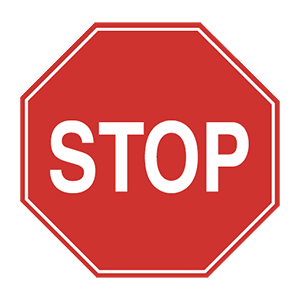
This sign means:
Stop.
Merge.
Upcoming change in direction.
Q.25.
When you see this sign, it means:
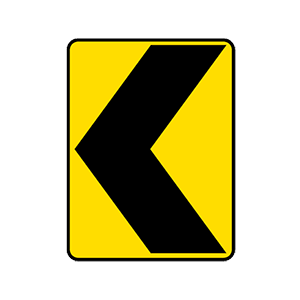
There is an object on the roadway.
Traffic is coming from the right.
The road is curving sharply to the left.
There is a merge point ahead.
Q.26.
This sign is used to warn drivers that:
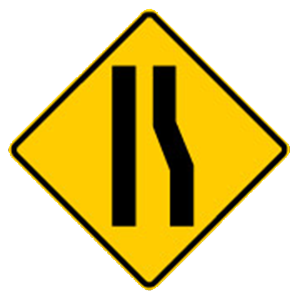
The right lane is ending and traffic should merge left.
The road curves ahead.
There are upcoming intersections.
Q.27.
This sign means:
Do not enter.
Pedestrian crossing.
Winding road ahead.
Q.28.
The correct way to use a freeway exit ramp is to:
Slow down before entering the exit ramp.
Slow down once moving onto the exit ramp.
Keep your speed constant once in the exit ramp.
Pass slower traffic in the exit ramp.
Q.29.
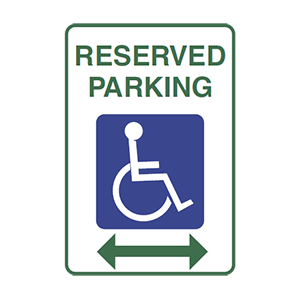
This sign means:
Reserved parking for persons with disabilities.
Slow-moving vehicle.
No U-turn.
Q.30.
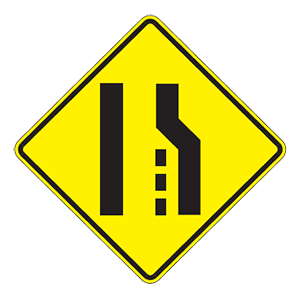
This sign means:
Merge right.
Divided highway begins.
Lane ends.
Support mcqgeeks.com by disabling your adblocker.
×
Please disable the adBlock and continue.
Thank you.
Reload page